
Walking Route
Photo Spots
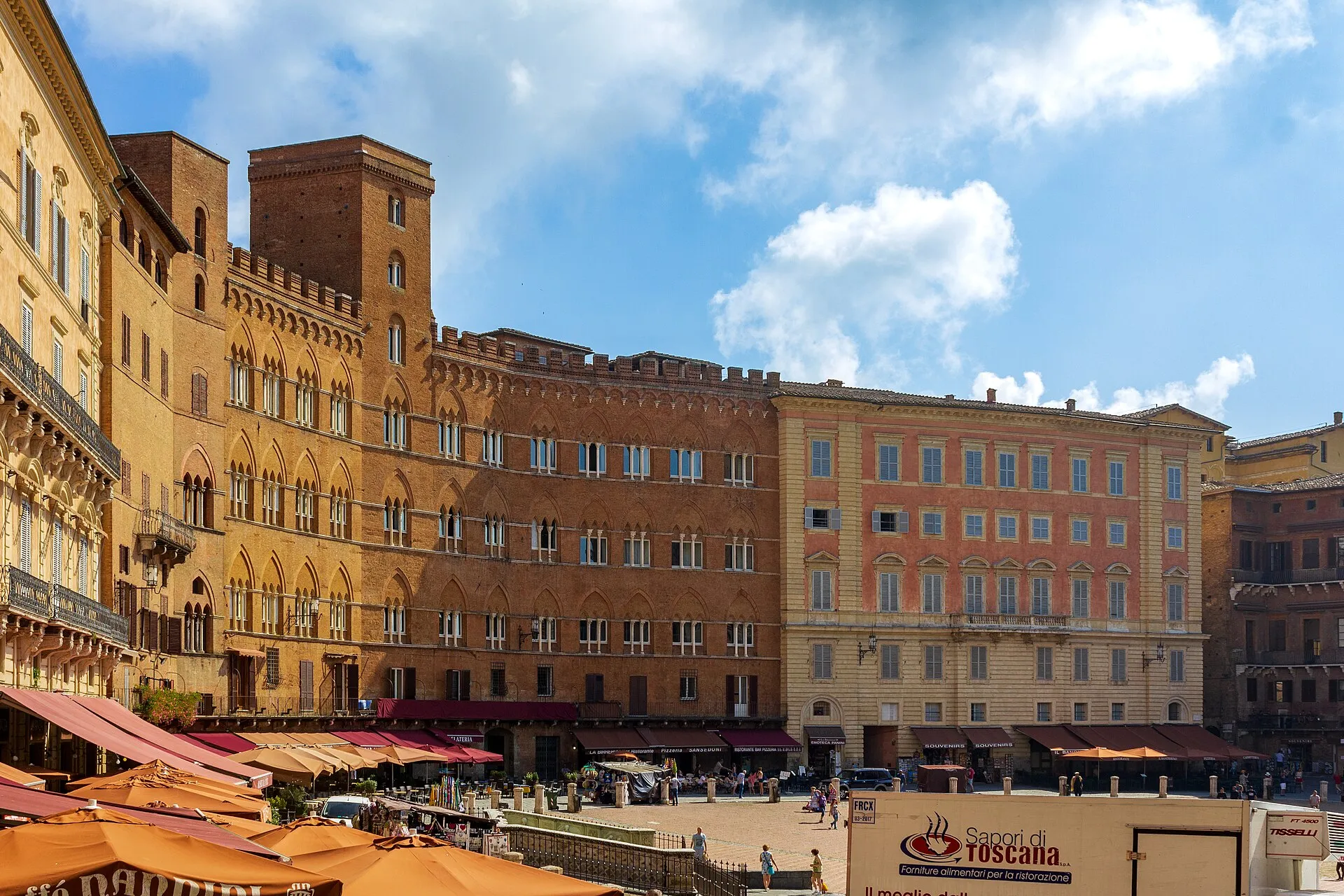
The classic frame is from the high north rim beside the Fonte Gaia, looking down the fan toward the Palazzo Pubblico and the Torre del Mangia spearing the sky. Climb the tower's 400-plus steps for the reverse view: the whole shell laid out below, ringed by medieval palaces and backed by the Tuscan hills. The Fonte Gaia itself — Jacopo della Quercia's 1419 Fountain of Joy, now represented in situ by a 19th-century copy — rewards close-up shots of its carved reliefs. During the Palio on 2 July and 16 August, earth laid around the perimeter and banners of the contrade transform the square entirely. For people-watching, the cafe terraces catch golden-hour light across the brick.
Landmarks Along
Palazzo Pubblico: the Gothic town hall begun in 1297, still Siena's seat of government, with Lorenzetti's Good and Bad Government frescoes and Simone Martini's Maestà inside the Museo Civico. Torre del Mangia: at 88 metres one of Italy's tallest medieval towers, named after its first bell-ringer, the spendthrift Mangiaguadagni. Cappella di Piazza: the marble loggia at the tower's base, built as a vow of thanks after the 1348 Black Death lifted. Fonte Gaia: the fountain fed by Siena's medieval underground aqueduct, the Bottini. The contrade: each of the city's 17 neighbourhoods keeps a church, museum, and fierce identity in the lanes radiating from the Campo.
Piazza del Campo timeline
-
The Government of Nine takes power
A council of nine merchants and bankers begins its rule over [Siena](/italy/siena/), governing until 1355 and shaping the Campo as the stage for the city's civic life.
-
Work begins on the Palazzo Pubblico
Construction starts on the Gothic town hall that anchors the low end of the square and still houses Siena's city government today.
-
Torre del Mangia tops out
The 88-metre bell tower is completed, named after its first bell-ringer Giovanni di Duccio, nicknamed Mangiaguadagni ("profit-eater") for his spendthrift habits.
-
The shell-shaped paving is completed
The Nine finish paving the Campo in red brick divided into nine wedges by white travertine lines — one for each member of the council.
-
Jacopo della Quercia carves the Fonte Gaia
The sculptor completes the marble Fountain of Joy on the square's high side; its weathered originals now sit in the Santa Maria della Scala museum, replaced in situ by a 19th-century copy.
-
The modern Palio di Provenzano begins
Siena formalises the July Palio around the Campo, cementing the twice-yearly horse race between the contrade that still defines the city's calendar.
When to Visit
The Campo itself is open space and never closes — you can cross it at any hour, and the brick is at its most atmospheric at dawn and again at dusk, when the warm light rakes across the slope. The Museo Civico inside the Palazzo Pubblico opens daily, roughly 10 AM - 6 PM, with shorter hours in winter. The Torre del Mangia admits visitors on timed entries (last climb mid- to late-afternoon) and caps the number of people on the stairs at once, so queues build quickly on summer middays. Steer around 2 July and 16 August unless you are here for the Palio: the square is fenced, floored with earth, and impassable for days around each race.
Admission and Costs
Standing in the Campo, sitting on its slope, and photographing the Fonte Gaia cost nothing — it is a public square, not a gated monument. You pay only to enter the buildings around it. The Museo Civico in the Palazzo Pubblico is around €6 ($7), home to Ambrogio Lorenzetti's Allegory of Good and Bad Government frescoes. The Torre del Mangia climb is around €10 ($11), and a combined ticket covering both runs about €15 ($16). A guided Siena walking tour typically bundles the Campo's history into its fee. Cafe tables ringing the square carry a premium; order standing at the bar for the same drink at local prices.
The Case for a Guide
The Campo looks self-explanatory — a pretty brick slope with a tower — but almost everything that makes it extraordinary is invisible until someone explains it, which is why a local guide turns ten minutes of photos into the key that unlocks all of Siena.
- Decoding the nine wedges: A guide shows how the paving maps the Governo dei Nove, so the square reads as a political statement in brick rather than mere decoration.
- The Palio behind the race: Beyond the 90-second sprint lie the contrade allegiances, the blessing of the horse in church, and rivalries older than most nations — context a guide supplies without which the Palio is just a crowd.
- Timing the Torre del Mangia: Locals know when the timed-entry queue is shortest and which hour gives the cleanest light over the Siena Cathedral from the top.
- Linking the monuments: A good route threads the Campo into the Palazzo Pubblico's frescoes and the uphill climb to the Duomo, so a half-day becomes a coherent story instead of three separate tickets.
Tips for Visitors
Come at sunset or after dark — the Campo glows and the locals reclaim it from the daytime crowds. Skip the premium cafe tables and drink standing at the bar like the Sienesi do. Sitting or lying on the brick slope is welcomed, not frowned upon; join the sprawl. For the Palio, the central standing area is free but fills hours ahead and seals once full, so arrive very early or budget for a private balcony seat booked months out. Pair the square with the Palazzo Pubblico museum and the uphill walk to the Siena Cathedral for a full day in the medieval core, and catch the Wednesday-morning market nearby.
Frequently Asked Questions
When is the best time to visit Piazza del Campo?
The square is public space and never closes, so the quietest light falls early in the morning and again at sunset, when the red brick glows and locals drift back to the cafes. The Museo Civico inside the Palazzo Pubblico opens daily, roughly 10 AM to 6 PM with shorter winter hours, and the Torre del Mangia runs timed entries that stop well before the square empties. Avoid the two Palio days — 2 July and 16 August — unless you have come specifically for the race, because the Campo is sealed off and packed from dawn.
Is Piazza del Campo free to visit, and what costs extra?
Walking into the Campo, sitting on its sloping brick, and watching the Fonte Gaia are all free — it is an open civic square, not a ticketed site. You pay only to go inside the monuments: the Museo Civico in the Palazzo Pubblico is around €6 (about $7), the climb up the Torre del Mangia is around €10 (about $11), and a combined ticket covering both runs about €15 (about $16). A guided walking tour of Siena usually folds the Campo and its history into the price.
How many steps is the Torre del Mangia, and is the climb worth it?
The Torre del Mangia rises 88 metres — 102 metres to the tip of its lightning rod — making it one of the tallest medieval towers in Italy. Reaching the top means more than 400 narrow stone steps up a tight spiral, with no lift, and entry is capped at a small number of visitors at a time, so queues form in summer. The reward is a 360-degree panorama over Siena's terracotta rooftops, the striped Duomo, and the Tuscan hills, with the whole fan of the Campo laid out directly below.
Why is Piazza del Campo shaped like a shell?
The Campo fans out in nine wedge-shaped segments that slope down toward the Palazzo Pubblico, separated by lines of white travertine set into the red herringbone brick. The nine divisions honour the Government of Nine, the merchant council that ruled Siena from 1287 to 1355 and commissioned the paving completed in 1349. The gentle concave bowl was deliberate: it drains rainwater toward the town hall and turns the whole square into a natural amphitheatre, which is exactly why the Palio can be run and watched here.
What is the Palio, and can visitors watch it?
The Palio is a bareback horse race run twice each summer — 2 July and 16 August — around a ring of packed earth (tufo) laid over the Campo's perimeter. Ten of Siena's seventeen contrade (historic neighbourhoods) compete in a frenzied three-lap sprint that lasts barely 90 seconds but caps days of processions, blessings, and rivalries. The centre of the square is free to stand in but fills hours ahead and is closed once full; balcony and grandstand seats are sold privately at steep prices and book out far in advance.