
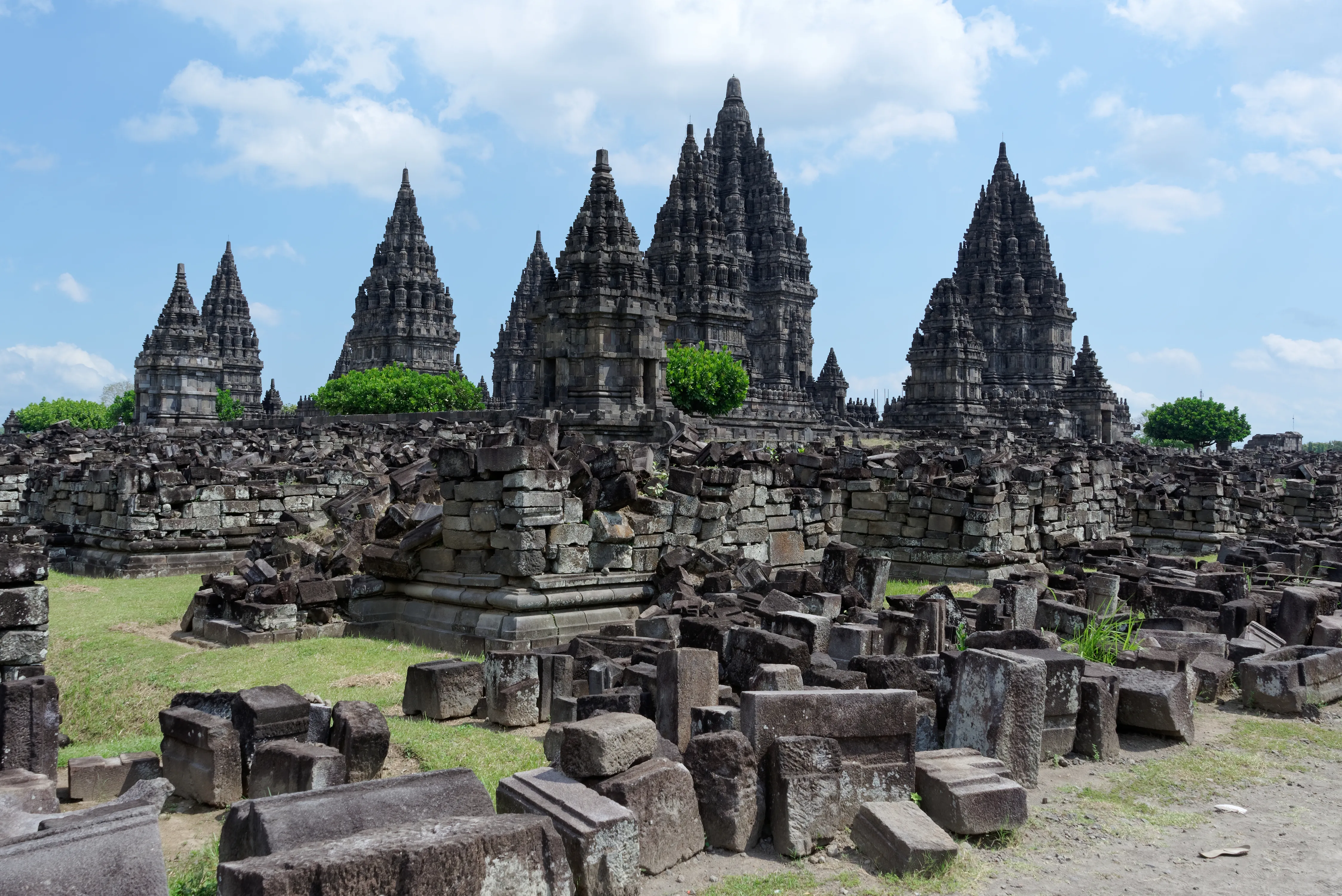
Excavation History
Prambanan's rediscovery and restoration spans two centuries. The Dutch antiquarian C.A. Lons documented the ruins in 1733, finding them overgrown and largely collapsed. Systematic archaeological work began under colonial Dutch authority in the 1880s; the first restoration attempt in the 1930s stabilised the Candi Shiva structure but the other two main towers remained in collapse. Large-scale UNESCO and Indonesian government restoration of the three Trimurti towers ran from the 1990s through the 2000s, employing a anastylosis method — rebuilding using original stones wherever possible, with concrete only where original material was missing.
Prambanan was severely damaged again by the 2006 Yogyakarta earthquake (magnitude 6.3), which toppled restored sections and cracked foundation structures. Restoration resumed and most damage was repaired by 2010, though engineering monitoring continues at the main towers. A guide can point to specific restoration joints in the stonework visible to the trained eye.
When to Visit
Open: Daily 6 AM – 5 PM. Best visit time: 6–9 AM for cool temperatures, low crowd density, and morning light on the east-facing main towers; or 3–5 PM for golden afternoon light and cooler conditions. Ramayana ballet: Full moon nights, May–October, 7:30 PM at the Trimurti open-air theatre (outdoor); year-round indoor performances available. Avoid: 10 AM–2 PM in peak season — stone surfaces heat significantly and the open plain offers little shade. Visit duration: 1.5–2 hours for the three main temples and wahana shrines; 2.5–3 hours with a guide covering the relief galleries and outer compound ruins.
Admission and Costs
- Foreign visitor ticket: USD 25 (2025 rate); combined Borobudur + Prambanan ticket available at discount
- Domestic ticket: IDR 50,000 (approximately USD 3)
- On-site guide: IDR 150,000–250,000 (USD 10–16) for a 1.5-hour guided tour
- Ramayana ballet tickets: IDR 125,000–350,000 (USD 8–22) per person depending on seating category
- Combined Borobudur + Prambanan full day with guide and transport: IDR 600,000–1,200,000 (USD 40–75) from Yogyakarta
The Case for a Guide
Prambanan's relief galleries are among the most detailed narrative carvings in Southeast Asia — and the most inaccessible without expert explanation:
- Ramayana relief reading: The Candi Brahma relief gallery contains the complete Ramayana narrative from Sita's abduction through the Lanka battle to the reunion scene — a guide reads the sequence panel by panel, identifying the key characters, narrative moments, and Javanese artistic conventions that distinguish Prambanan's version from Indian and Balinese tellings
- Krishnayana narrative: The Candi Vishnu reliefs depict the life of Krishna from the Harivamsa text — a story rarely depicted at this scale in Southeast Asia; a guide identifies the childhood episodes, the Govardhan mountain scene, and the Kurukshetra battle panels that compress the entire Krishna mythology into the gallery
- Iconographic reading: Each statue's position, attributes (ayudha), and associated symbolism — Durga's eight arms holding specific weapons, Ganesha's broken tusk and lotus position, Nandi's ritual orientation — are a complete theological vocabulary that a guide decodes in context
- Earthquake archaeology: Visible traces of the 9th-century collapse, the 20th-century restoration, and the 2006 earthquake repair are all readable in the stonework by a guide who can point out the original stones, the modern concrete fills, and the current monitoring instruments embedded in the foundation
Tips for Visitors
Relief gallery sequence: The Ramayana narrative in Candi Brahma's relief gallery begins at the east entrance and proceeds clockwise — start there rather than entering from the nearest gate to read the story in order. Nandi position: The Nandi (sacred bull) statue in the Wahana temple faces directly toward the Candi Shiva entrance, providing a perfectly framed photography axis from the east. Outer ruins: The rubble fields of the outer candi perwara zone are rarely visited but provide a striking sense of the compound's original scale — walk through them with a guide before or after the main temples. Sunset photography: The three main towers photograph dramatically from the western approach in the hour before sunset when the stone turns amber — the Ramayana theatre's open seating area provides an unobstructed western view. Candi Sewu: The large Buddhist temple 800 metres north of Prambanan within the same archaeological park was built by the same era's Buddhist kingdom and makes an excellent addition with a full-day guide. A living counterpoint: after these silent Hindu towers, the still-active Kraton palace in central Yogyakarta shows how Javanese court culture continues to be practised rather than excavated.
Frequently Asked Questions
What is the best time to visit Prambanan for the Ramayana ballet?
The Sendratari Ramayana ballet is performed at the open-air Trimurti Theatre adjacent to Prambanan's western gate on full moon nights from May through October — the Prambanan temples are lit and serve as the stage backdrop, creating one of the most visually spectacular performance settings in Asia. Performances typically run from 7:30 PM and last approximately two hours. Tickets range from IDR 125,000 to IDR 350,000 (USD 8–22) depending on seating category; reserved seats in the covered amphitheatre are recommended for the full temple backdrop view. An indoor Ramayana performance runs year-round in the climate-controlled Trimurti Theatre during the wet season months (November–April) when outdoor performances are cancelled. A guide can identify the Ramayana story episodes, explain the Javanese classical dance vocabulary, and contextualise the performance within the temple's original dedicatory mythology.
How do Borobudur and Prambanan compare, and can I see both in one day?
Borobudur and Prambanan are complementary rather than competing — one Buddhist, one Hindu; one representing the most complete surviving Buddhist cosmological monument in the world, the other Indonesia's finest Hindu architectural compound. The standard combined day tour departs Yogyakarta at 5–6 AM for Borobudur sunrise, covers the Buddhist temple with a guide through mid-morning, then drives 90 minutes east to Prambanan for a two-hour afternoon circuit. The contrast is intellectually striking: Borobudur's narrative relief programme tells stories through sequential panels around a circular mountain-form; Prambanan's iconography concentrates mythological narrative into the three main shrine interiors in a radically different theological vocabulary. Both are manageable in a single day with a private guide who handles transport and timing.
How many temples are in the Prambanan compound and which can I enter?
The Prambanan Archaeological Park originally contained 240 temples in concentric zones, of which approximately 50 have been substantially restored. The three main Trimurti temples — Shiva (47 metres), Brahma (33 metres), and Vishnu (33 metres) — are fully restored and accessible to visitors. Opposite each Trimurti temple stands a smaller Wahana temple dedicated to each god's animal mount: Nandi the bull (Shiva's mount), Hamsa the swan (Brahma's mount), and Garuda the eagle (Vishnu's mount). The two outermost zones of smaller temples (candi perwara) are mostly unrestored rubble fields — poignant evidence of the 9th-century earthquake that toppled the outer compound; a guide explains which stones have been identified and tagged for eventual reconstruction.