
Trails
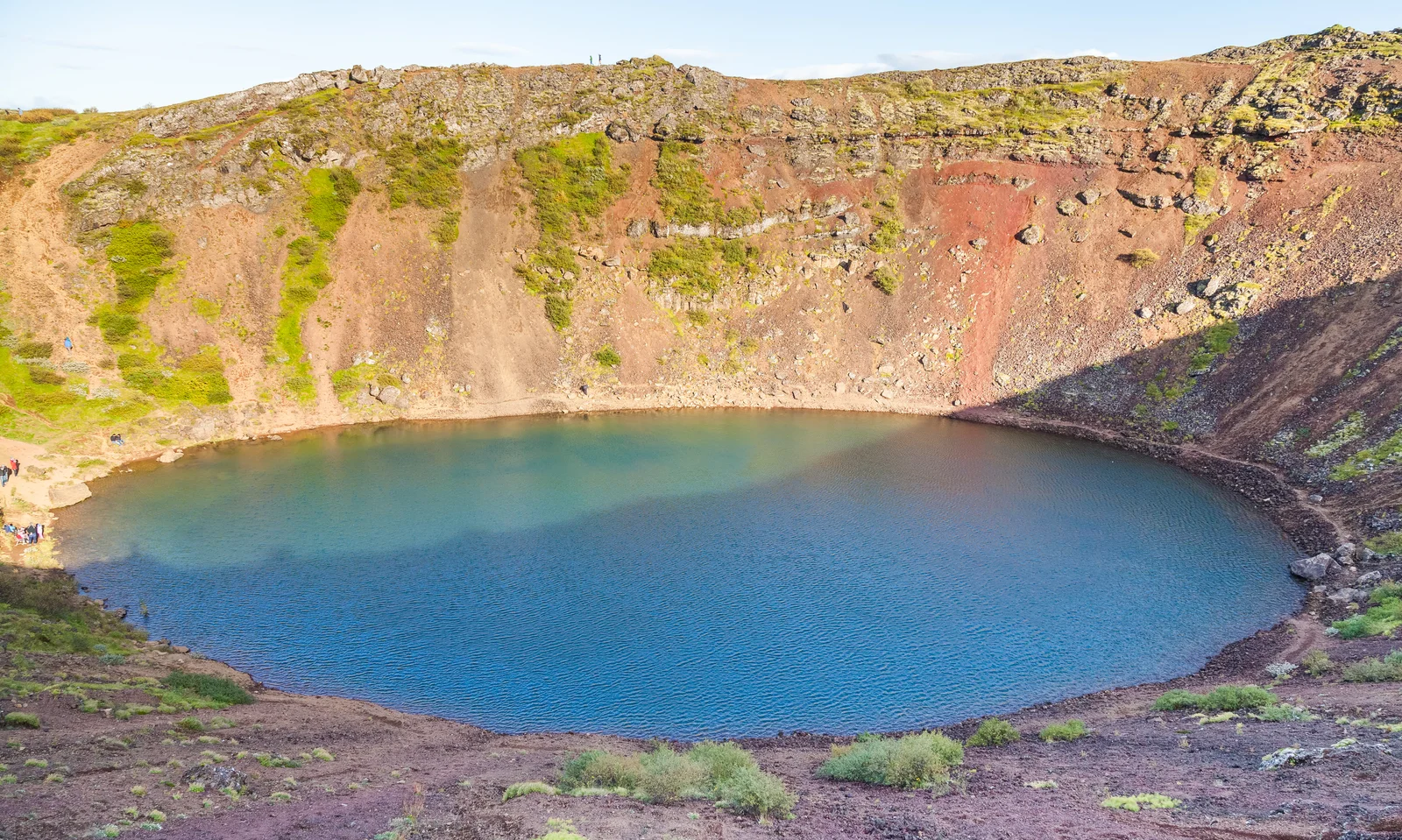
The main walk is a loop of the crater rim, an easy, mostly level circuit that takes 15 to 20 minutes and delivers a constantly changing view down onto the lake. Railings guard the steepest sections, though the path narrows in places and the surface is uneven volcanic scree, so it is manageable for most walkers but not fully step-free.
From the northern side, a stepped path descends to the shore of the lake at the base of the caldera, letting you stand beside the water and look up at the towering red walls. The descent and climb back are short but steep enough to raise a breath; take them slowly in wet conditions. Together the rim loop and the shore path give two entirely different perspectives on the same crater, which is why lingering here beats a single glance from the car park.
Formation
Kerið belongs to the Tjarnarhólar cluster of craters within the Grímsnes volcanic zone, a field of vents that erupted several thousand years ago in South Iceland. Rather than being blasted open by a violent explosion, the crater is thought to have formed when a cone of erupted material drained its underlying magma chamber and the emptied roof collapsed inward, creating the deep, steep-walled bowl seen today.
The lake at the bottom is not fed by a river but by groundwater, its surface rising and falling with the local water table, and its colour owes as much to dissolved minerals and the reflected red walls as to depth. That iron-rich red rock, oxidised over millennia, is what sets Kerið apart from the black basalt of so many other Icelandic sites and, together with the green rim in summer, gives the caldera the layered look that draws photographers off the Golden Circle road.
When to Visit
The site is accessible year-round and never truly closes, though the entrance booth is staffed mainly during daylight and the busier months. Summer, from June to August, brings the richest contrast between the red walls, the green rim and the blue water, and the long Icelandic daylight lets you visit late in the evening once the coach parties have moved on. Spring and autumn are quieter and still very photogenic, while winter can coat the crater in snow and freeze the lake into a pale disc.
Allow around 30 to 45 minutes for the full experience: a loop of the rim path plus the stepped descent to the water. Mornings before the mid-day Golden Circle rush and the hour before sunset are the calmest times to have the viewpoints to yourself. Because the crater is small, it is best treated as one stop among several rather than a standalone destination.
Admission and Costs
Kerið is one of the rare Golden Circle sights that charges admission, a modest fee of about ISK 600 ($4) per adult paid at the booth beside the car park. The charge supports upkeep of the paths, steps and safety railings by the private landowners, and children under a certain age are usually admitted free. Parking itself is included in the fee, and there is no need to book ahead.
If you arrive as part of a guided Golden Circle tour, the driver-guide will typically cover or collect the entrance fee, so confirm what is included when you book. Group coach tours of the Golden Circle from Reykjavík run broadly ISK 9,000–14,000 ($66–102) per person, while a private guided day for a small group costs considerably more but lets you set the pace and add Kerið without rearranging the whole itinerary.
The Case for a Guide
A local guide turns Kerið from a quick photo stop into a genuine geology lesson, explaining how the crater formed by collapse rather than explosion and pointing out the iron minerals that give the slopes their colour. Guides also read the day's Golden Circle traffic, timing your arrival for the quietest window and slotting the crater between Gullfoss, Geysir and Þingvellir so you never queue at the busiest sights. For visitors driving themselves, a guide's local knowledge of Route 35 and the region around Selfoss makes the difference between a rushed loop and a well-paced day.
Tips for Visitors
Wear shoes with grip: the rim path and the steps down to the lake are loose volcanic gravel that becomes slippery in rain or frost, and there are drop-offs without continuous fencing. Walking the rim anticlockwise puts the lake and the reddest wall in front of you for the best light through most of the day.
Photographers should try to come when the water is calm, as even a light breeze breaks up the mirror-like reflections that make the crater so striking. The site has a small car park but limited shelter, so bring a windproof layer, and combine the visit with nearby Selfoss for food and fuel, since there are no shops or cafés at the crater itself.
Frequently Asked Questions
How much does it cost to visit Kerið?
Unlike most stops on the Golden Circle, Kerið charges a small entrance fee, currently around ISK 600 ($4) per adult, collected at a booth by the car park. The money goes to the landowners who maintain the paths and railings around a fragile site. Children generally enter free, and the fee is paid in cash or by card on arrival rather than booked ahead.
How long do you need at Kerið crater?
Most visitors spend 30 to 45 minutes here, which is enough to walk the full loop around the rim and take the stepped path down to the water's edge. If you only want the classic view over the lake you can be back at the car in 15 minutes. It is a compact site, so it slots neatly between larger Golden Circle stops rather than demanding a half-day.
Is Kerið part of the Golden Circle?
Kerið sits on Route 35 in the Grímsnes district, the same road that carries traffic between Gullfoss, Geysir and Þingvellir, so it is an easy add-on to the classic Golden Circle loop. It lies about 15 km north of Selfoss, making it one of the first or last sights of the day for anyone basing themselves in the town. Many guided Golden Circle tours include a stop here on request.
Can you walk down to the lake at Kerið?
Yes. A set of steps and a graded path descend from the northern rim to the shore of the lake at the bottom of the caldera, and walking down is the best way to appreciate the scale of the red walls above you. The rim path and the descent are both short but uneven, so sturdy shoes help, especially after rain when the volcanic gravel turns slick.