
Getting Around Vík: A Practical Transport Guide
How to get around Vík on Iceland's South Coast — driving Route 1 from Reykjavik, choosing a group or private guided tour.
Read the full guideUpdated · 10 min read
Vík is a village you can walk across in ten minutes, but its landscape sights are scattered along kilometres of coast with no local bus to link them — so getting around really means two decisions: how you travel down the South Coast from Reykjavik, and how you cover the last few kilometres to the black sand once you arrive. For most visitors the answer is a rental car or a guided day tour, because independent public transport stops at the village edge.
Getting around Vík is less about the village itself than about the dramatic coastline around it. The settlement of roughly 300 people sits at the end of the paved South Coast road, backed by the Mýrdalsjökull ice cap and facing the North Atlantic. Everything a traveller comes for — the Reynisfjara black sand beach, the Reynisdrangar sea stacks, the Dyrhólaey arch, the glacier tongues — lies a short drive from the centre rather than within it. Grasp that shape and your logistics fall into place.
How Vík's geography shapes getting around
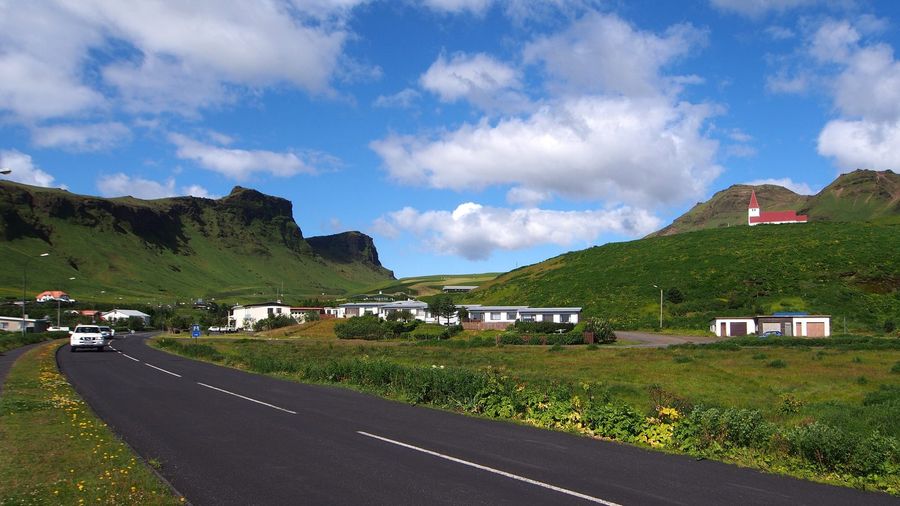
Vík is a road-end village: a tight core of houses and a landmark hilltop church, with its headline attractions strung west along the coast and the open Ring Road running east toward the glaciers. Understand that layout and every journey here plans itself.
The village core holds the petrol station, a supermarket, a handful of guesthouses and restaurants, and the red-roofed Víkurkirkja church on the hill above — all within a few minutes' walk. But the black sand beaches are not in the village. Reynisfjara lies a couple of kilometres west, and the Dyrhólaey promontory about 10 km west, both reached by short side roads off Route 1. To the east, the Ring Road continues across the Eldhraun lava field toward the glacier lagoons. Think of the village as your base and everything spectacular as a short drive out from it.
Driving the South Coast from Reykjavik
The classic way to reach Vík is to drive Route 1 south from the capital — about 187 km and two and a half hours non-stop — but the road is so studded with sights that the journey is really the day. A rental car gives you the freedom to stop where you like and to time the beach for the quiet hours.
Leaving Reykjavik, the paved Ring Road passes a run of famous waterfalls and glacier tongues before it reaches Vík: Seljalandsfoss, which you can walk behind; Skógafoss, a 60-metre curtain of water; and Sólheimajökull, a glacier tongue about 30 km west of Vík where guided ice walks depart. None of these needs a four-wheel-drive — the South Coast is all sealed highway — so a standard car is fine in summer. The single most rewarding piece of self-drive timing is to reach Reynisfjara at sunrise, before the coach tours from Reykjavik arrive around mid-morning, when you may have the basalt columns almost to yourself.
Reaching the sights around Vík
Once you are in Vík, the beaches and headlands still require transport — there is no local bus, so a car, a taxi, or a tour covers the last few kilometres to each site. The distances are short but the walk along a highway shoulder is neither safe nor pleasant.
| From Vík village | Distance | Typical drive | How to reach it |
|---|---|---|---|
| Reynisfjara black sand beach | ~2 km west | Under 5 min | Car, taxi, or guided tour |
| Dyrhólaey arch and promontory | ~10 km west | 15 min | Car or guided tour (upper road seasonal) |
| Víkurkirkja church viewpoint | In the village | Walkable | On foot, uphill |
| Sólheimajökull glacier tongue | ~30 km west | 25 min | Car or glacier-hike operator |
At Reynisfjara, park in the signed car park and stay well up the black-sand ridge — the beach is genuinely dangerous, and the drowning risk from sneaker waves is real. Dyrhólaey rewards the extra drive with a 120-metre arch and, from May through August, puffins nesting on the grassy clifftops; note that the higher access road can close seasonally to protect the birds. The church viewpoint above the village is the one sight you reach on foot, and the climb pays off with the classic view over the rooftops to the sea stacks.
Guided day tours from Reykjavik
By far the most common way people "get around" Vík is not to drive at all but to join a South Coast day tour from Reykjavik that folds Seljalandsfoss, Skógafoss, Reynisfjara, and Dyrhólaey into a single long day. It removes the driving, adds a guide's commentary, and — at Reynisfjara especially — adds a real margin of safety.
| Tour type | Typical price (per person) | What it covers |
|---|---|---|
| South Coast group day tour | ISK 11,000–16,000 | Seljalandsfoss, Skógafoss, Reynisfjara, Dyrhólaey |
| Small-group South Coast tour | ISK 16,000–24,000 | Same route, fewer people, more flexibility |
| Private local guide (Reynisfjara + Dyrhólaey) | ISK 30,000–50,000 (up to 6) | Tailored beach-and-arch itinerary at your pace |
| Glacier hike on Mýrdalsjökull | ISK 14,000–22,000 | Guided ice walk with crampons and helmet |
| Ice climbing (half-day) | ISK 18,000–26,000 | Roped climbing on the glacier ice |
A group coach tour is the budget option and the simplest if you are based in the capital. A private guide makes most sense if you are already staying in or near Vík and want to concentrate on the beaches without the long return drive to Reykjavik. Booking directly through Icelandic operators is usually cheaper than international resale platforms, and many will reschedule around severe weather. Whichever you pick, a guided visit means someone who knows exactly where the safe standing ground at Reynisfjara ends.
Arriving without a car: buses and transfers
If you are not driving, long-distance Strætó coaches connect Vík to Reykjavik and onward to Höfn, dropping you in the village — but they will not take you to the beaches, so plan the last leg separately. Vík has no traditional local bus network.
The scheduled long-distance service is the thrifty way to reach the village itself, and it drops you centrally near the shops and guesthouses. The catch is the one already noted: the coach serves the settlement, not Reynisfjara or Dyrhólaey, which have no bus link at all. Travellers arriving this way generally book a local guided excursion for the sights, arrange a taxi for the short hop west, or simply base a car-free stay around the village and a booked day tour. It is entirely possible to enjoy Vík without a car — you just have to accept that the beaches come via a tour or a taxi rather than a bus.
Budgeting and seasonal timing
Getting around Vík costs little in the village and everything in how you reach the sights — the seasons, more than the fares, should drive your planning. A day tour or a day's car hire is the real transport expense here.
June to August is peak season: the longest days, puffins nesting on Dyrhólaey and the Reynisdrangar stacks, and glacier hikes at their most accessible — but also the busiest car parks and highest tour prices. May and September are the shoulder sweet spots, with thinner crowds, puffins still present in May, and extraordinary autumn light in September. From October to April the coast turns dramatic and the Northern Lights appear on clear nights, but daylight is short and South Coast weather can close roads with little notice, so winter visitors lean heavily toward guided tours over self-driving. Whatever the month, Vík is one of Iceland's wettest villages — pack proper waterproofs regardless of the forecast. Iceland uses the Icelandic Króna, and cards are accepted almost everywhere, including at the village petrol station.
Local logistics and safety
The single most important thing to get right around Vík is not a route but a rule: never turn your back on the sea at Reynisfjara, and never stand on the lower flat sand. Everything else here is straightforward by comparison.
Fuel up in the village, because the next stretch of Ring Road east is thinly served. Carry snacks and water for beach and glacier outings, and check road and weather conditions on the Icelandic authorities' sites before setting out in shoulder or winter season, when the first snows arrive early on this coast. Glacier ice should only ever be walked with a certified operator — the surface hides crevasses, and Mýrdalsjökull conceals the active Katla volcano beneath it. Treat the guide's positioning at Reynisfjara as non-negotiable rather than cautious; multiple visitors have died there underestimating the Atlantic swell.
If you are still deciding how many days to give the village and how to sequence the wider South Coast, the Vík trip planner walks through seasons, itineraries, and a day-by-day budget. Once you have the logistics sorted, the Vík city guide covers what to see and do along the black sand coast, the Reykjavik guide — with landmarks such as Hallgrímskirkja — helps you plan the capital end of the trip, and the wider Iceland guide puts the South Coast in the context of the whole island.
Frequently Asked Questions
Do you need a car to visit Vík?
Not necessarily, but you need wheels of some kind. Vík itself is a walkable cluster of a few streets, yet its famous sights sit a few kilometres out along the coast — Reynisfjara to the west, Dyrhólaey further west again — with no local bus linking them. Most visitors either drive their own rental car down from Reykjavik or come on a guided South Coast day tour that handles all the driving. If you arrive by long-distance coach without a car, you can walk the village but will struggle to reach the beaches independently.
How long does it take to drive from Reykjavik to Vík?
About two and a half hours non-stop, covering roughly 187 km on Route 1 (the Ring Road). In practice almost no one drives it straight through — the South Coast between the capital and Vík is lined with waterfalls and glacier tongues, so with stops at Seljalandsfoss, Skógafoss, and Sólheimajökull the drive easily fills a full day each way.
Is it better to self-drive or take a guided tour to Vík?
It depends on your season and confidence. Self-driving gives you freedom to linger and to catch Reynisfjara at sunrise before the coaches arrive, but South Coast weather can turn fierce and winter roads demand care. A guided day tour removes the driving, adds context, and — crucially at Reynisfjara — puts an experienced guide between you and the beach's dangerous sneaker waves. Confident summer drivers often self-drive; winter visitors and nervous drivers usually prefer a tour.
Can you reach Reynisfjara beach by public transport?
Not directly. Long-distance Strætó buses stop in Vík village on the Reykjavik–Höfn route, but they do not serve Reynisfjara, which lies a couple of kilometres west with no bus connection. To reach the black sand beach you need a car, a taxi, a guided tour, or a determined walk. This is the main reason a car or organised tour is close to essential here.
Why do guides matter so much at Reynisfjara?
Because the beach has killed visitors. Reynisfjara is regularly listed among the world's most dangerous beaches thanks to sneaker waves — surges that arrive silently and can rush 30–40 metres up the sand with no warning. A guide who has worked the beach positions your group on the safe upper ridge from the first moment and never lets anyone turn their back on the Atlantic. That single piece of local knowledge is a genuine safety benefit, not an upsell.