
Getting Around Luxor: A Practical Transport Guide
How to move around Luxor across the Nile's two banks — ferries and feluccas, East Bank calèches, taxis and ride-hailing, hiring a West Bank driver.
Read the full guideUpdated · 12 min read
Getting around Luxor starts with one fact of geography: the Nile splits the city into an East Bank of the living and a West Bank of the dead, and each side moves at its own pace. A cheap public ferry and hired motorboats cross the water, calèches and taxis and ride-hailing cover the compact East Bank, and a private car or minibus tour ties together the scattered West Bank tombs. Once you grasp which mode belongs on which side of the river, a place that looks daunting on a map becomes easy to navigate.
Luxor sits on the site of ancient Thebes, roughly 670 kilometres south of Cairo in Upper Egypt, and its monuments are famously dense — but they are also divided by the river into two very different worlds. The East Bank, where the sun rises, holds the living city and its great temples; the West Bank, where the sun sets, holds the royal necropolis. That single division shapes every transport decision you make here, from how you cross the Nile to whether you can walk to a site or need a driver. This guide sorts the options bank by bank, then covers choosing a tour, timing your days around the heat, and what it all costs.
The two banks: how Luxor is laid out
Everything in Luxor is oriented around the Nile, so the first thing to fix in your mind is which sights sit on which bank. Get that straight and the rest of the network falls into place.
The East Bank is the modern town: hotels, the train station, the airport, the souk, and the two headline temples — Karnak Temple at the northern edge and Luxor Temple in the heart of the centre. The two are linked by the restored Avenue of Sphinxes, a 2.7-kilometre ceremonial road reopened to pedestrians in 2021, which doubles as a pleasant walking route between them. The West Bank, reached across the water, is the desert necropolis: the Valley of the Kings, Hatshepsut's terraced mortuary temple at Deir el-Bahari, and the towering Colossi of Memnon, all strung out along the cliffs and cultivated fringe. Because the two banks demand different transport, most itineraries treat them as separate half-days.
Arriving: airport, train, and Nile cruises
Most visitors reach Luxor by air, overnight train, or river cruise, and each drops you on the East Bank within easy reach of the centre. Sorting the arrival leg first spares you improvising after a long journey.
Luxor International Airport lies about 6 kilometres east of the centre — a 15–20 minute transfer by pre-booked hotel car, official taxi (agree the fare first, as they are not metered), or a ride-hailing app. The train is the classic overland approach: sleeper services and daytime trains run from Cairo down the Nile Valley, taking roughly ten hours, and the air-conditioned sleeper is a comfortable way to arrive rested at dawn. Many travellers instead reach Luxor by Nile cruise, sailing between here and Aswan over three or four nights; cruise ships dock on the East Bank, and their on-board Egyptologists handle shore transport as part of the package. However you arrive, your hotel can usually arrange the first transfer, which removes any guesswork on day one.
Crossing the Nile by ferry and felucca
The crossing between the two banks is the defining journey of any Luxor visit, and it is both cheap and frequent. You have three ways over the water, each suited to a different budget and mood.
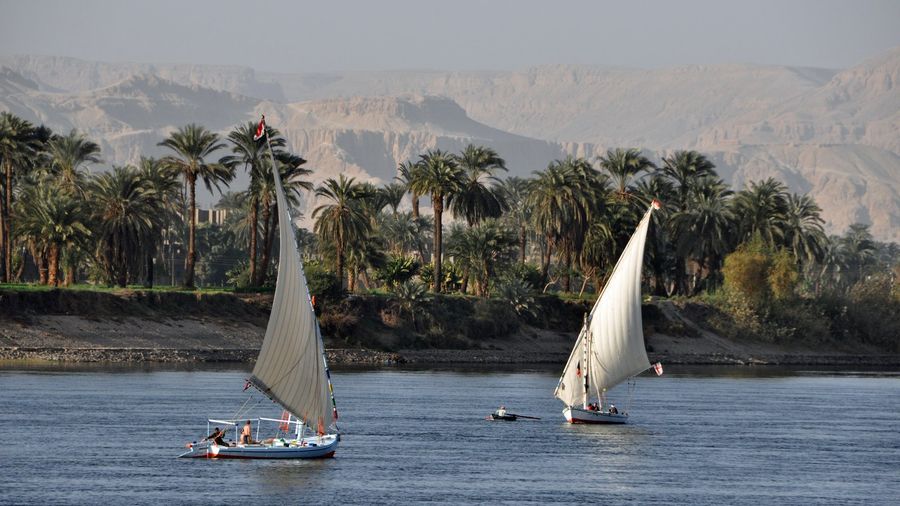
The public passenger ferry is the workhorse: it shuttles all day between the East Bank landing near Luxor Temple and the West Bank jetty for only a few Egyptian pounds, packed with locals, schoolchildren and the occasional bicycle. Private motorboats make the same crossing on demand for a negotiated fare — worth it when you want to leave on your own schedule or split the cost across a group. And the felucca, the traditional wooden sailboat pictured above, is less a way to commute than a way to savour the river: a sunset sail between the banks, with the desert cliffs turning amber, is one of Luxor's essential experiences. For travellers going straight to the tombs, taxis and tour cars skip the boats entirely and use the road bridge a few kilometres south of the centre.
Getting around the East Bank
The East Bank is compact enough that you can mix walking with short hops by taxi, ride-hailing, or a horse-drawn calèche. Distances between the main sights are modest, so the choice is more about comfort than necessity.
Between Luxor Temple and the souk, walking is genuinely the best option — the riverside Corniche is flat and the centre is small. For the longer stretch up to Karnak, a taxi or a ride-hailing car is quick and inexpensive; both Uber and Careem work in Luxor, showing the fare up front so you avoid negotiating. The city's signature ride is the calèche, a horse-drawn carriage that clip-clops along the Corniche — charming for the trip to Karnak, provided you agree the price in advance and pick a well-kept horse. Street taxis are plentiful and cheap, but older cabs rarely use a meter, so state your destination and settle the fare before you climb in.
Getting around the West Bank
The West Bank is the opposite of walkable: its monuments are spread several kilometres apart across the desert edge, so you need wheels to link them. Planning this side properly is what keeps a morning from unravelling in the heat.
Most visitors hire a private car and driver for the morning, looping the Valley of the Kings, Hatshepsut's temple and the Colossi of Memnon in a single efficient circuit — a driver who knows the sites removes all navigation stress. An organized minibus tour does the same for less per head and suits solo travellers happy to keep to a group schedule. The energetic occasionally rent bicycles near the ferry landing, which is a lovely way to pedal past sugarcane fields between sites — but only if you start at first light and carry plenty of water, because there is no shade and the midday sun is punishing. A pre-dawn hot-air balloon flight over the necropolis is a popular add-on and, in its own way, the most memorable transport of all.
Choosing the right tour
The type of tour you pick matters more than the price, because Luxor's sights reward different formats — a guided temple morning, a necropolis half-day, or a slow multi-day pass at both banks. Match the format to what you came for rather than defaulting to the longest option.
Egyptian law requires guides at archaeological sites to hold an Egyptology degree and a government licence, so at Karnak or the Valley of the Kings a qualified guide is the person legally permitted to lead and interpret — not an optional extra. The table below sorts the common formats by what each does best.
| Tour type | Best for | Typical length | Guide needed? |
|---|---|---|---|
| East Bank temples (Karnak & Luxor) | First-timers, temple history | Half day | Yes, at the sites |
| West Bank necropolis | Tombs, funerary art | Half day | Yes, at the sites |
| Combined both-banks private tour | Efficient overview in limited time | Full day | Yes |
| Multi-day guided itinerary | Slow, in-depth exploration | 2–3 days | Yes |
| Sunset felucca sail | Everyone, low effort | 1–2 hours | Boatman only |
A half-day on each bank is the natural rhythm for most trips: temples in one session, tombs in another. A combined full-day private tour compresses both into one long day when time is tight, while a multi-day itinerary lets Luxor breathe, adding a felucca sail or the Sound and Light Show at Karnak. The sunset sail needs no guide at all — just a captain, the light, and the river.
When to go and how to time your days
Luxor's transport rhythm is dictated by heat, not traffic, so the golden rule is to start early and rest through the fierce afternoons. A dawn start is the single most useful habit you can adopt here.
The comfortable season runs October through March, when daytime temperatures sit between 20 and 30 °C; from April onward the heat climbs fast, and high summer routinely exceeds 42 °C, making midday sightseeing genuinely gruelling. Whatever the month, front-load your outdoor time: most sites open around 6 AM, and arriving at first light means cooler air, softer photographs and far thinner crowds. Cross to the West Bank early, finish the tombs before the worst of the heat, and keep the middle of the day for shade, lunch and the river. Save the felucca for late afternoon, when the sun drops and the crossing turns golden.
What it costs and how to pay
Getting around Luxor is inexpensive, but almost all of it runs on cash in Egyptian pounds, and site tickets are always separate from transport and guiding. Carrying small notes is the real skill; the fares themselves barely register against the trip's cost.
The figures below are planning guides — official ticket prices in particular change periodically, so confirm current rates before you go.
| Item | Approximate cost |
|---|---|
| Public Nile ferry (one way) | A few EGP |
| Private motorboat crossing | Negotiated, low |
| Calèche along the Corniche | Agree per trip or hour |
| Licensed private guide, half day | ~US$40–80 |
| Licensed private guide, full day | ~US$80–150 |
| Group site tour, per person | ~US$20–35 |
A few notes worth knowing. Tickets are separate almost everywhere, and the headline sites are not cheap — the Valley of the Kings runs around EGP 600 and Karnak about EGP 450, with premium tombs such as Nefertari's priced far higher. The ferry and street transport are cash-only, and drivers rarely break large notes, so change money into small denominations early. And tipping — baksheesh — is customary: reckon on EGP 50–100 for tomb guards, 10–15 % for a private guide, and EGP 20–50 for drivers.
Why a local guide still helps
None of this is hard after a day, but a licensed local guide erases the learning curve and unlocks the parts visitors find intimidating — reading the ferry timings, hiring a fair West Bank driver, and pacing the day around the heat. In a place where the best logistics knowledge is unwritten, that experience is worth more than any map.
A good Luxor guide knows which motorboat captain is reliable, whether the ferry or the bridge gets you to the tombs faster on a given morning, and exactly when to break for shade before the afternoon turns hostile. Pairing a half-day guided orientation with a pocket of small bills is the quickest route to feeling that the city — both its banks — is yours to move through. For a sense of what guided experiences cost alongside your transport, the Luxor city guide lists typical tour prices, and the wider Egypt country guide sets out guide fees and the practical essentials in more detail.
Related Guides
- Getting Around Alexandria: A Practical Transport Guide — how another Egyptian city handles trams, microbuses and ride-hailing
- Guided Tours in Aswan: Choosing the Right Experience — planning feluccas, temples and the Abu Simbel run further up the Nile
- Cairo & the Giza Pyramids: A Practical Guide — tickets, timing and transport for the capital at the other end of the country
Fix the two banks in your head, change enough money into small bills on day one, and Luxor opens up along its river spine. The ferry carries you across for pocket change, a driver stitches together the West Bank tombs, taxis and ride-hailing cover the East Bank, and a sunset felucca turns the crossing itself into the highlight of the day.
Hero photograph of feluccas on the Nile at Luxor by Marc Ryckaert, licensed CC BY 3.0 via Wikimedia Commons.
Frequently Asked Questions
How do you cross the Nile between Luxor's two banks?
The cheapest way is the public passenger ferry, which shuttles between the East Bank landing near Luxor Temple and the West Bank jetty throughout the day for a few Egyptian pounds. Private motorboats make the same crossing on demand for a negotiated fare, saving you the wait if you are in a hurry or travelling as a group. There is also a road bridge several kilometres south of the centre, which taxis and tour cars use to reach the West Bank sites directly.
Does Uber work in Luxor?
Yes. Both Uber and the regional app Careem operate in Luxor, and they are the least stressful way to get around the East Bank because you see the fare up front and skip the haggling. Coverage is reliable in the city centre and along the Corniche, though a car can take a little longer to reach you than in Cairo. Keep some cash as a backup, since drivers occasionally prefer it.
How far is Luxor airport from the city centre?
Luxor International Airport sits about 6 km east of the centre, so the transfer takes only 15–20 minutes. A pre-arranged hotel car is the simplest option; official airport taxis are also available, but agree the fare before you set off, as they are not metered. Ride-hailing apps can be used too and usually work out cheaper than the taxi rank.
Are the horse-drawn calèches in Luxor worth it?
A calèche ride along the East Bank Corniche is a pleasant, old-fashioned way to travel between Luxor Temple and Karnak, and many visitors enjoy it as an experience rather than pure transport. Agree the price clearly before you climb in, confirm whether it is per trip or per hour, and only choose a horse that looks well cared for. For a straightforward point-to-point hop, a taxi or ride-hailing car is faster and cheaper.
What is the best way to see the West Bank sites?
The West Bank monuments — the Valley of the Kings, Hatshepsut's temple and the Colossi of Memnon — are spread several kilometres apart across the desert fringe, so walking between them is impractical. Most visitors hire a private car and driver for the morning or join an organized minibus tour that links the sites in one loop. Renting a bicycle is possible for the fit and heat-hardy, but an early start and plenty of water are essential.