
Getting Around Akureyri: A Practical Transport Guide
How to get around Akureyri on foot, by free town bus, and by rental car — walking the compact fjord-side centre, flying or driving in from Reykjavik.
Read the full guideUpdated · 9 min read
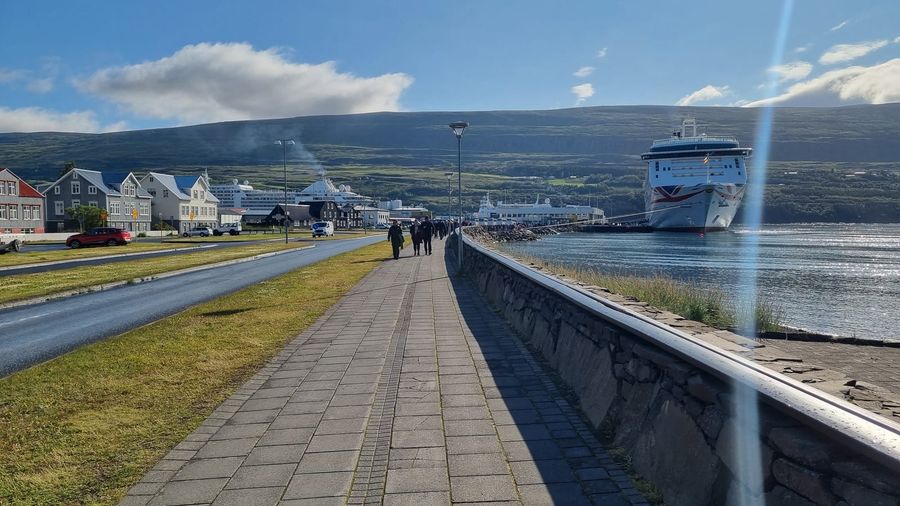
Akureyri is small enough to explore on foot: Iceland's northern capital folds its church, harbour, botanical garden, and main shopping street into a centre you can cross in twenty minutes. Save wheels for the day trips — the town's fare-free buses cover the rest of the urban area, and a rental car unlocks the Diamond Circle and Mývatn beyond the fjord.
Getting around Akureyri is refreshingly simple once you understand its shape. The town sits at the innermost point of Eyjafjörður, Iceland's longest fjord, with the flat waterfront holding the harbour and the hillside above it holding the landmark church. Everything a visitor comes for is packed into that compact strip, so walking does most of the work. The only real decisions are how you arrive from the south and how you reach the spectacular sights scattered across the north — and for those, the answer is a rental car or a guided tour.
How Akureyri's layout shapes getting around
Akureyri is a fjord-head town: a flat waterfront centre backed by a steep residential hillside, with the airport to the south and the open road to the Diamond Circle running east. Grasp that geography and every journey here plans itself.
The heart of town is the pedestrian-friendly stretch around Hafnarstræti and the harbour, where the shops, cafés, and the tourist information office cluster within a few blocks of the water. Rising directly behind it is the hillside crowned by Akureyrarkirkja, the twin-towered church reached by a monumental staircase — the one genuine climb in an otherwise level centre. South along the shore, about 3 km out, is Akureyri Airport; east, the Ring Road peels away toward Goðafoss and the wider north. Think of the centre as your walkable base and everything dramatic as a day trip from it.
Walking the compact centre
Walking is not just the best way around central Akureyri — it is almost the only one you need, because the church, the botanical garden, the harbour, and the shopping street all lie within a fifteen-to-twenty-minute stroll of each other. Wear something warm and windproof; the fjord air is cool even in summer.
A natural on-foot loop starts at the harbour, climbs Hafnarstræti past the shops, and detours up the church staircase for the view back over the rooftops and the fjord. From there it is a short, gentle walk south to the Lystigarðurinn Botanical Garden — the world's northernmost public botanical garden, free to enter and in bloom from May through September. The town's celebrated geothermal swimming pool and the small museums along Aðalstræti's old timber houses are all comfortably within range on foot. Because the centre is so contained, you can leave transport out of your day entirely and still see the headline sights.
Akureyri's fare-free town buses
Akureyri runs one of the few free urban bus networks you will meet as a traveller: the town buses carry passengers across the wider urban area at no charge, so you board and ride without a ticket. They are the easy way to cover the longer distances the walkable centre does not reach.
The municipal service, Strætisvagnar Akureyrar, operates under the yellow Strætó brand and threads the residential hillsides, the university, the hospital, and the approaches toward the Hlíðarfjall ski road. For a visitor the value is reaching a trailhead, the pool, or accommodation up the slope without a taxi. Timetables and live positions appear in the Strætó app, which is worth downloading before you travel. One point of confusion is worth clearing up: the standard Strætó fare you may have paid in the capital region does not apply here — Akureyri's own town buses are free, and only the long-distance coaches leaving the region charge a fare.
Arriving in Akureyri: flights, the Ring Road, and coaches
Akureyri is reached from Reykjavik in three ways — a sub-hour flight, a five-and-a-half-hour drive on the Ring Road, or a longer, cheaper coach — and the choice comes down to how much you value time against money and scenery. All three deliver you within a few kilometres of the centre.
| Route from Reykjavik | Typical time | Rough cost | Best for |
|---|---|---|---|
| Domestic flight | Under 1 hour | ISK 9,000–20,000 one-way | Speed and short trips |
| Drive the Ring Road (Route 1) | 5.5–6 hours | Fuel + car hire | Scenery and flexibility |
| Long-distance Strætó coach | 6–7 hours | Lowest of the three | Budget travellers without a car |
Flights depart Reykjavik's central domestic airport — not the international hub at Keflavík — and land at Akureyri Airport, a five-minute drive or short taxi from town. Driving from Reykjavik rewards you with the Hvalfjörður tunnel, the waterfalls of Skagafjörður, and the switchbacks above Öxnadalur en route. The coach is the thriftiest option and drops you centrally, but it is a long sit. Whichever you choose, note that Akureyri makes a far better base for the north than a day trip from the capital.
Renting a car for the Diamond Circle and Mývatn
A rental car earns its keep only beyond the town — for the Diamond Circle, Goðafoss, and the Mývatn geothermal area, where the distances are long and the bus network thins to almost nothing. For the centre itself, a car is a parking liability rather than a help.
Collect a vehicle at the airport or a town-centre office and use it purely for excursions. Goðafoss — the 'Waterfall of the Gods', where Iceland formally adopted Christianity in the year 999 — is about 50 km east on the Ring Road, an easy half-day. The Mývatn area, with its pseudocraters, lava fields, and open-air Nature Baths, lies roughly 100 km east and fills a full day. The complete Diamond Circle — looping through Húsavík, Dettifoss (Europe's most powerful waterfall by flow), and the Ásbyrgi canyon — is a long day's driving best given an overnight if you can spare one. Keep an eye on fuel, carry snacks, and check road conditions in shoulder season, when the first snows can arrive early in the north.
Choosing a guided tour: types, timing, and cost
If you would rather not drive the long northern distances yourself, Akureyri's operators run guided excursions from the harbour area that cover the same ground — and once fuel and car hire are counted, a group tour is often the better value. Match the tour to what the north does best: waterfalls, whales, and geothermal drama.
| Tour type | Typical price (per person) | What it covers |
|---|---|---|
| City walking tour (group) | ISK 6,000–9,000 | Church, harbour, town history |
| Diamond Circle day trip (group) | ISK 16,000–24,000 | Goðafoss, Húsavík, Dettifoss, Ásbyrgi |
| Whale watching from the harbour | ISK 12,000–16,000 | Eyjafjörður humpbacks and minkes |
| Mývatn day tour | ISK 10,000–15,000 | Pseudocraters, lava fields, Nature Baths |
| Private guide (half-day, up to 6) | ISK 50,000–75,000 | Tailored itinerary at your own pace |
Rates in Akureyri sit noticeably below Reykjavik prices for equivalent trips. For timing, book whale watching in the long light of June and July when Eyjafjörður's feeding is at its peak, and aim Diamond Circle tours for a clear-forecast day so the waterfalls show at their best. A whale tour pairs naturally with a stop at the Húsavík Whale Museum if you push on around the coast. Booking directly with local operators, rather than through international resellers, is usually the cheapest route.
Budgeting and seasonal timing
Getting around Akureyri costs almost nothing in the centre and adds up only when you head out of town, so the seasons — not the fares — should drive your planning. A little timing keeps both crowds and costs manageable.
Walking is free, the town buses are free, and the biggest transport expense is whichever day trip you choose. June and July bring the midnight sun, peak whale watching, and the botanical garden in full bloom; August and September offer thinner crowds and autumn colour in the valleys; January and February deliver the best Northern Lights odds against the dark fjord. If you are driving in winter, factor in shorter daylight, possible road closures, and studded tyres. Iceland uses the Icelandic Króna, and cards are accepted almost everywhere, including at remote petrol stations on the Ring Road.
Once you have the logistics sorted, the Akureyri city guide covers what to see and do, and the wider Iceland guide puts the north in the context of the whole island.
Frequently Asked Questions
Are Akureyri's town buses really free?
Yes. The municipal town buses, run as Strætisvagnar Akureyrar under the Strætó brand, carry passengers fare-free across the urban area — you simply board and ride, with no ticket to buy. That is a local arrangement specific to Akureyri; the long-distance Strætó coaches that link the town to Reykjavik and the rest of the country are paid services with standard national fares.
Is Akureyri's centre walkable?
Very much so. The church, harbour, botanical garden, swimming pool, and the Hafnarstræti shopping street all sit within a fifteen-to-twenty-minute walk of one another, and the flat waterfront makes the strolling easy. The one climb worth noting is the staircase up to Akureyrarkirkja. You rarely need any transport inside the centre itself.
How do you get from Akureyri Airport to the town centre?
Akureyri Airport sits about 3 km south of the centre on the western shore of the fjord, roughly a five-minute drive. There is no dedicated airport shuttle, so most arrivals take a taxi, collect a pre-booked rental car at the terminal, or arrange a hotel pickup. The town buses also pass nearby if you are travelling light.
How do you get from Reykjavik to Akureyri?
You have three options. Domestic flights from Reykjavik's city airport take under an hour and are the fastest way north. Driving the Ring Road (Route 1) covers about 390 km in roughly five and a half to six hours with stops. Long-distance Strætó coaches make the same trip in six to seven hours for the lowest fare of the three.
Do you need a rental car in Akureyri?
Not for the town, which is best walked. You want a car — or a guided tour — only for the day trips: the Diamond Circle, Goðafoss, and the Mývatn geothermal area all lie well beyond the fjord, where public transport is sparse. If you plan to stay in and around the centre, skip the car and save on parking.
Can you do the Diamond Circle without a car?
Yes. Several operators run guided Diamond Circle and Mývatn day tours from Akureyri, picking up in the harbour area, so you can reach Goðafoss, Húsavík, Dettifoss, and Ásbyrgi without driving. It is the simplest option if you would rather not tackle long distances and gravel side-roads yourself, and it is often the better value once fuel and car hire are counted.