
Walking Route
Landmarks Along
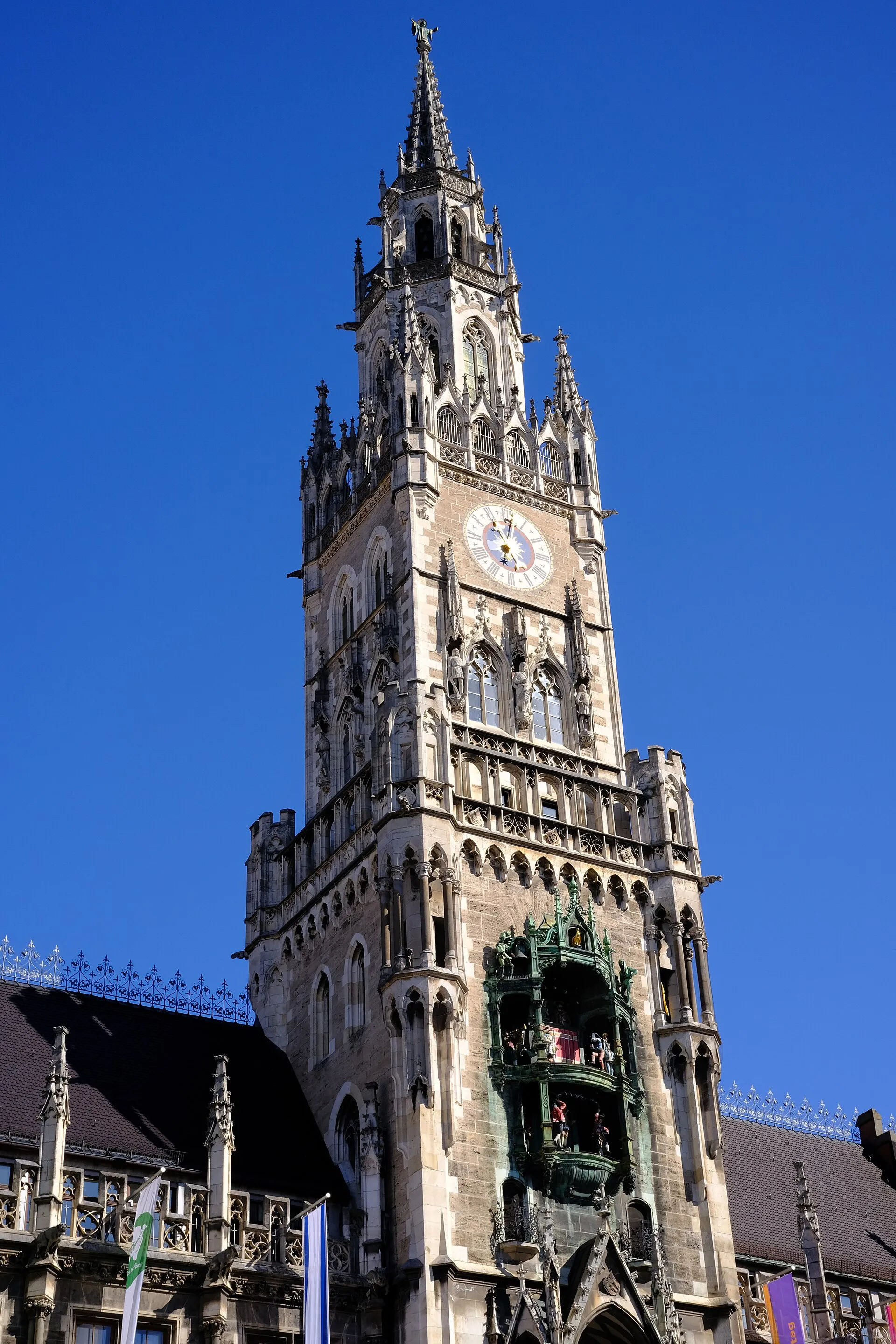
- Neues Rathaus (New Town Hall) — The square's centrepiece was built between 1867 and 1908 to designs by architect Georg von Hauberrisser, its filigree Neo-Gothic facade lined with statues of the Wittelsbach dukes. Its 85-metre tower holds a lift up to an enclosed viewing gallery.
- The Glockenspiel — Set into the tower in 1908, the Rathaus-Glockenspiel has 43 bells and 32 near-life-size figures that re-enact the 1568 wedding tournament of Duke Wilhelm V above and the plague-ending Schäfflertanz below.
- Mariensäule (Mary's Column) — The gilded Marian column of 1638 stands at the exact centre, its four bronze putti battling the beasts of war, plague, hunger, and heresy.
- Altes Rathaus (Old Town Hall) — The Gothic hall closing the eastern end dates to the 1470s; its tower now houses a small toy museum (Spielzeugmuseum).
- Fischbrunnen (Fish Fountain) — The bronze fountain on the north-east corner is a long-standing Munich meeting point and the stage for the mayor's Ash Wednesday "purse-washing" ritual.
- Frauenkirche & St. Peter's — Munich's brick cathedral with its landmark onion domes stands a block north, while Alter Peter, the city's oldest parish church, rises just to the south.
- Nearby, the Hofbräuhaus royal beer hall is a five-minute walk east, and day trips to Neuschwanstein Castle traditionally set off from here.
Photo Spots
- The full facade at showtime — Stand on the square's south side for a head-on frame of the Neues Rathaus with the mechanical figures turning above the crowd.
- From the town-hall tower — The 85-metre gallery gives a rooftop panorama over the old town, reaching the Alps on clear days.
- From the tower of St. Peter's (Alter Peter) — The classic postcard shot looks straight down the square with the town hall, the Frauenkirche domes, and the Alps stacked behind it.
- Christmas market season — Through late November and December the Christkindlmarkt fills the square with lit stalls and a towering tree in front of the town hall.
- Golden hour and the blue hour after sunset light the stone beautifully; the Hofbräuhaus is a short walk east if you keep shooting into the evening.
When to Visit
The square itself is open 24/7 and never charges admission. The Glockenspiel plays daily at 11 AM and noon year-round, with an extra 5 PM performance from March to October; a shorter night scene featuring the Münchner Kindl and an angel chimes at 9 PM. The Neues Rathaus tower gallery is generally open 10 AM–7 PM (May–October) and 10 AM–5 PM (November–April). Arrive about 15 minutes before a Glockenspiel show to secure a clear sightline, and favour early morning or the hour after the noon show to avoid the thickest summer crowds.
Admission and Costs
Standing in the square and watching the Glockenspiel are both completely free. Climbing the Neues Rathaus tower by lift costs about €8 (about $9) for adults. Tips-based free walking tours frequently gather here and expect a €10–15 (about $11–17) tip; scheduled group city tours run €28–40 (about $31–44) per person for two to three hours, and a private guide for a half-day of old-town highlights is typically €200–300 (about $220–330). Food and coffee on the square carry a tourist premium, so the cafes a couple of streets away — or the stalls of the nearby Viktualienmarkt — cost noticeably less.
The Case for a Guide
Marienplatz rewards context, and a knowledgeable local turns a quick photo stop into a story worth remembering. The strongest reasons to walk it with a guide:
- Decode the Glockenspiel — A guide explains who the jousting knights and dancing coopers are before the figures start turning, so the twelve-to-fifteen-minute show actually makes sense.
- Read the facades — The Neues Rathaus, the medieval Altes Rathaus, and the Marian column each belong to a different Munich century; a guide threads them into a single narrative.
- Skip the tourist traps — Locals steer you off the overpriced square-front cafes toward the Viktualienmarkt and the better-value lanes just off the square.
- Connect the old town — Many guides link Marienplatz to the Hofbräuhaus, the Frauenkirche, and the pedestrian shopping streets into one efficient loop, and use the square as the departure point for Neuschwanstein Castle day trips.
Tips for Visitors
- Arrive early for the Glockenspiel — Be in place about 15 minutes ahead on the south side; the best spots fill fast in summer.
- Mind your belongings — The dense show-time crowds make the square a known pickpocket hotspot, so keep bags zipped and worn to the front.
- Shop the pedestrian streets — Kaufingerstraße and Neuhauser Straße run west from the square as one of Germany's busiest shopping runs, while the historic Dallmayr delicatessen sits a block to the north-east.
- Eat smart — The Ratskeller beneath the Neues Rathaus serves Bavarian fare in vaulted cellars, Café Glockenspiel overlooks the show, and the Viktualienmarkt two minutes south is the local choice for cheaper, fresher bites.
- Ride the U-Bahn and S-Bahn — Marienplatz station sits directly beneath the square, putting most of Munich within a short ride.
- Come back after dark — The floodlit facade and quieter square make for a very different evening visit, and the Hofbräuhaus is only five minutes away.
Frequently Asked Questions
When is the best time to see the Glockenspiel and visit Marienplatz?
The square is a public space open around the clock, so there is no wrong time to walk through it. For the Glockenspiel, aim for one of its daily shows at 11 AM or noon (with an extra 5 PM performance from March to October) and arrive about 15 minutes early to claim a clear sightline on the south side. Early morning and the hour after the noon show are the calmest windows during the summer peak.
What is the story behind the Glockenspiel figures?
The 32 figures act out two tales from Munich history. The upper tier stages the 1568 wedding tournament of Duke Wilhelm V, where a Bavarian knight unhorses his Lothringian rival, and the lower tier performs the Schäfflertanz, the coopers' dance that is said to have coaxed Münchners back onto the streets after the plague of 1517. The full show runs about twelve to fifteen minutes.
What are the main sights on and around Marienplatz?
The Neo-Gothic Neues Rathaus and its 85-metre tower dominate the north side, the medieval Altes Rathaus closes the eastern end, and the gilded Mariensäule marks the centre. Within a two-minute walk you also reach the twin-domed Frauenkirche, the tower of St. Peter's (Alter Peter), and the Viktualienmarkt food market.
Where should you shop and eat around Marienplatz?
Kaufingerstraße and Neuhauser Straße run west from the square as one of Germany's busiest pedestrian shopping streets, and the historic Dallmayr delicatessen sits a block to the north-east. For food, the Ratskeller beneath the Neues Rathaus serves Bavarian classics in vaulted cellars, Café Glockenspiel overlooks the show, and the nearby Viktualienmarkt offers cheaper, fresher bites than the square-front cafes.
How do you get to Marienplatz?
Marienplatz has its own U-Bahn and S-Bahn station directly beneath the square, making it one of the easiest points to reach in Munich. All main S-Bahn lines stop here, so it is a short ride from the central station and roughly 45 minutes from the airport. The surrounding Altstadt is car-free and easily walkable.