
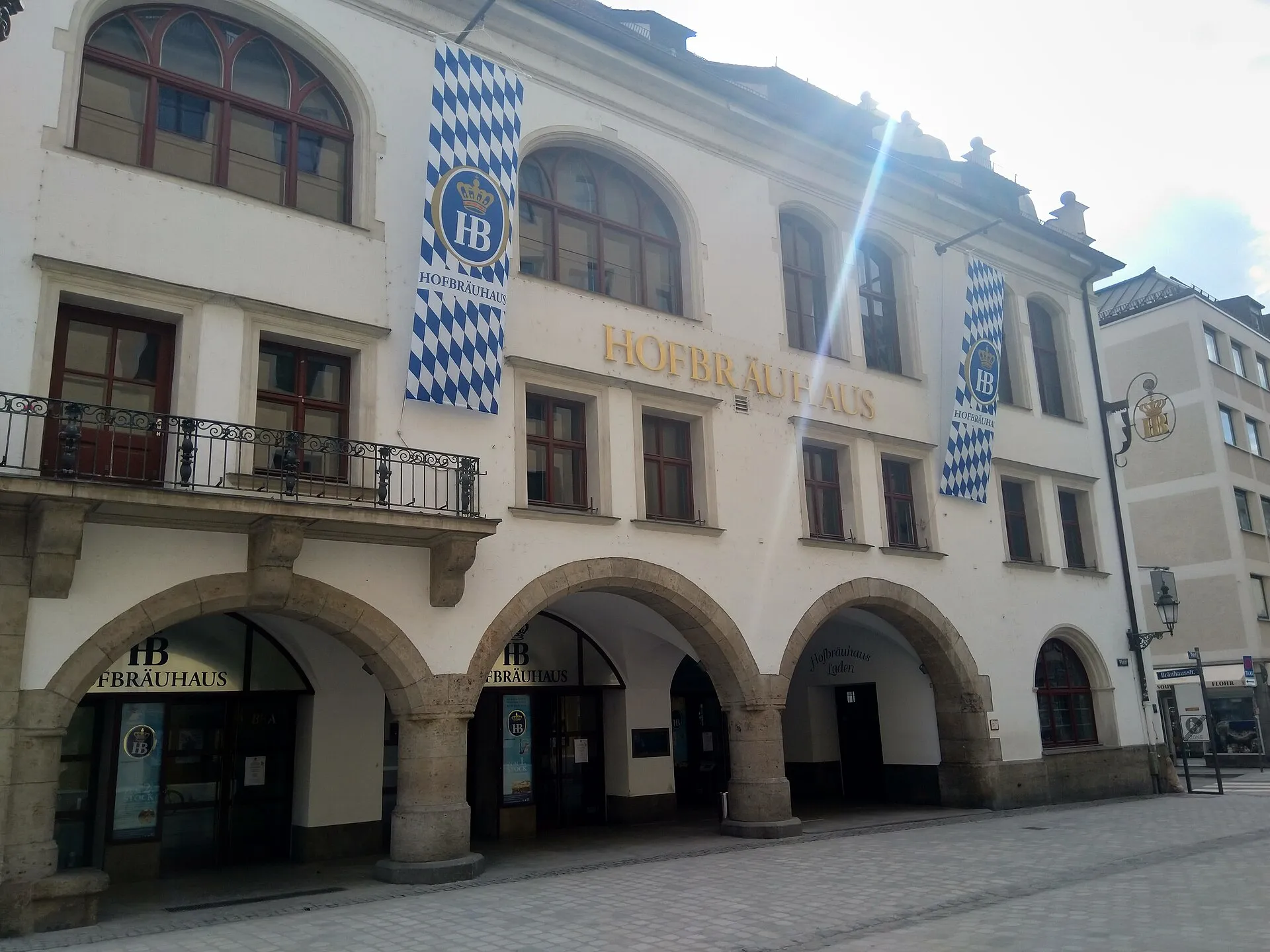
Tasting Guide
The pour to order is the Maß — a full one-litre stein — of one of the house beers brewed by Hofbräu München to the 1516 Reinheitsgebot purity law:
- Hofbräu Original — the flagship golden Helles lager, malty and easy-drinking; the default order.
- Hofbräu Dunkel — a dark lager with bready, lightly caramel notes, closest to the brewery's 16th-century roots.
- Hofbräu Weisse — a cloudy wheat beer with banana-and-clove aromatics, best in the beer garden on a warm afternoon.
- Maibock — a strong seasonal lager tapped in spring, for the potent end of the range.
Line the beer with classic Bavarian fare: a warm Brezn (pretzel) the size of a dinner plate served with obatzda, a paprika-spiced soft-cheese spread; Schweinshaxe (crackling-skinned roast pork knuckle) with a potato dumpling; Weißwurst with sweet mustard before noon in the old tradition; or roast Hendl (chicken).
Two rituals matter. First, table-sharing is the norm — spot an open stretch of bench at a long Stammtisch table, ask "Ist hier frei?", and sit down beside strangers. Second, roughly every fifteen minutes the band strikes up the toasting song and the whole hall rises:
Ein Prosit, ein Prosit der Gemütlichkeit!
Stand, clink steins, meet each drinker's eye, say "Prost!", and drink. Flag down the aproned servers rather than going to a bar, tip by rounding up, and remember that cash is strongly preferred.
Local Producers
The "terroir" here is really a five-century brewing lineage. Hofbräu München is still a state-owned brewery — the Free State of Bavaria owns it outright, the last survivor of the old ducal monopolies — which is why the initials HB and a royal crown appear on every stein, beer mat, and festival tent. Every beer is brewed to the Bavarian Reinheitsgebot, the 1516 Beer Purity Law that limits ingredients to water, barley, and hops (yeast was added once its role was understood), making it one of the world's oldest food-quality regulations still in force.
A few details reward a closer look:
- The Stammtisch cabinet near the entrance holds around 600 personalised, padlocked steins reserved for regulars; some families have kept the same lockable mug for generations.
- The painted barrel-vault ceiling of the ground-floor Schwemme carries Bavarian heraldry, mottos, and the blue-and-white lozenges of the state.
- The brewery still runs its own Oktoberfest tent, the Hofbräu-Festzelt, among the largest on the Theresienwiese.
To go deeper, a beer-culture guide can walk you from the Hofbräuhaus to lesser-known halls and the Viktualienmarkt beer garden near Marienplatz, explaining how a royal cellar grew into a civic institution for all of Munich.
Hofbräuhaus München timeline
-
Court brewery founded
Duke Wilhelm V established the Hofbräuhaus to brew brown ale for the Bavarian ducal court.
-
Wheat-beer monopoly
Maximilian I switched production to Weissbier and held the lucrative ducal monopoly on it for decades.
-
Opened to the public
King Ludwig I let ordinary Münchners drink in the former royal beer hall for the first time.
-
Platzl hall rebuilt
Architect Max Littmann rebuilt the beer hall at the Platzl as brewing moved to the city edge.
-
Destroyed in WWII
Wartime air raids gutted the building, leaving little more than the ground-floor Schwemme standing.
-
Reconstructed and reopened
The faithfully rebuilt hall, including the grand upstairs Festsaal, reopened to guests.
When to Visit
The beer hall is open daily from 9:00 AM to 11:30 PM, and admission is always free — you pay only for what you eat and drink. The traditional Bavarian oompah band plays every evening, generally from around 6:00 PM to 10:30 PM, and often at lunchtime too.
For a calmer experience, come on a weekday around lunch (11 AM–1 PM) or in the mid-afternoon lull (3–5 PM), when you can actually claim a table and hear yourself talk. Weekend evenings are shoulder-to-shoulder, and during Oktoberfest (late September to early October) the whole city — Hofbräuhaus included — runs at maximum capacity. The house rates highest from June through October, when the courtyard beer garden is open, and again in December, when Christmas markets and seasonal specialities make the indoor hall especially cosy. Budget 1–2 hours for a meal and the full atmosphere.
Admission and Costs
There is no entry fee; the only cost is your order. A Maß (one-litre stein) of Hofbräu runs about €11 ($12) — roughly double the volume of a standard pint. A giant pretzel with obatzda is €5–6 ($6–7), and a hearty main such as Schweinshaxe, schnitzel, or sausages with sauerkraut is typically €15–25 ($17–28). There is an ATM inside, but cash is strongly preferred and speeds up service.
If you want the story as well as the beer, a small-group beer-hall tour with tastings costs roughly €30–45 ($33–50) per person, while a private Bavarian beer-culture guide visiting several halls runs about €150–250 ($165–275) for the group.
The Case for a Guide
The Hofbräuhaus is free to enter and easy to find, so a guide's value is context and access, not logistics. The strongest reasons to visit with a local:
- Read the room — a guide decodes the heraldry on the vaults, the meaning of the locked Stammtisch steins, and how the Schwemme, beer garden, and upstairs Festsaal each fit into the building's history.
- Order like a local — which beer suits your taste, what to eat alongside it, and the etiquette of table-sharing and the "Ein Prosit" toast, so you spend less time puzzling over the menu.
- Escape the tourist bubble — the hall runs heavily to visitors, and guides pair it with authentic neighbourhood beer halls and gardens most tourists never find.
- Understand the hard history — a good guide handles the Festsaal's 1920s political past honestly rather than as a punchline.
- Skip the scramble for a table — many guides hold connections or reservations for the busiest evenings.
Beer-hall walking tours typically fold the Hofbräuhaus into a wider Munich old-town circuit that also takes in Marienplatz.
Tips for Visitors
- Bring cash — there is an ATM inside, but servers strongly prefer notes and coins, and it keeps things moving.
- Just sit down — table-sharing is expected; find space at a long table, ask "Ist hier frei?", and join the strangers already there.
- Join the toast — when the band plays "Ein Prosit" every quarter-hour, stand, clink, make eye contact, and say "Prost!".
- Flag the servers — order from the aproned staff rather than heading to a bar; service can be slow when the hall is packed, so be patient.
- Look up — the frescoed vaults of the Schwemme and the grand Festsaal upstairs are worth the climb, and the cabinet of 600+ locked regulars' steins sits near the entrance.
- Not a drinker? — Radler (beer with lemonade), Spezi, apple-juice spritzers, and alcohol-free wheat beer are all on the menu.
- Make a day of it — the Glockenspiel at Marienplatz is five minutes west, and Neuschwanstein Castle day trips through Munich round out a Bavarian itinerary.
Frequently Asked Questions
What is the best time of year to visit Hofbräuhaus München?
June through October is prime time: the courtyard beer garden is open, evenings are warm, and the run-up to Oktoberfest (late September to early October) fills the hall with energy — though those weeks are also the most crowded. December is the other sweet spot, when Munich's Christmas markets and seasonal Bavarian dishes make the vaulted indoor hall especially cosy over a warming Maß. In any season, a weekday is far calmer than a weekend.
What should I order at Hofbräuhaus München?
Start with a Maß — a full one-litre stein — of Hofbräu Original (golden Helles), Dunkel (dark lager), or Weisse (wheat beer), all brewed to the 1516 Reinheitsgebot purity law. Pair it with a plate-sized Brezn pretzel and obatzda cheese spread, Schweinshaxe (roast pork knuckle) with a potato dumpling, or Weißwurst with sweet mustard in the pre-noon tradition. Non-drinkers can order Radler, Spezi, or alcohol-free wheat beer.
How much does a visit to Hofbräuhaus München cost?
Entry is free — you pay only for food and drink. A one-litre Maß of Hofbräu costs about €11 ($12), a giant pretzel €5–6 ($6–7), and a traditional main such as Schweinshaxe or schnitzel €15–25 ($17–28). Small-group beer-hall tours with tastings run roughly €30–45 ($33–50) per person, and a private Bavarian beer-culture guide about €150–250 ($165–275) for the group. Cash is strongly preferred.
What are the etiquette rules at Hofbräuhaus München?
Table-sharing is the norm: find space at a long communal table, ask "Ist hier frei?", and sit down with strangers. Roughly every fifteen minutes the band leads the "Ein Prosit" toast, when everyone stands, clinks steins, makes eye contact, and says "Prost!". Order from the aproned servers rather than at a bar, tip by rounding up, and bring cash, as cards are often not welcome.
When was Hofbräuhaus München founded and who has drunk there?
Duke Wilhelm V founded the Hofbräuhaus as the Bavarian court brewery in 1589, and King Ludwig I opened it to the public in 1828; the hall visitors see today dates to an 1897 rebuild and was reconstructed after WWII, reopening in 1958. Popular tradition threads famous names through its benches — from Mozart during his Munich years to Lenin, who lived in the city in 1900–1902 — while the upstairs Festsaal has a documented history as a venue for mass political meetings in the 1920s.