
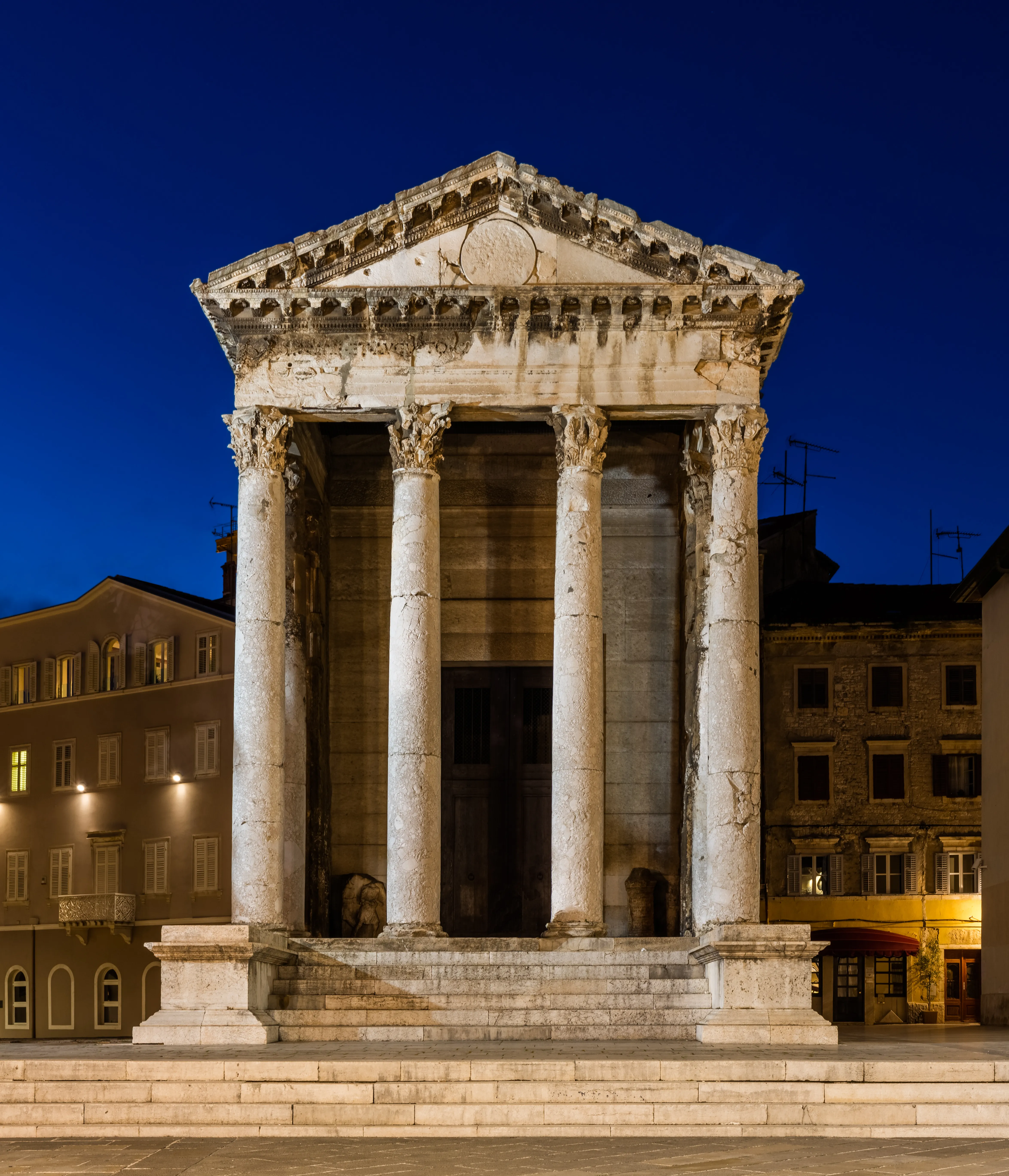
Architecture
The Temple of Augustus is a textbook prostyle Corinthian temple of the Augustan period. It sits on a raised stone podium reached by a frontal staircase, with a deep pronaos (porch) formed by six free-standing fluted columns topped by ornate Corinthian capitals carved with acanthus leaves. Above the columns runs a plain architrave, a frieze, and a triangular pediment whose tympanum was originally decorated. Behind the porch the windowless cella held the cult statues. The whole composition measures roughly 8 by 17 metres, modest in footprint but unusually pure in proportion — close enough to the famous Maison Carrée in Nîmes that the two are routinely studied side by side. Much of the visible stone is original Roman work re-erected after 1944, with replacement blocks cut to match the ancient masonry.
Historical Significance
The temple is a rare survivor of the Roman imperial cult in a provincial setting, dedicated to Roma and the living Augustus when Pula was the thriving colony of Pietas Iulia. Its continuous reuse — as church, granary, and museum — traces the entire post-Roman history of the city through Byzantine, Frankish, Venetian, and Habsburg rule. Its destruction in 1944 and meticulous reconstruction make it equally a monument to 20th-century conservation, a building that embodies both ancient Rome and the modern determination to preserve it. Standing on a square that has been the civic heart of the city for over two thousand years, it offers one of the clearest demonstrations anywhere of how a single Roman structure can carry the memory of every era that followed.
When to Visit
Opening hours are seasonal. In summer (roughly late May to early October) the temple is typically open Monday to Friday 9 AM–8 PM and weekends with slightly shorter hours; in winter it is often closed or open only on request, so check locally before visiting off-season. A visit takes 15–25 minutes to view the lapidary collection and study the exterior. The best light for photographing the columns is mid to late morning, when the sun strikes the eastern facade. Combine the temple with the surrounding Forum and you can comfortably spend 30–45 minutes in the square.
Admission and Costs
Entry to the temple's lapidary museum is approximately €2–4 (about $2–4) for adults, with reduced rates for students and children and free admission for young children. The Forum square itself is free to enter and enjoy at any hour. A combined ticket bundling the temple with other Pula heritage sites is sometimes offered through the local museum service at a small saving. A licensed guide leading a Roman Pula walk that includes the temple typically charges €15–25 ($16–27) per person in a small group, or €90–150 ($97–162) for a private half-day tour covering the Forum, the arch, and the Pula Arena.
The Case for a Guide
The temple is small and self-explanatory at first glance, which is exactly why a knowledgeable guide changes the experience — most of its meaning is invisible without context.
- Spotting the 1944 reconstruction: A guide can point out where original Augustan stone meets postwar replacement, turning a tidy facade into a visible record of wartime destruction and recovery
- Decoding the imperial cult: Explaining why a provincial town dedicated a temple to a living emperor reveals how Roman power was projected through religion and loyalty rituals rather than armies alone
- The lost twin temple: A guide shows where the matching Temple of Diana once stood and how its surviving wall was swallowed by the medieval town hall, making the recycling of Roman fabric tangible
- Reading Corinthian order: The acanthus-leaf capitals, fluting, and pediment follow strict architectural rules; a guide unpacks the grammar of classical design so the proportions stop being abstract
- Placing it in the Forum: Understanding the temple as one element of a complete Roman civic centre — basilica, square, and shops — lets you reconstruct daily life in ancient Pietas Iulia
Tips for Visitors
Visit the Forum first: Stand in the centre of the square to appreciate how the temple was designed to dominate the civic space before stepping closer. Bring small change: The entry fee is modest and the ticket desk inside the cella is cash-friendly. Look for the buried twin: Walk to the adjacent town hall and find the embedded rear wall of the former Temple of Diana — many visitors miss it entirely. Time it with the Arena: The temple sits a flat 10-minute walk from the amphitheatre, so pair them in a single Roman-heritage morning around Pula. Café strategy: The Forum's cafés make an ideal pause; a coffee at a terrace table gives you the temple as your backdrop.
Frequently Asked Questions
Why was the Temple of Augustus rebuilt in the 20th century?
During an Allied bombing raid in 1944, a direct hit reduced the temple to a heap of rubble — the columns toppled, the pediment shattered, and the cella walls collapsed. Because the temple had been carefully surveyed and photographed in earlier decades, restorers were able to reassemble it between 1945 and 1947 using the original blocks wherever they could be recovered, supplemented by new stone cut to match. The result is roughly 70% original material. If you look closely at the columns and the architrave you can sometimes distinguish the weathered ancient stone from the smoother postwar replacements.
How does the Temple of Augustus relate to the Roman emperor cult?
The temple was dedicated to the goddess Roma and to the emperor Augustus while he was still alive, between roughly 2 BCE and 14 CE — making it an instrument of the imperial cult that bound provincial cities to Rome. Worshipping a living emperor alongside the personified spirit of Rome was a political loyalty ritual as much as a religious one. Pula, then the Roman colony of Pietas Iulia, was demonstrating its allegiance in marble. An almost identical twin temple once stood on the opposite side of the Forum, dedicated to Diana; only its rear wall survives, embedded in the medieval town hall next door.
What can you actually see inside the temple today?
The single cella now serves as a small lapidary museum displaying Roman stone sculpture and bronzes unearthed around Pula, including fragments of statuary, inscriptions, and architectural pieces. It is a modest, one-room collection that takes ten to fifteen minutes to view, but the setting — standing inside an intact Roman temple chamber — is the real attraction. Entry is inexpensive and the building is rarely crowded compared with the Pula Arena.
How does this temple compare with other surviving Roman temples?
It is one of the best-preserved Roman temples outside Italy and is frequently compared with the Maison Carrée in Nîmes, France, which shares the same prostyle Corinthian design from the Augustan era. Pula's temple is smaller but follows the textbook proportions of Roman temple architecture so faithfully that it appears in architectural histories as a model example. Its survival on a still-functioning town square, rather than as an isolated ruin, gives it a sense of continuity that many grander Roman temples have lost.