
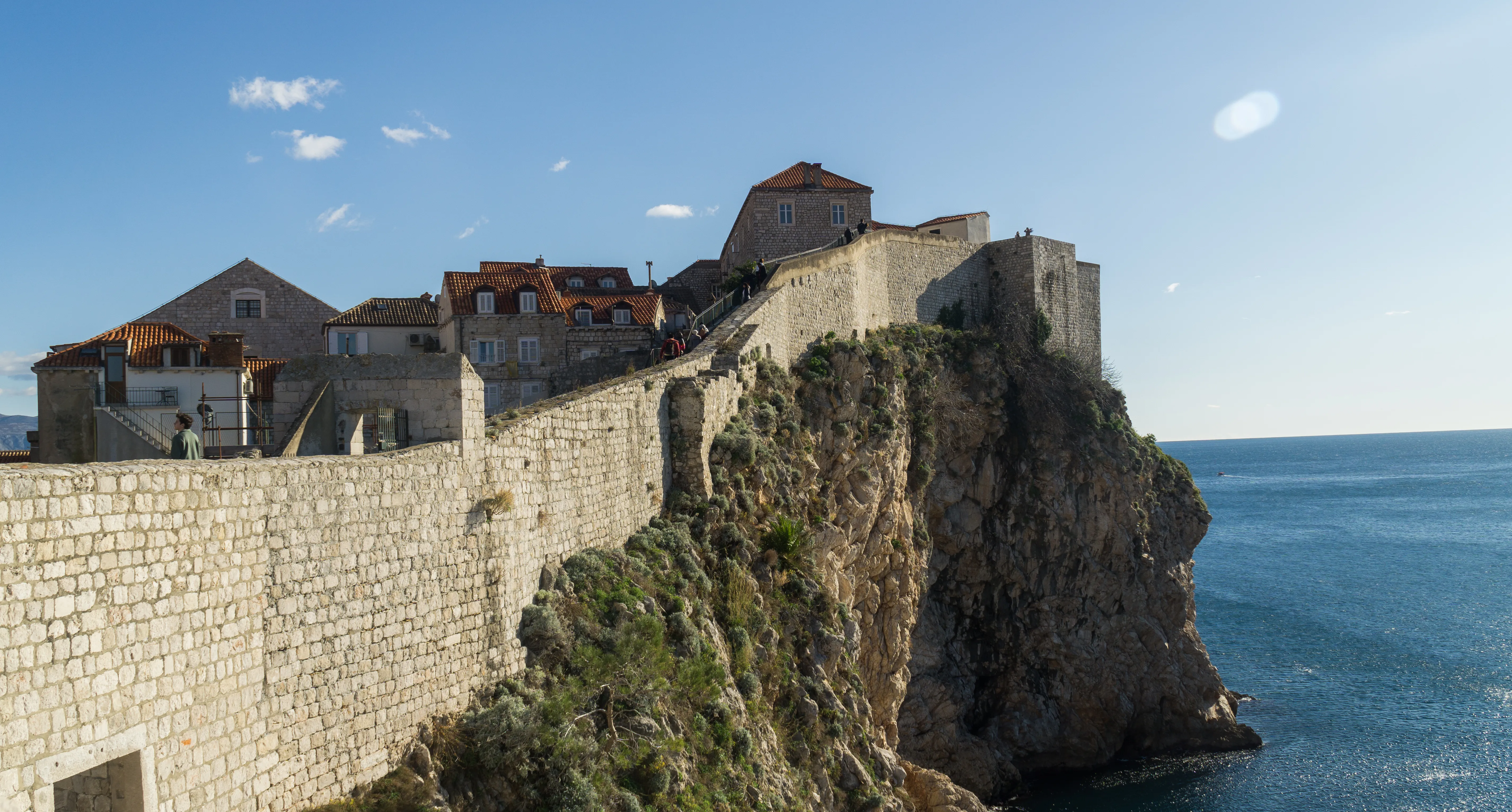
Architecture
Minčeta Fortress: The round tower at the highest northern point, designed by the Florentine architect Michelozzo Michelozzi in 1461 and completed by Juraj Dalmatinac — a panoramic belvedere above the Old Town rooftops. Bokar Fortress: The southwestern round tower, also by Michelozzo, positioned to provide flanking fire along the western wall and the moat. Revelin Fortress: The massive eastern fortress completed in 1551, designed specifically to withstand artillery — its thick walls were the most modern fortification on the Adriatic when built. St John Fortress: Guards the Old Harbour entrance and houses the Maritime Museum and Aquarium at its base; the harbour chain was stretched between this fortress and the breakwater to prevent hostile vessels entering. The Pile Gate: The western main entrance, with its drawbridge, Gothic arch, and Renaissance addition by Juraj Dalmatinac — the gate through which most visitors enter the Old Town today.
Historical Significance
The walls' fundamental historical significance lies in their political function: they are the reason the Republic of Ragusa could describe itself as a free state, abolish slavery in 1416, and maintain a foreign policy independent of its powerful neighbours for 451 years. A republic the size of a small city — no larger than a few city blocks — operated as a recognised sovereign state, issued passports, signed treaties, and conducted diplomacy from behind these walls. When Napoleon's army entered the city in 1806, it was the first time in centuries that foreign troops crossed the threshold — an event so traumatic to Ragusan identity that the city's residents still refer to the Republic with a peculiar nostalgia, four centuries later.
When to Visit
Open daily from 8 AM (closing times vary by season: 7:30 PM in summer, 3 PM in winter). Best time: Arrive exactly at 8 AM opening — the crowd builds exponentially between 9 AM and noon. The full circuit takes 90 minutes to 2 hours without stops; allow 2.5–3 hours with photography. Direction is one-way only (anticlockwise from Pile Gate); once started, you complete the circuit. No return allowed.
Admission and Costs
Adult entry: €35. Children under 7: Free. Dubrovnik City Card: Covers wall entry plus several museums. Tickets available at the Pile Gate and Ploče Gate entrances. No toilets on the walls — use facilities at the entrance before starting. Private guided wall circuits available from €120–180 for groups up to six.
The Case for a Guide
Walking the walls without a guide delivers outstanding views. Walking them with a knowledgeable local guide delivers the political and military context that transforms a panoramic stroll into an immersive history of medieval European statecraft.
- Ragusan Republic's survival strategy: A guide explains how the city maintained independence for 451 years not through military dominance but through a combination of commercial wealth, strategic tribute payments to the Ottomans, and the psychological deterrent of these very walls
- 1991 impact marks identified: Guides who lived through the siege can point to exact shell impact locations on the walls and explain the tactical logic of the Yugoslav Army's artillery targeting — a visceral history impossible to read from a plaque
- Fortification engineering decoded: Each tower's position relative to its neighbours made specific military sense; a guide explains the geometry of flanking fire and dead ground that made these walls so difficult to assault
- Game of Thrones locations pinpointed: The walls' seaward bastions served as multiple King's Landing locations — a guide connects the fictional geography to the real medieval one, showing how HBO's production team used the authentic architecture
- Minčeta Tower's symbolic importance: The highest point on the circuit was designed as much for psychological effect — visible from miles offshore, announcing Ragusan power — as for defensive function; guides explain how the tower's height relative to its surroundings was carefully calculated
Tips for Visitors
Arrive at 8 AM: The difference between 8 AM and 10 AM is the difference between a contemplative experience and a bottleneck. Bring water: No shade, no water fountains, no mercy from the Dalmatian sun in July and August. Wear appropriate shoes: Smooth limestone ramparts become treacherous when wet; avoid sandals, flip-flops, or heeled shoes. Photography direction: The seaward southern walls catch the best morning light (east-facing at that angle); the Minčeta Tower's panorama is best around 9–10 AM. After the walls: The Buža cliff bar (access through a hole in the southern wall) is exactly what it promises — cold drinks at the edge of the Adriatic.
Frequently Asked Questions
When is the best time to walk the Dubrovnik city walls?
Arrive at 8 AM opening without exception — the walls can attract 3,000+ visitors daily in peak summer, and the narrow rampart walkway becomes genuinely congested by 10 AM. The circuit takes 90 minutes to two hours at a comfortable pace; beginning at 8 AM means finishing before the sun reaches its most punishing angle and before cruise ship passengers arrive ashore. September and October mornings are ideal: the light is extraordinary, the crowds are modest, and the sea temperature still invites a swim from the Buža cliff bar below the walls after your circuit. In winter, the walls open later (typically 9 AM) and the experience is atmospheric and virtually solitary.
How much does it cost to walk the Dubrovnik city walls?
Adult entry costs €35 (as of 2025), which includes a map of the circuit. The ticket is valid for the full wall circuit with a single entry. Children under 7 enter free. The fee does not include access to the individual fortress interiors — Bokar, Minčeta, Revelin, and St John are ticketed separately. Some guided tour packages include wall entry in their pricing. Note that Dubrovnik city cards typically include wall access and can represent good value if you plan to visit multiple museums.
What should I bring for the wall walk?
The walls have no shade along most of the circuit — bring sunscreen, sunglasses, a hat, and at least 500 ml of water per person in summer. There are no toilets on the walls, so use the facilities at the Pile Gate entrance before starting. Comfortable, non-slip shoes are essential — the ramparts are uneven limestone, often polished smooth, and slippery when wet. Photography is outstanding throughout, particularly from the Minčeta Tower (northern high point) looking south over the Old Town, and from the southern seaward walls where the Adriatic drops directly below.