
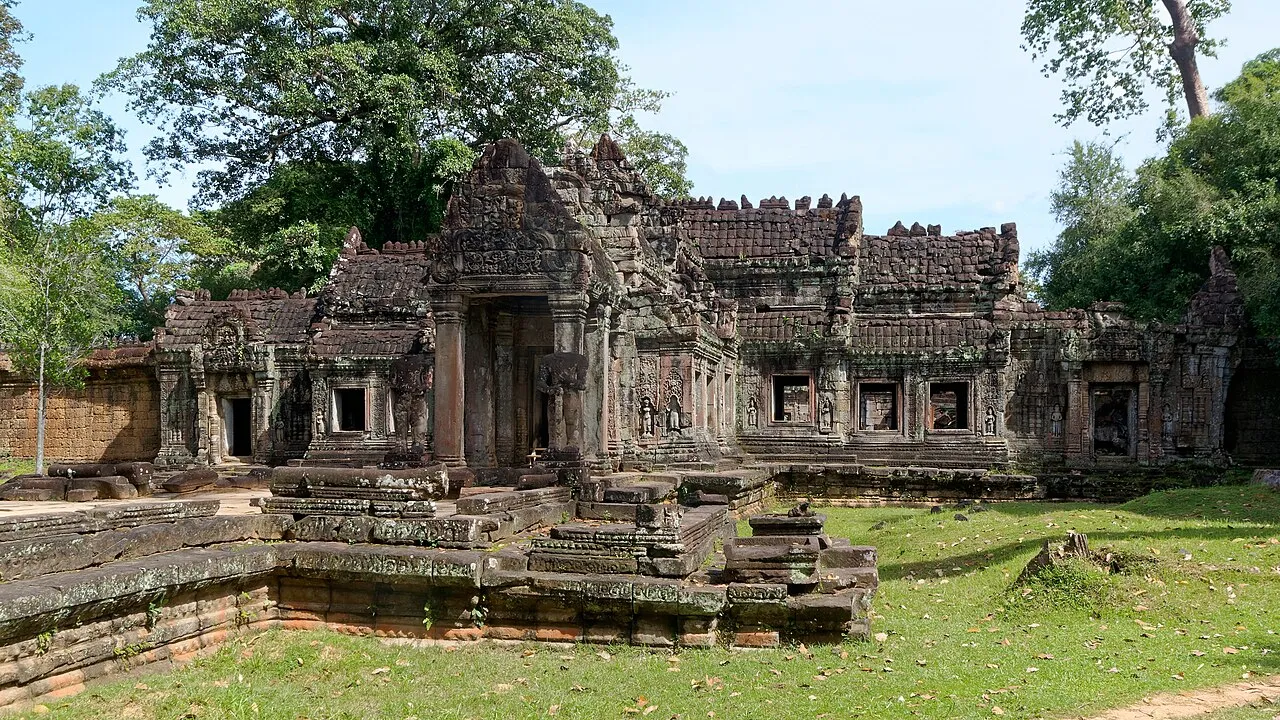
Spiritual Significance
Preah Khan was conceived as a Mahayana Buddhist foundation, and its religious programme is unusually legible for a temple of its age. The central sanctuary once held an image of Lokeshvara — the bodhisattva of compassion — carved in the likeness of the king's deified father and named Jayavarmeshvara, so that an act of worship was simultaneously an act of filial devotion and of loyalty to the crown.
What makes the site exceptional is its four-faith layout: the main eastern axis served the Buddha, while subsidiary shrine groups were dedicated to Shiva (west), Vishnu (north), and the deified royal ancestors (south). Preah Khan was, in effect, a single enclosure honouring the whole Khmer religious spectrum at once.
That syncretism did not survive the century. Under Jayavarman VIII (reigned c. 1270–1295) a Hindu reaction swept Angkor, and Preah Khan's Buddha images were systematically defaced or re-carved — pediment Buddhas chiselled into meditating ascetics or converted to Shiva lingas. The scars of this iconoclasm are visible on many lintels and are one of the clearest records anywhere of Angkor's religious upheavals. A small later Buddhist stupa, added inside the central sanctuary long after the empire's fall, still receives incense and offerings today, so visitors should treat the inner shrine as an active place of worship, not merely a ruin.
Visitor Etiquette
Preah Khan remains a sacred site, and the central stupa is tended by local caretakers who leave offerings there. A little care keeps the visit respectful and protects fragile 800-year-old stonework.
- Dress modestly: cover shoulders and knees as you would at any active Angkor temple; this is enforced loosely here but expected at the central sanctuary
- Remove hats and lower your voice near the inner stupa, and give way to anyone making an offering
- Do not climb on collapsed blocks, lean on carved reliefs, or touch the apsara carvings in the Hall of Dancers — skin oils and weight accelerate erosion that conservators are actively fighting
- Stay on the cleared paths: the northern arm has unstable masonry, and stepping off-route risks both your ankles and the stabilised ruins
- Photography is welcome, but avoid flash near worshippers and ask before photographing monks or caretakers
When to Visit
Open: 7:30 AM – 5:30 PM daily, within the Angkor park's overall 5 AM – 6 PM window. Best time: 8–10 AM, before the modest tour-group activity peaks and while the low eastern light still rakes across the carved gopura pediments. Late afternoon (4–5:30 PM) is the next-quietest slot and lights the western corridors.
- Dry season (November–April): firmest footing through the collapsed-block sections and the clearest light; the surrounding forest is thinner, so the garudas on the outer wall are easier to pick out
- Monsoon (June–October): the jungle closes in and the stone darkens with moss for a more atmospheric visit, but the low northern arm can flood and some passages become slippery
- Full circuit: allow 90–120 minutes for a thorough guided walk through all four cardinal corridors, the Hall of Dancers, and the round-columned building — far longer than the 20–30 minutes most groups spend crossing straight through
Admission and Costs
Preah Khan has no separate entry fee — access is covered by the single Angkor Archaeological Park pass, sold by the official state operator Angkor Enterprise. Buy it at the main ticket centre on Apsara Road (open from 4:30 AM for sunrise visitors) or online; a passport-style biometric photo is taken and printed on the pass, which is checked at every temple and is non-transferable.
| Pass | Price (USD) | Validity |
|---|---|---|
| 1-day | $37 | the calendar day of use |
| 3-day | $62 | any 3 days within 10 days |
| 7-day | $72 | any 7 days within 1 month |
- Currency: the US dollar is the everyday currency across Siem Reap and Angkor; change under $1 is returned in Cambodian riel (KHR, roughly 4,000 to the dollar). Passes are priced and paid in USD
- Free entry: Cambodian nationals enter free, as do foreign children under 12 (bring the child's passport for proof of age)
- Guide: a licensed Khmer-speaking or English-speaking guide for a full Angkor day runs $35–60 ($140–240 KHR-equivalent is never quoted — guides price in USD); a specialist art-history or Khmer-history guide is $60–100
- Transport: a tuk-tuk for the Grand Circuit (which includes Preah Khan, Neak Pean, Ta Som, East Mebon, and Pre Rup) is $18–25 for the day; adding the 5-minute hop to Neak Pean costs nothing extra on a daily-rate hire
The Case for a Guide
Preah Khan's labyrinthine layout and comparative lack of English signage make it particularly guide-dependent — visitors without orientation can miss its finest features entirely.
- Directional navigation: the cruciform corridor system means visitors can arrive at the east gate, walk straight through to the west gate, and see only a fraction of the complex; a guide maps a complete circuit through all four cardinal corridors and the second enclosure to capture the full experience
- Round-column building: the two-storey structure with circular columns is a genuine architectural mystery — a guide presents the competing scholarly interpretations (library, granary, dance platform, treasury) and explains what makes it uniquely anomalous in the Angkor architectural vocabulary
- Reading the iconoclasm: the defaced and re-carved Buddha pediments are invisible as a story unless someone points them out — a guide traces the shift from Jayavarman VII's Buddhism to the Hindu reaction under Jayavarman VIII across specific lintels
- Foundation stele data: the inscription listing Preah Khan's 97,840 residents and 515 stone images is a statistical record of medieval institutional life unparalleled in Southeast Asian history; a guide contextualises these numbers against comparable medieval European institutions
- Carving quality in the outer enclosure: the outer gopura's pediment carvings are among the finest in Angkor for their retention of original surface detail — a guide identifies the mythological scenes depicted and explains why outer-enclosure carvings were typically executed at a higher standard than inner work
Tips for Visitors
- Enter from the east: cross the guardian causeway for the intended processional experience; most tuk-tuks default to the west entrance, so ask your driver to drop you at the east gate and collect you at the west (or vice versa) to walk straight through without backtracking
- Find the garudas: the five-metre guardian birds on the outer wall are easy to miss — a short walk along the enclosure wall from the east gate reveals several in good condition
- Explore the northern arm: some of the most dramatic partly-collapsed corridors are in the rarely-walked northern section, off the standard straight-through route
- Combine with Neak Pean: the small circular island temple Neak Pean is a 5-minute tuk-tuk ride away and rarely crowded — a guide can fold it into the same morning for minimal extra time
- Wear closed shoes: the complex has many uneven stone fragments and some areas require stepping over collapsed blocks
Frequently Asked Questions
What is Preah Khan and who built it?
Preah Khan (Sacred Sword) was built by King Jayavarman VII in approximately 1191 CE as a Buddhist monastery and teaching complex dedicated to his father, Dharanindravarman II — a deliberate companion to Ta Prohm, which he built to honour his mother. Its original name was Nagara Jayasri, the "city of victorious royal fortune," and it stood on the site where Jayavarman VII is believed to have defeated the invading Cham and reclaimed the Khmer capital. At its operational peak the complex served as a city within a city: its foundation stele records a staff of 97,840 people, including some 1,000 dancers, sustained by the produce of thousands of surrounding villages.
How is Preah Khan different from the other major Angkor temples?
Preah Khan differs from Angkor Wat and Bayon in its scale and navigational complexity — the complex is enormous (roughly 900 × 700 metres within its outer wall) and its corridors extend in all four cardinal directions through a series of concentric enclosures, creating a labyrinthine experience quite different from the compact verticality of Angkor Wat or the face-tower focus of Bayon. It is also less restored than those flagship sites, so more of it retains an overgrown, partially collapsed character. A unique two-storey colonnade — the only round-columned structure in the entire Angkor complex — stands in the second enclosure as an architectural anomaly still unexplained by scholars.
Is Preah Khan crowded?
Preah Khan receives significantly fewer visitors than Angkor Wat, Bayon, and Ta Prohm — it is frequently described as the best-value visit in the entire Angkor complex precisely because its scale, carved detail, and atmosphere rival the flagship sites with a fraction of the foot traffic. Mornings before 10 AM are particularly quiet. A guide who knows the complex's directional layout is useful here — the cruciform corridors and multiple enclosures make getting disoriented easy without guidance.
When was Preah Khan rediscovered and who conserves it today?
Preah Khan was never truly "lost" — it appears on French survey maps of the Angkor group from the late 19th century — but its history became precise in 1939, when the archaeologist Georges Trouvé of the École française d'Extrême-Orient located and recorded its foundation stele, the inscribed sandstone slab that documents the temple's dedication and endowment. Since 1991 the site has been the subject of one of the longest-running conservation programmes in Angkor, led by the World Monuments Fund, which chose partial anastylosis — stabilising walls and selectively managing the trees — rather than full reconstruction, deliberately preserving Preah Khan's half-ruined atmosphere.
How does Preah Khan fit into a day of temple visits?
Preah Khan sits on the Grand Circuit, the longer of the two standard Angkor loops, and pairs naturally with the nearby water temples: Neak Pean (a 5-minute tuk-tuk ride north), Ta Som, East Mebon, and Pre Rup. A common itinerary spends the first morning on the Small Circuit (Angkor Wat at sunrise, then Angkor Thom and Bayon and Ta Prohm) and the following morning on the Grand Circuit, opening at Preah Khan while it is still cool and empty. Your Siem Reap tuk-tuk driver can run either loop for a fixed daily rate.