
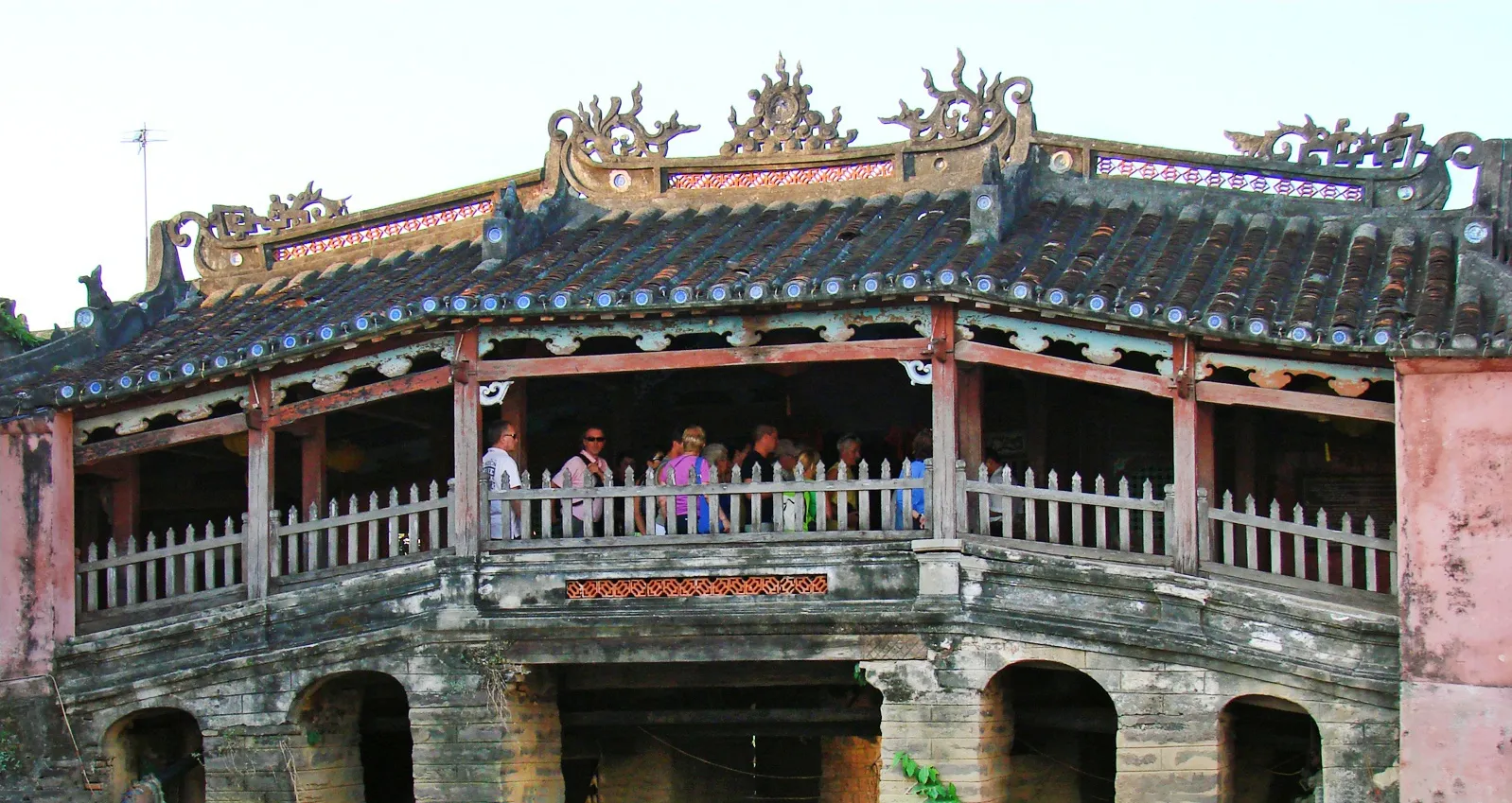
Architecture
The Japanese Covered Bridge represents a physical meeting point of three distinct architectural traditions:
Japanese structural contribution: The bridge's basic structural logic — a covered wooden bridge on stone foundations with rain protection — follows Japanese carpenter traditions of the Edo period, when Japanese merchants in Hoi An maintained close connections with carpenter guilds at home. The original timber selection (hardwoods suited to tropical humidity) reflects Japanese knowledge of wood species appropriate for humid maritime climates.
Chinese decorative layers: The ceramic tile roof, the decorative screens, the altar furnishings of the small temple, and the carved animal figures at the entrances reflect Chinese decorative traditions imported by the craftsmen who maintained and expanded the bridge through the 18th century, after the Japanese community had departed following the sakoku closure.
Vietnamese adaptation: The bridge's maintenance since the 19th century has been managed by Vietnamese conservation authorities, who added the characteristic Vietnamese curved roofline tiles and the coloured tile decorative bands that give the bridge's exterior its current appearance.
Historical Significance
The bridge's historical significance extends beyond architecture into economic and diplomatic history. Its construction in the early 17th century physically embodied the cooperative commercial relationship between the Japanese and Chinese merchant communities in Hoi An — two groups that, in their home countries, were simultaneously engaged in the complex political tensions of East Asian regional trade rivalries.
That these two communities would collaborate to build shared infrastructure in a Vietnamese port city — infrastructure that also incorporated a Taoist deity acceptable to both Buddhist-influenced Japanese merchants and Taoist-practicing Fujian Chinese traders — illustrates the pragmatic cultural negotiations that made Hoi An's multicultural trading community work. The bridge is not merely a pretty structure: it is evidence that pre-modern Southeast Asian trade created forms of intercultural cooperation that the merchants' home countries did not practice.
After Japan's sakoku policy ended Japanese overseas merchant communities in the 1630s, the bridge became a Vietnamese monument commemorating a community that no longer existed — a role it has occupied for nearly 400 years, outlasting the Japanese community it served by the equivalent of several generations.
When to Visit
- Access hours: The bridge is accessible as a public crossing 24 hours — it remains a functional pedestrian bridge
- Temple entry (included in combined ticket): Daily 8:00 AM – 5:00 PM
- Best photography time: 7–9 AM on a weekday morning — low light from the east, minimal tourists, and the bridge's reflection visible in the canal below
- Full Moon Festival: On the 14th night of the lunar month, the bridge is lit only by lanterns and candles — the most atmospheric photography window of the month
- Crowd peak: 10 AM – 4 PM daily; the bridge is narrow and can feel congested with tour groups during these hours
- Quietest visiting window: Weekday mornings before 9 AM and weekday evenings after 6 PM
Admission and Costs
- Crossing the bridge (pedestrian use): Free
- Temple entry (Chua Cau): Included in the 120,000 VND Ancient Town combined ticket — one of the five heritage sites covered
- Guided interpretation: Most Hoi An Ancient Town walking tours include the bridge; private guide rates for the full Ancient Town run 1,000,000–1,800,000 VND per day for up to four people
Tips for Visitors
- Optimal photography position: Stand on the canal bank below Tran Phu Street and photograph from water level — the perspective from beneath shows the bridge's curve and the small temple above the arch most clearly
- Banknote comparison: Bring a 20,000 VND note and compare the banknote image to the real bridge from the Tran Phu Street approach — a good conversation-starter with local guides
- Shoes off for the temple: The small temple inside the bridge requires shoes removed before the altar area — a small gesture of respect that guards occasionally remind visitors about
- Morning light from the east: The bridge faces roughly east-west; morning light illuminates the Chinese-quarter end (eastern side) most beautifully; afternoon light suits the Japanese-quarter (western) side
- Combined with market morning: Start at the Central Market at 6 AM, walk Tran Phu Street to the bridge by 7:30 AM for the quietest photography window, then continue to Phuc Kien Assembly Hall when it opens at 8 AM
Frequently Asked Questions
Who built the Japanese Covered Bridge and why?
The bridge was constructed in the early 17th century by the Japanese merchant community in Hoi An — most historians date it to approximately 1593, though the current structure reflects subsequent renovations through the 18th century. Its Vietnamese name is Lai Vien Kieu ("Bridge for Receiving Distant Travellers"), while its Sino-Vietnamese name Nhat Ban Kieu means simply "Japanese Bridge." The Japanese community built it to connect their residential and commercial quarter (on the western side of the canal) with the Chinese merchant quarter to the east — facilitating the daily commerce between the two largest foreign trading communities in Hoi An. The small temple built into the bridge's arch was dedicated to Tran Vo Bac De, a Taoist deity associated with weather and the northern sky — an appropriate patron for a merchant community whose livelihoods depended on maritime weather. After Japan's sakoku (closed country) isolationism policy took effect in the 1630s, the Japanese community in Hoi An gradually dissolved, but the bridge they built became the town's defining symbol.
What is the significance of the Japanese Covered Bridge being on the 20,000 VND banknote?
The 20,000 Vietnamese Dong banknote depicts the Japanese Covered Bridge on its reverse side — a deliberate choice by the State Bank of Vietnam to represent Vietnamese cultural heritage in everyday currency. Being selected for a banknote denomination in common circulation is one of the strongest signals of national cultural significance a building can receive; in Vietnam's case, the bridge was chosen over Hanoi's imperial monuments and Ho Chi Minh City's colonial landmarks specifically because it represents the unique fusion of cultures — Japanese construction, Chinese decoration, Vietnamese function — that makes Hoi An's heritage internationally distinctive. Visitors who arrive with 20,000 VND notes can compare the banknote image to the bridge from the optimal photography position on the Tran Phu Street side.
Was the Japanese Covered Bridge recently restored and why is there controversy?
The bridge underwent a major structural restoration from 2022 to 2024, during which scaffolding covered the entire structure and photographic access was severely limited — a source of frustration for visitors and considerable controversy among Vietnamese heritage experts and international travel communities. The restoration was required because the bridge's original 17th-century timber foundations had deteriorated to a point where structural failure was a genuine risk. The conservation authority chose a restoration approach that used new timber cut to original specifications rather than synthetic conservation materials — consistent with the approach used on historic Japanese buildings like Ise Jingu. The bridge reopened in 2024 with its structural integrity preserved; the debate about whether the replacement of significant original material compromises its heritage value continues among architectural conservation specialists. A guide who followed the restoration can explain what changed, what was preserved, and why the decisions were made.