
Observation Spots
Seasonal Highlights
The bat colony at Waugh Drive offers one of the most spectacular urban wildlife displays in the country. Why did 250,000 Mexican free-tailed bats choose this particular bridge? Guides explain that the colony consumes roughly 2,500 pounds of insects every night, providing a service no pesticide programme could match. The bats' echolocation, their seasonal migration patterns, and their role in the broader Houston ecosystem become part of the spectacle rather than afterthoughts.
Spring brings the park's restored prairies alive with Texas wildflowers from March through May, drawing butterflies and migratory songbirds to the meadows above the bayou. Summer belongs to the water — golden-hour kayak paddles and the nightly bat show — while the Fourth of July fills Eleanor Tinsley Park, the park's eastern lawn, with the Freedom Over Texas festival and fireworks over the skyline. Autumn is the reward for surviving the summer, with comfortable temperatures returning by October. Houston floods with a regularity that shapes every aspect of the city's infrastructure, and Buffalo Bayou sits at the centre of that ongoing struggle between development and drainage; the park's retention basins and sloped banks are engineered to disappear underwater and re-emerge. After exploring the bayou, continue to Hermann Park for a different expression of Houston's green spaces.
Activities
Waugh Drive bat colony: Roughly 250,000 Mexican free-tailed bats swirl out from beneath the bridge each evening from March through November, one of the most spectacular urban wildlife displays in the country. Kayaking under the murals: Paddling beneath highway overpasses decorated with colourful murals and light installations is a uniquely Houston experience that combines outdoor recreation with unexpected public art.
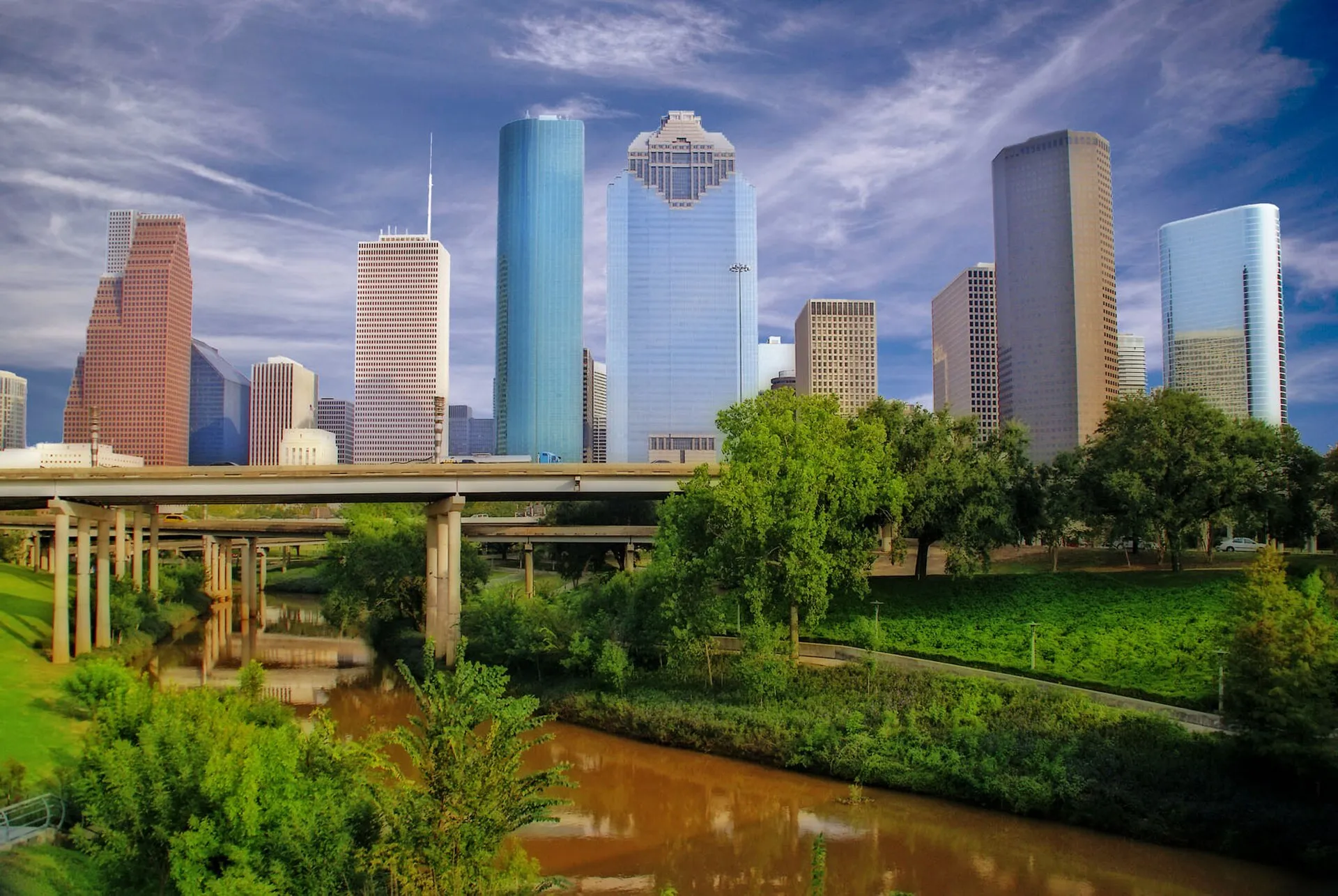
The Cistern tours: The 1926 underground reservoir — 221 columns, an 87,500-square-foot floor, and a 17-second echo — hosts guided history tours and immersive light-and-sound art. Johnny Steele Dog Park: A beautifully landscaped off-leash area with separate small-dog sections, water features for splashing, and shade structures overlooking the bayou. Skyline views from the eastern trails: The stretch between Sabine Street and downtown offers postcard-perfect views of Houston's skyscrapers reflected in the bayou water, especially at sunset. Public art walk: The Tolerance sculptures of kneeling figures built from steel letters, the granite ziggurat of the Police Officers Memorial, and the coloured lighting of the Sabine Promenade reward a slow stroll along the banks. Native wildflower meadows: Restored prairies and wetlands showcase Texas wildflowers in spring (March-May), attracting butterflies and migratory songbirds. Barbara Fish Daniel Nature Play Area: A nature-inspired playground for children featuring climbing logs, sand areas, water play streams, and spaces designed to connect kids with the outdoors. Rosemont Pedestrian Bridge: An elegant suspension bridge connecting the north and south banks of the bayou, offering elevated views of the park and passing kayakers below.
Buffalo Bayou Park timeline
-
The bayou founds Houston
The Allen brothers found Houston at the head of navigation on Buffalo Bayou, using the slow tidal stream as the shipping channel that carried cotton and commerce to the young republic's new town.
-
The underground Cistern is built
The city sinks a vast reinforced-concrete reservoir beside the bayou as Houston's first underground drinking-water store — 87,500 square feet beneath 221 columns, forgotten by most residents for decades.
-
Buffalo Bayou Partnership formed
The non-profit Buffalo Bayou Partnership is founded to revitalize the neglected, flood-scarred waterway, beginning the long campaign to reclaim it from drainage ditch to public parkland.
-
The Cistern is decommissioned
An irreparable leak takes the 1926 reservoir out of service; slated for demolition, its remarkable acoustic chamber is instead spared and later opened to the public.
-
The $58 million park opens
A transformation led by landscape architects SWA Group and anchored by a Kinder Foundation gift reshapes the floodplain into 160 acres of native prairie, sculpted hills, and hike-and-bike trails.
-
The Cistern opens to visitors
After restoration, the underground reservoir reopens for guided tours and immersive art installations, becoming one of the park's most distinctive draws.
-
Hurricane Harvey submerges the park
Harvey's floodwaters bury the park under the bayou for days; because it was engineered to flood, the sloped banks and native plantings largely recover once the water recedes.
When to Visit
Park hours: Open daily from 6 AM to 11 PM; trails are lit for evening use. Kayak and paddleboard rentals: Thursday through Sunday, typically 8 AM to sunset; reservations strongly recommended on weekends. Bat emergence: Visible from March through November, beginning 15-30 minutes after sunset at the Waugh Drive Bridge viewing platform. The Cistern: Guided and self-guided tours run Wednesday through Sunday, on timed tickets booked separately from park entry.
Best for running and cycling: Early mornings before 9 AM, when temperatures are tolerable and trails are uncrowded. Best for kayaking: Late afternoon when golden-hour light illuminates the downtown skyline from the water. Best for the bats: Arrive 30 minutes before sunset in spring or fall. Avoid: Midday from May through September, when temperatures above 95 degrees F with full humidity make outdoor activity punishing.
Admission and Costs
Park entry: Completely free, including all trails, playgrounds, dog park, and the bat viewing platform at Waugh Drive. Single kayak rental: $25 per hour from the Lost Lake Visitor Center (Thursday through Sunday). Stand-up paddleboard rental: $30 per hour. Tandem kayak: $35 per hour. The Cistern: roughly $5 on general-admission days and about $12 for a guided history tour, with proceeds supporting the Buffalo Bayou Partnership. Guided naturalist tour of the park: $30-50 per person for a 90-minute walk covering ecology, flood infrastructure, and the bat colony. Private guided kayak tour: $100-175 per person for a 2-hour paddle with an expert naturalist.
The Case for a Guide
Paddling beneath graffiti-covered bridges or watching 250,000 bats spiral into the sunset creates spectacle, but spectacle without context remains surface entertainment. Naturalist and history guides transform Buffalo Bayou from a pretty park into a living textbook of urban ecology, flood engineering, and public art.
- The bat colony explained: Why did 250,000 Mexican free-tailed bats choose the Waugh Drive Bridge specifically? Guides answer while you watch the nightly emergence, explaining that the colony consumes roughly 2,500 pounds of insects every night — and what their echolocation, migration patterns, and ecosystem role reveal about urban wildlife.
- Ecology of the restored waterway: Guides identify great blue herons, turtles, and returning egrets, explaining how carefully selected native plantings filter stormwater before it reaches Galveston Bay — cleaning Houston's runoff through the same natural processes that predated the city.
- Flood infrastructure hidden in plain sight: Houston floods with a regularity that shapes every aspect of the city's design; guides reveal the retention basins, sloped banks, and engineering compromises built into the park — the same features that let it survive Hurricane Harvey in 2017 and re-emerge within weeks.
- The Cistern's story: The 1926 underground reservoir, decommissioned in 2007 and reopened in 2016, is invisible from the trails; guides explain how a doomed water tank with a 17-second echo became one of Houston's most atmospheric art spaces.
- Public art beneath the overpasses: The murals, the light-washed Sabine Promenade, the Tolerance sculptures, and the granite Police Officers Memorial tell stories of Houston's immigrant communities and industrial past — context that transforms colourful walls into a chapter of the city's social history.
- Connections beyond the park: After the bayou, guides connect the experience to the Museum District and Hermann Park, building a coherent Houston day that balances outdoor exploration with the city's cultural institutions.
Tips for Visitors
Arrive early for bats: The Waugh Drive viewing platform gets crowded on weekends; stake out a spot 30 minutes before sunset for the best sightline. Bring mosquito repellent — you're standing near water at dusk. Book the Cistern ahead: Tours run on timed tickets that sell out on weekends, so reserve online before you arrive rather than hoping for a walk-up slot. Hydrate aggressively: Houston's humidity is brutal. Bring a refillable water bottle and plan to drink more than you think you need, even on cooler days. Reserve kayaks online: Weekend afternoon slots fill up quickly, especially in spring and fall when weather is most pleasant; book at least a day ahead. Use the hike-and-bike trail: The 6-mile paved trail connects to downtown and the Heights neighborhood, making it possible to bike into the park from elsewhere in central Houston. Pair with downtown: The park's eastern trailhead at Sabine Street is steps from Houston's downtown tunnel system and the Market Square historic district, making it easy to combine outdoor time with urban exploration. Combine with the Museum District: A morning along the bayou followed by an afternoon in the free museums makes a well-rounded Houston day without spending on admission. Parking: Free lots are available at the Lost Lake Visitor Center and near the Waugh Drive Bridge; street parking is also available along Allen Parkway.
Frequently Asked Questions
What months are ideal for visiting Buffalo Bayou Park?
March through April and October through November offer the most comfortable conditions, with mild temperatures in the 70s and the bat colony in full residence beneath the Waugh Drive Bridge. Avoid June through September when Houston's punishing humidity and temperatures above 95 degrees make outdoor activity along the exposed trails genuinely miserable.
What are the hours and rental options at Buffalo Bayou Park?
Park hours: Open daily from 6 AM to 11 PM; trails are lit for evening use. Kayak and paddleboard rentals: Thursday through Sunday, typically 8 AM to sunset; reservations strongly recommended on weekends. The underground Cistern runs guided tours Wednesday through Sunday and must be booked separately.
Is Buffalo Bayou Park free to enter?
Park entry: Completely free, including all trails, playgrounds, dog park, and the bat viewing platform. Single kayak rental: $25 per hour from the Lost Lake Visitor Center. The Cistern tour is a low-cost add-on, roughly $5 on general-admission days and about $12 for a guided history tour.
What tips help visitors see the bat colony at Buffalo Bayou Park?
Arrive early for bats: The Waugh Drive viewing platform gets crowded on weekends; stake out a spot 30 minutes before sunset for the best sightline. Bring mosquito repellent — you're standing near water at dusk. The bats emerge from March through November, beginning 15 to 30 minutes after sunset.
How do you get to Buffalo Bayou Park and where do you park?
By car: Free lots sit at the Lost Lake Visitor Center (1300 Allen Parkway) and near the Waugh Drive Bridge, with additional street parking along Allen Parkway and Memorial Drive; arrive before mid-morning on spring and fall weekends when lots fill. On foot or bike: The 6-mile hike-and-bike trail links the park directly to downtown, Montrose, and the Heights, and the eastern trailhead at Sabine Street is a short walk from downtown Houston.
What is the Cistern at Buffalo Bayou Park?
The Cistern is Houston's first underground drinking-water reservoir, built in 1926 and decommissioned in 2007 after an irreparable leak. Reopened for public tours in 2016, its cathedral-like chamber holds 221 concrete columns 25 feet tall and produces a haunting 17-second echo. It now hosts guided history tours and rotating light and sound art installations; tickets are timed and separate from park admission.