
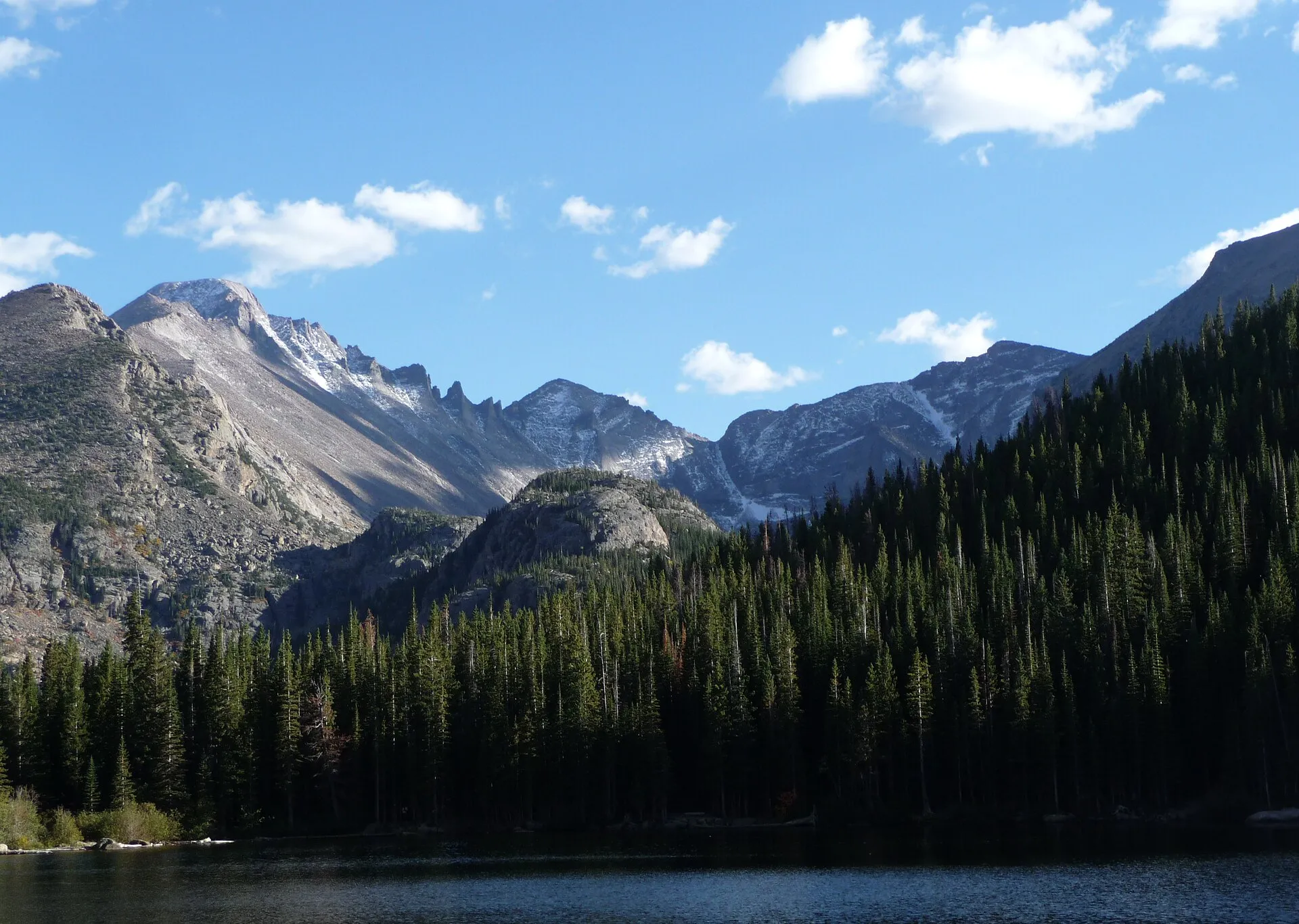
Formation
The rock underfoot is staggeringly old. The park's core is Precambrian metamorphic schist and gneiss formed as much as 1.7 billion years ago, later intruded by the pale Silver Plume Granite -- roughly 1.4 billion years old -- that builds the sheer east face of Longs Peak. For most of the last billion years this basement lay buried; the mountains you see today are a geologically recent arrival.
The modern range rose during the Laramide Orogeny, beginning about 70 million years ago, when tectonic forces heaved the ancient basement thousands of feet skyward. Ice did the sculpting. Through the Pleistocene, valley glaciers -- most recently the Pinedale glaciation, which peaked some 20,000 years ago -- gouged the U-shaped valleys, amphitheatre-like cirques, and the moraines that now dam lakes such as Bear Lake, as the U.S. Geological Survey and NPS geologists describe.
People have followed the seasons into this high country for more than 10,000 years; Ute and Arapaho hunters crossed the tundra on routes that Trail Ridge Road still roughly traces. The Missourian Joel Estes first rode into the valley now called Estes Park in 1859. Naturalist Enos Mills, later honoured as the park's founding advocate, campaigned from 1909 until President Woodrow Wilson signed the park into being on January 26, 1915, as the park's own history recounts.
In 1976 UNESCO named Rocky Mountain a Biosphere Reserve, recognising the tundra, forests, and wetlands packed inside its boundaries. More than a century of federal protection has kept the skyline essentially unchanged since Mills's day -- a rare constancy among American landscapes.
Wildlife
Elk are the park's signature animal. Several thousand range across the meadows of Moraine Park, Horseshoe Park, and the Kawuneeche Valley, and from late September into October the autumn rut turns dawn and dusk into theatre as bull elk bugle and spar for harems -- one of North America's great wildlife spectacles, best watched from behind the park's 75-foot minimum distance.
Rocky Mountain bighorn sheep, Colorado's state animal, descend in late spring and early summer to the mineral licks at Sheep Lakes in Horseshoe Park, where rangers sometimes halt traffic to let the herd cross the road. Moose, re-established on the wetter western slope, browse the willow thickets of the Kawuneeche Valley near Grand Lake, where they are far easier to spot than on the Estes Park side.
The tundra has its own residents. The pika, a hamster-sized relative of the rabbit, harvests wildflowers into hay piles among the rocks and chirps alarms at passers-by, while the yellow-bellied marmot suns itself on boulders near Rock Cut. Mule deer, coyotes, black bears, and more than 280 recorded bird species round out a cast that the park's naturalists help visitors find and read.
Trails
More than 355 miles of trail thread the park, and the Bear Lake corridor holds its greatest hits. From the lake at 9,450 feet, an easy half-mile loop circles the water beneath Hallett Peak, while a steady climb strings together Nymph, Dream, and Emerald Lakes, a staircase of glacial tarns. Stronger hikers push past the Timberline Falls scramble to Sky Pond, one of Colorado's most photographed alpine basins.
Elsewhere, the gentle path to Alberta Falls suits families, Gem Lake in the Lumpy Ridge area rewards a short climb with granite domes and valley views, and the one-way gravel of Old Fall River Road -- the park's original 1920 motor route -- offers a slow, adventurous alternative to Trail Ridge Road. The ultimate objective is Longs Peak: its Keyhole Route is a strenuous Class 3 scramble of roughly 15 miles round trip that the park rightly treats as mountaineering, not hiking.
When to Visit
The park is open 24 hours a day, year-round, but the mountains set the calendar. Late June through early September brings the fullest access -- all of Trail Ridge Road open, tundra wildflowers at their July peak, and the most settled weather, though afternoon thunderstorms still build almost daily by 1-2 PM at altitude, so plan to be off exposed ridges by noon.
Trail Ridge Road itself is usually plowed open from late May to mid-October; snow can close it in any month. Late September into October is elk-rut and golden-aspen season -- cooler, quieter, and spectacular. Winter locks the high country in snow, but lower east-side trails stay open for snowshoeing, and the Beaver Meadows and Kawuneeche visitor centres run year-round on reduced winter hours.
From late May through mid-October, a timed-entry reservation is required during daytime hours, and a separate, earlier-selling permit covers the busy Bear Lake Road corridor. Reservations release in monthly batches on recreation.gov and vanish within minutes, so set a reminder and book the moment your dates open.
Admission and Costs
Entry follows the National Park Service fee schedule: a private vehicle pays $30 for one day or $35 for a seven-day pass; motorcycles pay $25/$30; and individuals on foot or bicycle pay $15/$20. A park-specific annual pass costs $70, while the $80 America the Beautiful interagency pass covers every U.S. national park for a full year and pays for itself in three visits.
Those fees are separate from the timed-entry reservation, which carries a small $2 processing charge on recreation.gov. Guided day trips from Denver typically run $150-250 per person for 8-10 hours including transport, while private naturalist guides working inside the park charge more for small, custom-built groups. Children under 16 enter free, and the fee is waived on a handful of federal free-entrance days each year.
The Case for a Guide
Wildlife-watching rewards local knowledge. A naturalist guide carries a spotting scope and years of field notes on which meadows elk favour at first light during the rut, which cliff bands bighorn traverse in early summer, and which willow flats hide moose. That turns a hopeful drive-through into a sequence of near-certain sightings, with the animal behaviour explained as you watch.
Altitude is the other reason to hire help. Much of the park sits above 9,000 feet, with trails climbing past 12,000, and altitude sickness strikes regardless of fitness. Experienced guides pace the ascent, watch their group for symptoms, and carry first aid, while handling the logistics that devour a self-planned day -- the timed-entry permit, the dawn dash for trailhead parking, and the retreat from exposed terrain before the afternoon storms.
With routes ranging from wheelchair-accessible boardwalks to the Class 3 scramble up Longs Peak, matching the trail to your party matters. A guide builds the day around your fitness and interests, explains how glaciers ground out the valley you are standing in, and positions you for the light -- Bear Lake at sunrise, Moraine Park for elk at dusk, and a Trail Ridge overlook for alpenglow on distant summits.
Tips for Visitors
Acclimatise before you climb. Spend a day or two in Denver at 5,280 feet before attempting a strenuous high-altitude hike, and drink roughly twice your usual water. Pack for every season regardless of the city forecast -- a rain shell, a warm layer, a sun hat, and sunscreen -- because tundra weather flips in minutes and the thin air sunburns fast.
Start early and choose your approach. Trailhead lots fill by 7-8 AM in summer, so set a recreation.gov reminder for timed-entry release dates. The Grand Lake entrance on the west side is far less crowded than Estes Park and offers lakeside lodging and dining. And despite the altitude warnings, no bear spray is needed here -- the park has only shy black bears, not grizzlies, and encounters on the trail are rare.
Frequently Asked Questions
When is Trail Ridge Road open in Rocky Mountain National Park?
Park access: open 24 hours a day, 365 days a year. Trail Ridge Road: typically plowed open late May through mid-October, though snow can close it in any month.
How much does it cost to access Rocky Mountain National Park?
Park entrance: $30 per vehicle for a single day or $35 for a 7-day pass; $15 per person on foot or bike. Annual pass: $70 for RMNP or $80 for the America the Beautiful interagency pass.
Do you need a reservation for Rocky Mountain National Park?
Yes, in season: a timed-entry reservation is required during daytime hours from late May through mid-October, with a separate permit for the Bear Lake Road corridor. Book early on recreation.gov -- permits sell out within minutes.