
Denver Union Station timeline
-
The first depot opens
Denver's railroads consolidate their separate stations into one Union Depot, designed by William E. Taylor of Kansas City and opened on 1 June 1881, making the young city a railroad crossroads.
-
Fire and Romanesque rebuild
A fire that began in the women's restroom guts the central block; the Kansas City firm Van Brunt & Howe rebuilds it in heavy Romanesque Revival stone, flanked by the surviving 1881 wings.
-
The Mizpah welcome arch
A 70-ton steel arch strung with more than 2,000 light bulbs is dedicated on 4 July 1906 across Wynkoop Street, greeting arriving passengers with the Hebrew blessing "Mizpah."
-
The Beaux-Arts Great Hall
The Denver firm Gove & Walsh replaces the central portion with the soaring Beaux-Arts hall that defines the building today, keeping the 1881 wings on either side.
-
The arch comes down
The Mizpah Arch is dismantled as an automobile traffic hazard, ending 25 years as the ceremonial threshold between the station and downtown Denver.
- 1950s
TRAVEL BY TRAIN
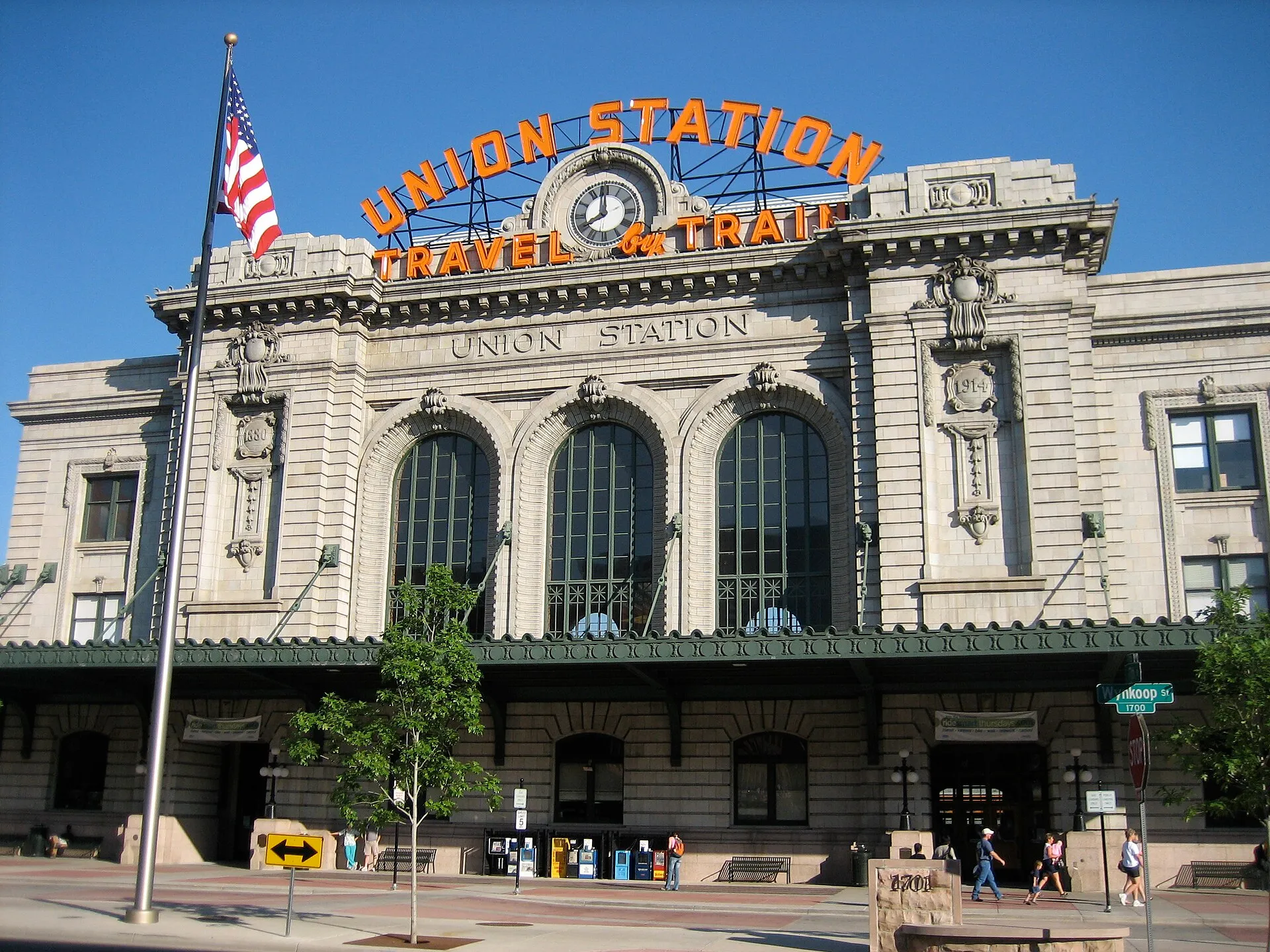
As rail travel declines, the orange "UNION STATION / TRAVEL BY TRAIN" signs are mounted on both faces of the building - the rooftop landmark still visible from blocks away today.
-
National Register listing
Denver Union Station is added to the National Register of Historic Places, protecting the fabric that the LoDo revival would later build upon.
-
The doors close for restoration
The main building closes on 1 December 2012 so the Union Station Alliance can begin a 99-year-lease restoration, with the rail yard behind it rebuilt as a modern transit hub.
-
Reborn as Denver's living room
After a $54 million restoration the station reopens on 26 July 2014 with the 112-room Crawford Hotel, ten independent restaurants and shops, and the Great Hall as a public lounge.
-
The airport train arrives
RTD's A Line commuter rail opens in April 2016, linking Denver International Airport to the station's open-air train hall in about 37 minutes.
Historical Significance
Three building campaigns are layered into Union Station, and tracing its layered history is the key to reading the structure. The first depot, designed by William E. Taylor of Kansas City, opened on 1 June 1881 and made Denver a railroad crossroads. A fire that began in the women's restroom gutted the central block in 1894, rebuilt in Romanesque Revival stone by the firm Van Brunt & Howe.
The Beaux-Arts central hall that defines the building today replaced that section in 1914, designed by the Denver firm Gove & Walsh and flanked by the surviving 1881 wings. Out front, the Mizpah Arch -- a 70-ton welcome arch strung with over 2,000 bulbs and dedicated on 4 July 1906 -- greeted arriving passengers until it was torn down as a traffic hazard in 1931.
Denver's story cannot be separated from the railroads that built it, and the station sits at the centre of it. The tracks running through the building connected mining boom towns in the mountains to markets in the East, carrying the gold and silver that financed Colorado's growth. Workers from around the world laid those lines, and a guide connects the elegant Great Hall to the labour and capital that made it possible.
The station also anchors Lower Downtown, and understanding its role illuminates the broader LoDo renaissance. This district of Victorian warehouses was nearly demolished in the 1960s before preservationists recognised its value; today the brick buildings house breweries, galleries, and lofts. The walk from the station to Larimer Square -- Denver's first historic district -- traces that transformation.
The 2014 adaptive reuse, awarded for its preservation craft, is the newest layer. Under a 99-year lease the Union Station Alliance converted a sleepy Amtrak stop into a hotel-and-dining complex while keeping the historic fabric intact. A guide decodes these layers -- original terrazzo, restored ceiling medallions, deliberately mismatched furniture -- and extends the tour toward Red Rocks Amphitheatre and the Denver Art Museum.
Architecture
Union Station is Denver's most photogenic interior, and its details reward a slow, camera-in-hand circuit. The standout spots:
- The Great Hall. Sit in a leather wingback chair beneath the original chandeliers and shoot straight up at the coffered ceiling -- the single most-photographed frame in the building, best in soft late-afternoon light.
- The rooftop sign. The orange "UNION STATION / TRAVEL BY TRAIN" lettering, added during rail's postwar decline and visible for blocks, glows best at dusk against the twilight sky; frame it from Wynkoop Plaza.
- Terminal Bar. Order a craft cocktail at the bar set in the centre of the hall and photograph the room as a living social space, exactly as the designers intended.
- Tattered Cover Bookstore. Denver's beloved independent bookseller runs a shop inside the station -- browse Colorado history and Western literature between trains.
- The train-hall canopy. Walk out to the open-air platforms to catch the sweeping steel canopy that shelters Amtrak and light-rail passengers.
- Wynkoop Plaza after dark. The front plaza hosts seasonal food markets and the winter light display, the exterior's best evening shot.
Reading the facade deepens every frame: the central Beaux-Arts block of 1914 is bracketed by the older 1881 wings, so a single wide photograph captures more than a century of the building's evolution.
When to Visit
Great Hall: open daily 6:00 AM - 1:00 AM. Restaurants and shops: most open 7:00 AM - 11:00 PM, though hours vary by establishment. Transit operations: RTD light rail and bus service runs roughly 4:30 AM - 1:15 AM, and Amtrak's California Zephyr departs westbound in the early morning and eastbound in the evening.
Best time to visit: mid-morning on weekdays lets you appreciate the architecture without crowds, while Friday and Saturday evenings bring the hall's social scene to life. Seasonal events: holiday lighting from November to January transforms the Wynkoop Plaza frontage, and warmer months fill the plaza with food markets and outdoor gatherings.
Admission and Costs
Entry and exploring are completely free -- walk in anytime and admire the Great Hall. Budget only for what you consume:
- Dining: roughly $15-50 per person depending on the restaurant (Mercantile Dining & Provision, Stoic & Genuine, Pigtrain Coffee).
- Cocktails: $14-18 at Terminal Bar, served in the centre of the Great Hall beneath the chandeliers.
- Airport train: the RTD A Line reaches the station from Denver International Airport in 37 minutes for about $10.50 one way.
Guided LoDo walking tour: $25-40 per person for a 2-hour walk including Union Station history. Private architecture tour: $175-300 for groups up to 8, 2-3 hours covering the station and surrounding LoDo district -- compared with the ticketed Denver Art Museum nearby, the station itself costs nothing to experience.
The Case for a Guide
You can wander the Great Hall for free, but a guide turns a handsome lobby into the founding story of a railroad city. A local walking guide is worth it when you want to:
- Read the three building campaigns. Guides point out which walls belong to the 1881 depot, which stonework is the 1894 rebuild, and which detail is Gove & Walsh's 1914 Beaux-Arts hall.
- Follow the preservation story. The award-winning 2014 adaptive reuse balanced modern function with historic fabric; a guide shows you where the seams are and what was saved.
- Connect the station to LoDo. From here the walk extends to Larimer Square and the warehouse district the revival ultimately rescued.
- Handle the logistics. Restaurant introductions, the best photo stops, and the walking route, so you can concentrate on the story.
The station anchors most LoDo history and food tours, making it the natural first stop before heading out to Red Rocks Amphitheatre or the Denver Art Museum.
Tips for Visitors
Union Station works best as the hub of a wider downtown day, and a little planning sharpens the visit:
- Arrive by train: the A Line from Denver International Airport reaches the station in 37 minutes for about $10.50, so you can start your trip here rather than in a taxi queue.
- Reserve ahead: marquee tables like Mercantile Dining & Provision and Stoic & Genuine fill up, especially on weekends -- book a week or two out.
- Use it as a walking base: the station is the natural starting point for LoDo, Larimer Square, Coors Field, and the 16th Street Mall on foot.
- Work from a wingback chair: free WiFi runs throughout the Great Hall, a more inspiring office than any coworking space.
- Stay the night: if budget allows, the Crawford Hotel occupies the upper floors, its rooms designed around the building's original architecture.
- Rent a bike: Denver B-cycle stations sit directly outside -- ride the South Platte River trail, or chain the day westward to Red Rocks Amphitheatre.
Frequently Asked Questions
Is there a best season to visit Denver Union Station?
Denver Union Station is a year-round indoor destination with restaurants, cocktail bars, and the magnificent Great Hall providing a comfortable experience regardless of weather. That said, April through October lets you enjoy the Wynkoop Plaza outdoor events and the LoDo neighbourhood walk to Larimer Square without braving Denver's cold winters. The holiday season from November through January transforms the station's exterior and plaza into a spectacular winter light display that draws locals and visitors alike.
When can visitors tour Denver Union Station?
Great Hall: Open daily 6:00 AM - 1:00 AM. Restaurants and shops: Most open 7:00 AM - 11:00 PM (varies by establishment). Transit operations: RTD light rail and bus service runs approximately 4:30 AM - 1:15 AM.
How much is the entrance fee for Denver Union Station?
Entry and exploring: Completely free - walk in anytime and admire the Great Hall. Dining: $15-50 per person depending on restaurant (Mercantile, Stoic & Genuine, Pigtrain Coffee).
What is the highlight of Denver Union Station's interior?
The Great Hall: Sit in one of the leather wingback chairs beneath original chandeliers and look up at the coffered ceiling - this is Denver's most photogenic interior.
How do you get from Denver International Airport to Union Station?
The RTD A Line commuter train runs directly between Denver International Airport and Union Station in about 37 minutes for roughly $10.50 one way, with departures every 15 minutes. It arrives into the open-air train hall behind the historic building, so you step off the plane and into Denver's social heart without a taxi or rental car.
Where are the best photo spots at Denver Union Station?
Shoot straight up at the coffered ceiling and chandeliers from a leather wingback chair in the Great Hall for the signature frame. The orange rooftop UNION STATION / TRAVEL BY TRAIN sign glows best at dusk from Wynkoop Plaza, and the sweeping steel canopy over the open-air platforms makes a strong architectural shot.