
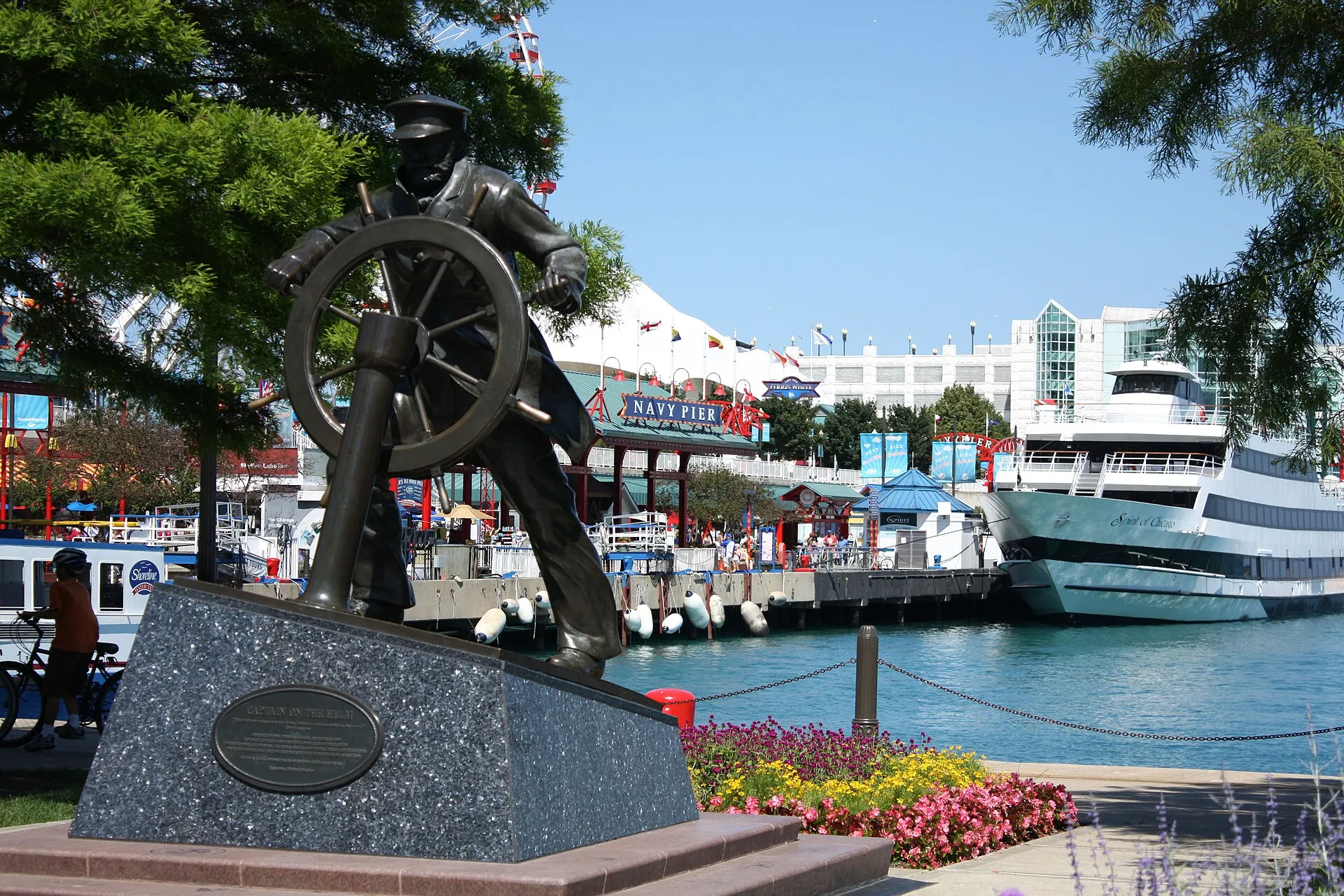
Seating Guide
From the climate-controlled gondolas of the Centennial Wheel, 196 feet above Lake Michigan, the Chicago skyline unfolds in every direction. Most riders enjoy the view without knowing what they are seeing. Guides name each landmark visible from the top: the X-braced Hancock Center, the bundled tubes of Willis Tower, Marina City's iconic corncob towers, and Lake Point Tower, which held the record as the world's tallest all-residential building when it opened in 1968. This aerial literacy transforms a carnival ride into an architectural education, with the entire history of Chicago's skyward ambition visible through a single pane of glass.
Navy Pier's own history spans more than a century of reinvention that the pier itself barely advertises. Built in 1916 as Municipal Pier No. 2 for shipping and public recreation, it served as a Navy training facility during both World Wars, educating thousands of aviators and mechanics in its Great Hall. The University of Illinois operated its undergraduate campus here in the postwar years, and the structure sat largely abandoned through the 1970s and 1980s before a $200 million renovation transformed it into the entertainment destination that now draws 9 million annual visitors. Guides unearth this layered past, pointing out historical photographs in the hallways and explaining how the pier's multiple lives mirror Chicago's own cycles of ambition, decline, and renewal.
Families discover that guided visits turn the pier into an interactive treasure hunt, connecting the Centennial Wheel's engineering to the Chicago Shakespeare Theater's courtyard design and the pyrotechnic choreography of the Wednesday and Saturday summer fireworks. The pier sits at the eastern end of a walking route that continues to the Magnificent Mile in fifteen minutes or Millennium Park in twenty-five, making it either the starting point or grand finale of a day exploring Chicago's lakefront.
Events Schedule
- Centennial Wheel at night: The climate-controlled gondolas mean comfort in any weather, and the nighttime views of the illuminated Chicago skyline reflecting off Lake Michigan are among the most photogenic in the city.
- Chicago Shakespeare Theater: A world-class repertory company performing in an intimate 500-seat courtyard theatre inspired by Shakespeare's own Globe, with a year-round season ranging from the Bard to bold new adaptations and its holiday productions.
- Summer fireworks: Wednesday (9:30 PM) and Saturday (10:15 PM) evening displays launched from barges just off the pier, synchronised to music and visible from the entire lakefront.
- Architecture river cruise: Board at the pier's south dock for one of the most popular tours in Chicago, a 75-minute narrated journey through the canyon of skyscrapers along the Chicago River.
- Pier-end panorama: Walk to the very tip of the 3,300-foot pier for a near 270-degree view of the skyline, the lake, and the coastline stretching south toward the Field Museum and Museum Campus.
- Rotating art and gardens: The pier's public art program rotates large-scale works — immersive light installations in Festival Hall, sculpture along the edge — while the glass-roofed Crystal Gardens stays green year-round.
- Dining with a view: Harry Caray's Tavern and the Billy Goat Tavern bring Chicago dining institutions right onto the pier, with lakefront tables during warm months.
When to Visit
Summer (Memorial Day-Labor Day): Sunday-Thursday 10:00 AM to 10:00 PM, Friday-Saturday 10:00 AM to midnight. Rest of year: Daily 10:00 AM to 8:00 PM (hours vary; check the pier's calendar for seasonal adjustments). Walking the pier itself is free and possible whenever the gates are open, but individual attractions keep their own hours — the Centennial Wheel and Pier Park rides run later in summer, while off-season the action shifts indoors.
- Best overall: Late afternoon into evening, when the sun drops behind the skyline and the Centennial Wheel lights up against the darkening lake.
- Fireworks: Wednesday and Saturday evenings in summer, typically at 9:30 PM (Wednesdays) and 10:15 PM (Saturdays). Arrive 30 minutes early for lakeside positioning.
- Winter: November through March the outdoor rides largely close, but the Chicago Children's Museum, Chicago Shakespeare Theater, the enclosed Crystal Gardens atrium, and the seasonal ice rink keep the pier worthwhile even in the cold.
- Avoid: Saturday afternoons in July and August bring the heaviest crowds, especially when combined with festivals or a Chicago Shakespeare matinee.
Admission and Costs
Pier entry is completely free — walking the deck, taking in the views, and watching the fireworks cost nothing, which makes Navy Pier one of Chicago's best-value outings before you add a single ride.
| Experience | Price | Notes |
|---|---|---|
| Centennial Wheel | $18 standard / $35 VIP | ~15 min; VIP adds leather seats and faster boarding |
| Pier Park rides | $8-14 each | Unlimited wristband $30-45 by season |
| Architecture river cruise | $45-65 | 75-90 min narrated, departs the south dock |
| Guided pier history walk | $25-40 | 90 min, covering a century of reinvention |
| Chicago Children's Museum | $17 | Free for children under 1 |
Buying a Centennial Wheel ticket bundled with a couple of Pier Park rides usually beats paying à la carte, and the architecture cruise is the single experience most worth reserving ahead in summer.
The Case for a Guide
Navy Pier reads as a carnival on the water, but that surface hides one of the most layered civic stories in Chicago, and a good guide is what makes the difference between a photo stop and an afternoon that sticks. The pier packs a Ferris wheel, a Shakespeare company, a children's museum, a cruise dock, and a century of reinvention into a single half-mile deck — without a thread to follow, most visitors ride the wheel, buy a hot dog, and leave having seen almost none of it.
A knowledgeable guide adds value by:
- Reading the skyline from the wheel — naming the Hancock Center, Willis Tower, Marina City, and Lake Point Tower so a 15-minute ride becomes a lesson in how Chicago invented the skyscraper.
- Surfacing the hidden history — the WWII aviator training, the "Harvard on the Rocks" university years, and the near-demolition that a redevelopment reversed in 1995.
- Timing the day — sequencing the Centennial Wheel, an architecture cruise, and the fireworks so you are never queuing at the busiest moment.
- Connecting the lakefront — folding the pier into a walking route to the Magnificent Mile, Millennium Park, and the Field Museum so the pier becomes the start or finale of a full day, not an isolated stop.
Tips for Visitors
- Skip the car. Parking at the pier garages can top $30 and the lines are brutal on weekends. The CTA bus #29 stops directly at the pier, and the free Navy Pier shuttle runs during peak season — both cheaper and faster than driving.
- Dress for the lake. The pier juts far into Lake Michigan, and the wind at the end can be fierce, especially in spring and fall. Bring a jacket even on warm days; temperatures at the pier's tip often run noticeably cooler than inland.
- Book cruises ahead. Architecture river cruises departing from Navy Pier sell out 2-3 days ahead during summer, so reserve online before arriving.
- Time the fireworks. For the best view, stake out a spot on the south side of the pier or along the lakefront trail south of the entrance, facing northeast, and arrive 30 minutes early.
- Walk from the Magnificent Mile. The pier is a 15-minute stroll east along Grand Avenue or Illinois Street, passing through Streeterville.
- Extend to Millennium Park. Head south on the lakefront trail for about 25 minutes to reach Cloud Gate, the Art Institute of Chicago, and the Pritzker Pavilion.
- Winter still works. The outdoor ice rink runs November through March, and paired with a Centennial Wheel ride it makes a festive cold-weather evening in Chicago.
Frequently Asked Questions
When is the best time of year to visit Navy Pier?
Memorial Day through Labor Day is the prime window, when the Centennial Wheel spins against Lake Michigan sunsets, free fireworks light up the sky on Wednesday and Saturday nights, and the rooftop terrace bars buzz with energy. September still offers warm weather with thinner weekday crowds. November through March the pier's outdoor attractions largely shut down and the brutal Lake Michigan winds make the exposed 3,300-foot structure bitterly cold, though the indoor Chicago Children's Museum and Shakespeare Theater remain open.
When can visitors attend events at Navy Pier?
Summer (Memorial Day-Labor Day): Sunday-Thursday 10:00 AM to 10:00 PM, Friday-Saturday 10:00 AM to midnight. Rest of year: Daily 10:00 AM to 8:00 PM (hours vary; check the pier's calendar for seasonal adjustments).
What do tickets cost at Navy Pier?
Pier entry: Completely free to walk the pier, enjoy the views, and watch the fireworks. Centennial Wheel: $18 for a standard ride (about 15 minutes), $35 for a VIP gondola with leather seats and faster boarding.
How should visitors prepare for Navy Pier?
Wind warning: The pier juts far into Lake Michigan, and the wind at the end can be fierce - bring a jacket even on warm days. Book architecture river cruises in advance as they sell out 2-3 days ahead during summer.
How do you get to Navy Pier?
Navy Pier sits at 600 East Grand Avenue in Streeterville, a 15-minute walk east of the Magnificent Mile. The CTA #29, #65, #66, and #124 buses all stop at the entrance, and the free Navy Pier shuttle connects to the Grand and Chicago Red Line stations during peak season. Driving is the slowest option: the pier's garages charge $30 or more on event days and back up badly on summer weekends.
What is the history of Navy Pier?
Navy Pier opened in 1916 as Municipal Pier No. 2, designed by architect Charles Sumner Frost as both a working shipping dock and a public playground. It was renamed in 1927 to honor Navy personnel who served in World War I, became a U.S. Navy training center during World War II, housed the University of Illinois's undergraduate campus from 1946 to 1965, then fell into disuse before a $200 million redevelopment reopened it as an entertainment destination in 1995.
Is Navy Pier accessible for visitors with mobility needs?
Yes. The pier is flat, paved, and step-free from end to end, with accessible restrooms, elevators to the upper levels, and wheelchair-accessible gondolas on the Centennial Wheel. Because the deck is long and exposed, plan for rest stops and lake wind, especially outside the summer months.