
Harvard University timeline
-
Harvard is founded
The Great and General Court of the Massachusetts Bay Colony votes to establish a college at Newtowne, soon renamed Cambridge — the first institution of higher learning in the English colonies.
-
Named for John Harvard
The dying minister John Harvard bequeaths his library of some 400 books and half his estate to the new college, which takes his name; the first printing press in British North America arrives at Cambridge the same year.
-
First commencement
Harvard confers degrees on its first graduating class of nine young men, beginning an unbroken line of American commencements.
-
The Harvard Corporation is chartered
The colonial legislature charters the President and Fellows of Harvard College, the oldest corporation in the Western Hemisphere and still the university's governing body.
-
Massachusetts Hall rises
The Georgian brick dormitory is completed; it survives as the oldest Harvard building and today houses the university president's office alongside first-year students.
-
Washington's troops in the Yard
During the Siege of Boston the Continental Army quarters soldiers in Harvard's halls while George Washington takes command in nearby Cambridge.
-
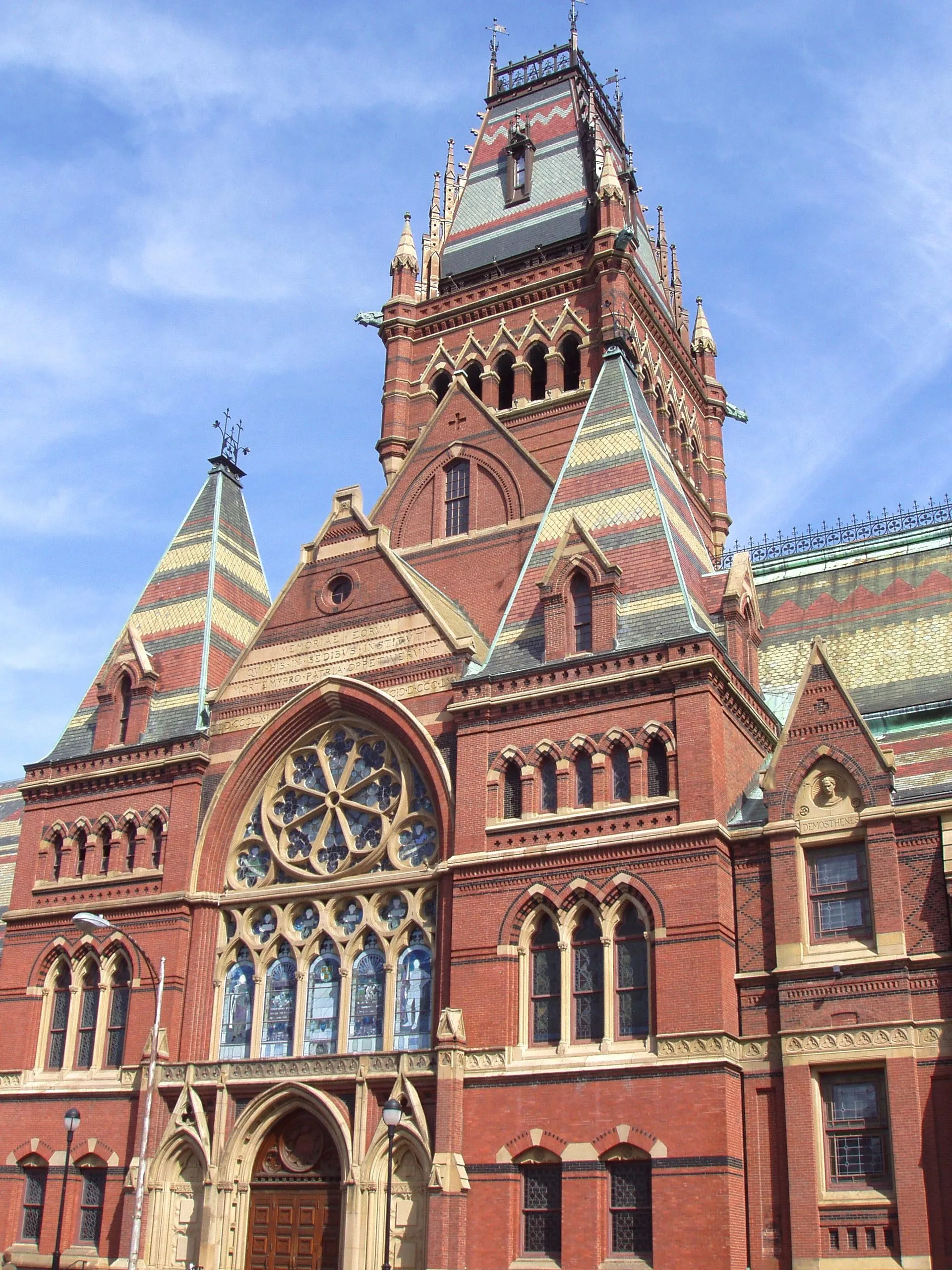
Memorial Hall completed
The polychrome Victorian Gothic hall, honouring the Harvard men who died for the Union in the Civil War, is finished, enclosing the acoustically renowned Sanders Theatre.
-
Women admitted through the Annex
The Harvard Annex begins instructing women, evolving into Radcliffe College and, more than a century later, merging fully into Harvard.
-
Widener Library opens
Funded by Eleanor Elkins Widener in memory of her son Harry, lost on the Titanic, the library opens as the monumental centrepiece of what becomes the world's largest academic library system.
-
Piano reimagines the Art Museums
Renzo Piano's renovation unites the Fogg, Busch-Reisinger, and Sackler collections under a single glass roof, flooding a central courtyard with daylight.
Historical Significance
The bronze John Harvard statue in Harvard Yard is the university's most photographed landmark, yet its inscription — "John Harvard, Founder, 1638" — contains three factual errors the institution has never corrected: Harvard was a benefactor rather than the founder, the college was established in 1636 rather than 1638, and the seated figure is not even Harvard, for no likeness of him survives and a 19th-century student sat as the model instead. Guides explain each "lie" while visitors rub the statue's left shoe for luck.
History is layered through the Yard. Massachusetts Hall, the oldest surviving Harvard building (1720), quartered George Washington's Continental Army troops during the Siege of Boston in 1775–76. Mark Zuckerberg wrote the first version of Facebook in his Kirkland House suite in 2004; T. S. Eliot composed early poems in his Harvard rooms; and W. E. B. Du Bois, the first African American to earn a Harvard PhD (1895), studied here before becoming the nation's foremost civil-rights intellectual.
The Widener Library, with its grand Corinthian colonnade, was given by the mother of Harry Elkins Widener, a young bibliophile who perished on the Titanic, and anchors a system of more than 20 million volumes — the largest academic library in the world.
Architecture
🦱 John Harvard statue and the "three lies": The campus's signature photo. Frame the seated bronze against University Hall's grey granite, rub the polished left shoe, then learn why the inscription gets the founder, the date, and the face all wrong.
📚 Widener Library: The sweeping Corinthian colonnade and monumental staircase are spectacular from the Yard even without entering; the story of its construction as a Titanic memorial is among the campus's most moving. 🎨 Harvard Art Museums: The combined Fogg, Busch-Reisinger, and Sackler collections sit under Renzo Piano's 2014 glass roof, whose top-lit central courtyard is the best interior photograph on campus — and admission is free to all.
🏆 Memorial Hall: The polychrome Victorian Gothic landmark, completed in 1878 to honor Harvard's Union dead, shelters Sanders Theatre, whose stage has hosted voices from Winston Churchill to Yo-Yo Ma; the stained glass and hammer-beam ceiling reward a look upward. 🐥 Glass Flowers: The Blaschka collection at the Harvard Museum of Natural History comprises roughly 4,300 botanically exact models crafted entirely from glass by a father-and-son team in Dresden between 1887 and 1936 — unique in the world.
🌿 Arnold Arboretum: Harvard's 281-acre living museum in Jamaica Plain, laid out with Frederick Law Olmsted, holds more than 15,000 plants; its lilacs draw crowds each May on Lilac Sunday. ⛺ Harvard Yard at dawn: Arrive before the tour groups to shoot the elm-shaded brick dormitories and the Johnston Gate — the Yard's oldest and grandest entrance — in soft morning light.
When to Visit
Harvard Yard and the surrounding paths are open 24 hours a day, year-round, and cost nothing to wander; most individual buildings, libraries, and residential houses require a university ID. Free student-led campus tours run through the Harvard Visitor Center at the Smith Campus Center, typically departing mid-morning and early afternoon on weekdays with extra weekend and summer slots. Because student guides keep to the academic calendar, confirm the day's departures and reserve a place through the official visitor pages before arriving.
The Harvard Art Museums are generally open daily 10 AM to 5 PM, now with free admission for everyone — a policy in place since 2022 — so always check the current days and hours on the museum's visit page.
The Harvard Museum of Natural History, home of the celebrated Glass Flowers, opens daily 9 AM to 5 PM, and a single ticket also admits you to the adjoining Peabody Museum of Archaeology & Ethnology (hours and details). The most rewarding time to visit is a weekday morning during term (September through May), when students stream between classes and the Yard is fully alive; summer brings easier tour availability but a quieter campus.
Admission and Costs
Wandering Harvard Yard and the wider campus is completely free — it is open public ground with no gates or admission. Student-led campus tours are also free and need no ticket, though spots are limited and groups cap around 20, so arrive about 15 minutes early or reserve through the Harvard Visitor Center.
Admission to the Harvard Art Museums is free to all visitors (confirmed on the museum's visit page), so the Fogg, Busch-Reisinger, and Sackler collections under Piano's glass roof cost nothing to see. The Harvard Museum of Natural History charges roughly $15 for adults and $10 for students, seniors, and children 3–18 (free under 3), and that ticket also covers the Peabody Museum next door — check current rates before you go. For a tailored experience, independent private guides run about $150–250 for a 90-minute campus walk for up to eight people.
The Case for a Guide
Harvard is wrapped in so many legends that separating documented history from campus folklore has become an art form. Guides cut through the mythology to reveal the real stories beneath the ivy — and ensure you find the hidden details that most self-guided visitors walk straight past.
- The three lies in Harvard Yard: The bronze John Harvard statue is the most photographed landmark on campus, yet its inscription contains three factual errors the university has never corrected; guides explain each one while visitors rub the polished left shoe for luck.
- Revolutionary and literary connections: Guides identify Massachusetts Hall (1720), the oldest surviving Harvard building, where Continental Army troops were quartered during the Siege of Boston — and pinpoint the Kirkland House suite where Mark Zuckerberg launched Facebook in 2004 and the rooms where T. S. Eliot wrote his earliest poems.
- Four centuries of architecture: From colonial brick dormitories in Harvard Yard to Renzo Piano's luminous 2014 glass canopy over the Art Museums, guides read the campus as a timeline of American intellectual life, explaining the stories behind Memorial Hall and Widener Library's Titanic connection.
- Hidden campus details: Tucked-away courtyards, gargoyles on building corners, and traditions like the Primal Scream before finals reward visitors who have an expert pointing them out.
- Insider perspective from student guides: Current undergraduates share firsthand insights about the application process, daily campus life, and what it means to study where eight United States presidents once walked the same paths.
Tips for Visitors
Harvard Station on the Red Line drops you straight into Harvard Square; from downtown Boston the ride runs about 15 minutes from Park Street. That same Red Line connects the Square directly to Boston Common and the start of the Freedom Trail, so Harvard pairs naturally with a day of Revolutionary-era history; afterwards you can stay on the line toward the New England Aquarium or ride the Green Line out to a game at Fenway Park.
In the Square itself, Mr. Bartley's Burger Cottage has fed students since 1960, and the Harvard Book Store on Massachusetts Avenue is one of America's finest independents. Treat the Yard as the working university it is: keep voices moderate near the dormitories and stay out of ID-restricted buildings.
Commencement in late May and freshman move-in in early September are atmospheric but crowded; spring and autumn weekdays are ideal. Most Yard paths are paved and step-free, and both museums are wheelchair accessible, though a few historic thresholds in the older halls are uneven.
Frequently Asked Questions
Which months are best for touring Harvard University?
May through August and October are the prime months, with the campus at its most photogenic when ivy covers the red brick dormitories and the ancient elms of Harvard Yard provide a shaded canopy. October fall foliage surrounding the Charles River is unforgettable. Student-led tours are most animated during the academic year (September-May), as current undergraduates bring genuine insider enthusiasm, though January and February can be brutally cold for an outdoor walking tour across the exposed Yard.
When can visitors tour Harvard University?
Campus grounds: Harvard Yard and surrounding paths are open 24 hours a day, year-round; most buildings require a university ID.
How much is the entrance fee for Harvard University?
Campus walking: Completely free; Harvard Yard is an open public space. Student-led tours: Free, no reservation needed; arrive 15 minutes early as groups cap at 20. The Harvard Art Museums are free to all; the Museum of Natural History charges a modest admission.
What should visitors know before visiting Harvard University?
Getting there: Harvard Station on the Red Line puts you in Harvard Square; from downtown Boston the ride is about 15 minutes from Park Street.
Where are the best photo spots at Harvard University?
The John Harvard statue in front of University Hall is the classic shot, best in early morning before tour groups gather. The Johnston Gate, Harvard Yard's oldest and grandest entrance, frames the red-brick dormitories, while the Corinthian colonnade and staircase of Widener Library make a dramatic backdrop.
For interiors, the top-lit central courtyard of the Harvard Art Museums under Renzo Piano's glass roof is the finest shot on campus, and admission is free. In autumn, the elms of Harvard Yard and the foliage along the Charles River turn gold around mid-to-late October.
Is Harvard University accessible for visitors with limited mobility?
Largely yes. The main paths through Harvard Yard are paved and step-free, and both the Harvard Art Museums and the Harvard Museum of Natural History are wheelchair accessible with elevators and accessible restrooms. Harvard Station on the Red Line is an accessible stop. A few of the oldest buildings, such as Massachusetts Hall (1720), have uneven historic thresholds, and some residential houses stay ID-restricted regardless of access needs; the free student-led campus tour keeps to accessible outdoor routes.