
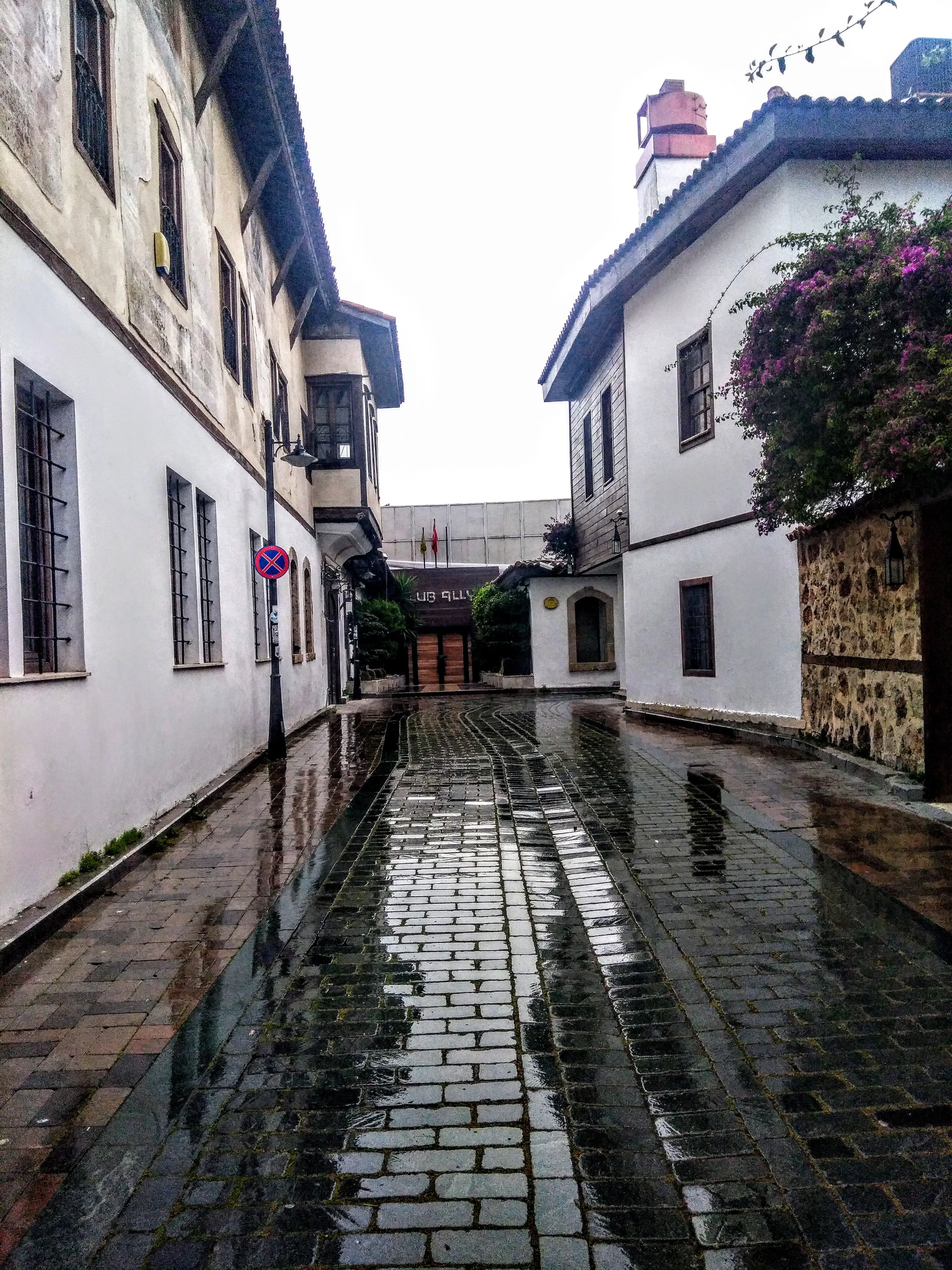
Walking Routes
The old town is compact enough to cross in twenty minutes, but the pleasure is in the detours. A classic top-to-bottom route follows the natural slope from the city walls down to the water:
- Start at Hadrian's Gate on Atatürk Caddesi, the marble arch of 130 CE that marks the northern threshold of the quarter.
- Cut south to the Kesik Minare (Broken Minaret), one building that has served as a Roman temple, a Byzantine church and an Ottoman mosque in turn — its truncated minaret lost its cap to fire in the 19th century.
- Continue to the Hıdırlık Tower, a cylindrical Roman monument of the 2nd century CE on the cliff edge, thought to have worked as both a lighthouse and a tomb for a Roman notable.
- Drop through Karaalıoğlu Park, a clifftop garden of palms and tea gardens with the widest open sea views in the city.
- Finish at the old harbour, the Roman-era port that stayed Antalya's working dock until the mid-20th century and is now a yacht marina ringed with restaurants.
Because the lanes fan out and rejoin, the smartest tactic when you lose your bearings is to head downhill toward the harbour, or uphill toward the Yivli Minare when you want to leave. A local guide is worth having here for the shortcuts between courtyards and for spotting the reused Roman blocks most visitors walk straight past.
Local Life
Kaleiçi is a lived-in neighbourhood as much as a monument, and much of its character comes from small institutions rather than headline sights. The Suna & İnan Kıraç Kaleiçi Museum, set in a restored Ottoman mansion with a former Greek Orthodox chapel as its exhibition hall, holds an absorbing collection of Çanakkale ceramics and ethnographic tableaux of Ottoman Antalya. The 18th-century Tekeli Mehmet Paşa Mosque, glazed inside with İznik-style tiles, is the district's finest Ottoman prayer hall and welcomes respectful visitors outside prayer times.
For food, the quarter splits in two. The harbour is where you go for a slow fish dinner with the boats bobbing below and the sun dropping into the sea — expect tourist prices but unbeatable atmosphere. The inland lanes are better value and more local: this is the place for a wood-fired gözleme folded by hand, a proper multi-plate Turkish breakfast under the orange trees, or a glass of tea in a courtyard where the resident cats will inevitably join you. Round it off with künefe, the cheese-and-shredded-pastry dessert soaked in syrup that southern Turkey does better than anywhere.
Above all, Karaalıoğlu Park is where Antalya families actually spend their evenings — a wide clifftop promenade of palms, rose beds and sea-facing benches, busiest at sunset when the light turns the Beydağları mountains pink across the bay.
When to Visit
Kaleiçi's streets never close — the quarter is a public right of way — so timing is really about light and heat. The golden hour before sunset shows the district at its best: low sun sets the ochre stone and timber balconies glowing and the harbour turns copper. Arrive mid-to-late afternoon, wander the shaded lanes as the temperature drops, then be at the water for the sunset. Early morning is the other sweet spot, when tour groups are still at breakfast and you can photograph Hadrian's Gate and empty cobbles in soft, even light.
For photographs, the strongest vantage points are the clifftop terraces of Karaalıoğlu Park and the ramparts by the Hıdırlık Tower (sea and mountains together), the marina steps looking back up at the tiered houses, and the framed view of the old town through Hadrian's triple arch. Seasonally, May, June and September deliver warm, clear evenings without the crush of high summer, while even January stays mild at 12–15 °C, though some rooftop bars and boutiques trim their hours until spring.
Admission and Costs
Wandering Kaleiçi itself costs nothing — the lanes, the harbour promenade and Karaalıoğlu Park are all free and open around the clock. Budget instead for the handful of paid sights and for eating:
- Suna & İnan Kıraç Kaleiçi Museum — around ₺60–100 ($2–3) entry.
- Yivli Minare mosque area — roughly ₺20–30 (under $1); the courtyard is free and modest dress is expected.
- Harbour boat trip — ₺150–300 ($5–10) for a short coastal cruise, some running east toward the Düden Waterfalls shoreline.
- Sit-down meal — ₺300–600 ($10–20) per person at a harbour fish restaurant, or far less, ₺120–200 ($4–7), for gözleme or a Turkish breakfast in the back lanes.
- Getting there — the AntRay tram to Kalekapısı or İsmetpaşa costs a single flat fare of a few lira, cheaper and easier than the scarce, metered parking inside the walls.
Prices swing with the lira, so treat the dollar figures as a guide rather than a fixed rate. Bargaining is still expected in the carpet and souvenir shops, though not in restaurants or museums.
The Case for a Guide
A stroll through Kaleiçi is rewarding on its own, but the quarter hides its history in plain sight, and that is where a knowledgeable local guide earns their fee. Because the streets stack twenty centuries on top of each other, the most interesting details are the easiest to miss — a Roman column drum built into a garden wall, the seam where Seljuk masonry meets Ottoman timber, the original road level surviving a full storey below today's cobbles.
A good guide will typically:
- Decode the layers, pointing out reused Roman, Byzantine and Seljuk stonework embedded in the Ottoman streetscape.
- Navigate the maze efficiently, linking Hadrian's Gate, the Kesik Minare, the Hıdırlık Tower and the harbour into one coherent walk instead of a run of dead ends.
- Open the right doors, knowing which courtyards, mansions and tea gardens welcome visitors and which are private homes.
- Explain the customs, from mosque etiquette at the Tekeli Mehmet Paşa Mosque to the unwritten rules of bargaining in the bazaar.
For deeper context on the wider region, many Kaleiçi walking tours pair the old town with Antalya's Roman sites, and reputable Turkey specialists can extend the day to Perge or Aspendos.
Tips for Visitors
A few practical notes make the old town easier going:
- Wear proper shoes. The cobbles are uneven and frequently steep; the climb back up from the harbour to Hadrian's Gate is the toughest stretch.
- Embrace getting lost. The lanes are short and the district is small, so wandering without a map is the best way to find the quiet courtyards — aim downhill for the sea, uphill for the Yivli Minare to reorient.
- Carry some cash. Small cafés, tea gardens and market stalls often prefer lira, even where the larger restaurants take cards.
- Dress modestly for mosques. Cover shoulders and knees, and women should bring a scarf for the Tekeli Mehmet Paşa Mosque and the Yivli Minare complex.
- Be cat-friendly. Kaleiçi's street cats are a beloved fixture; feeding them is fine, but the courtyard tea gardens would rather you not lure them onto the tables.
- Time the heat. In July and August, explore in the morning or after 4 pm and retreat to the shaded lanes or a waterfront terrace at midday.
Frequently Asked Questions
When is the ideal season to explore Old Town Kaleiçi?
May through September is the prime season, with long warm evenings perfect for dining at the harbour restaurants and strolling the Ottoman lanes as sunset light paints the stone facades golden. July and August are hot but the sea breeze and proximity to swimming spots offset the temperature. Antalya's mild Mediterranean winters around 12-15°C keep the old town pleasant even in January, though many boutique shops and rooftop bars reduce their hours or close until spring.
What time of day is best for exploring Old Town Kaleici?
The streets are open at all hours, so plan around light and heat rather than opening times. Late afternoon into the golden hour before sunset is ideal — the low sun warms the Ottoman stone and the harbour glows copper — while early morning gives you empty cobbles and soft light for photographing Hadrian's Gate. In high summer, skip the midday sun and explore the shaded inland lanes or a harbour-side terrace instead.
What are the key landmarks to see in Old Town Kaleici?
The essentials are Hadrian's Gate, the marble Roman arch of 130 CE at the northern entrance; the red-brick Seljuk Yivli Minare (Fluted Minaret) that crowns the skyline; the Kesik Minare, a single building raised over a Roman temple and a Byzantine church; the 2nd-century Hıdırlık Tower on the cliff edge; and the old harbour, now a yacht marina ringed with restaurants. Karaalıoğlu Park adds the finest open sea views in the city.
Is a walking tour of Old Town Kaleici worth it?
A guide turns a pleasant stroll into a journey through millennia, identifying Seljuk stonework embedded in Ottoman walls and leading you to the second-century Hidirlik Tower where Roman funeral customs are still debated by archaeologists.