
Plaza de Armas & Cathedral timeline
- 15th c.
Huacaypata, heart of the Inca world
Under the emperor Pachacutec, Cusco was rebuilt as the capital of Tawantinsuyu and the great square of Huacaypata became its ceremonial centre — a surface partly spread with sand carried from the Pacific coast, where the Inti Raymi sun festival and the empire's rituals were staged.
-
Spanish capture of Cusco
Francisco Pizarro's forces entered the Inca capital and began carving Huacaypata into a smaller Spanish plaza, parcelling the surrounding ground into lots for the conquistadors and the churches that would rise on Inca palace foundations.
-
Siege of Cusco and the Triunfo church
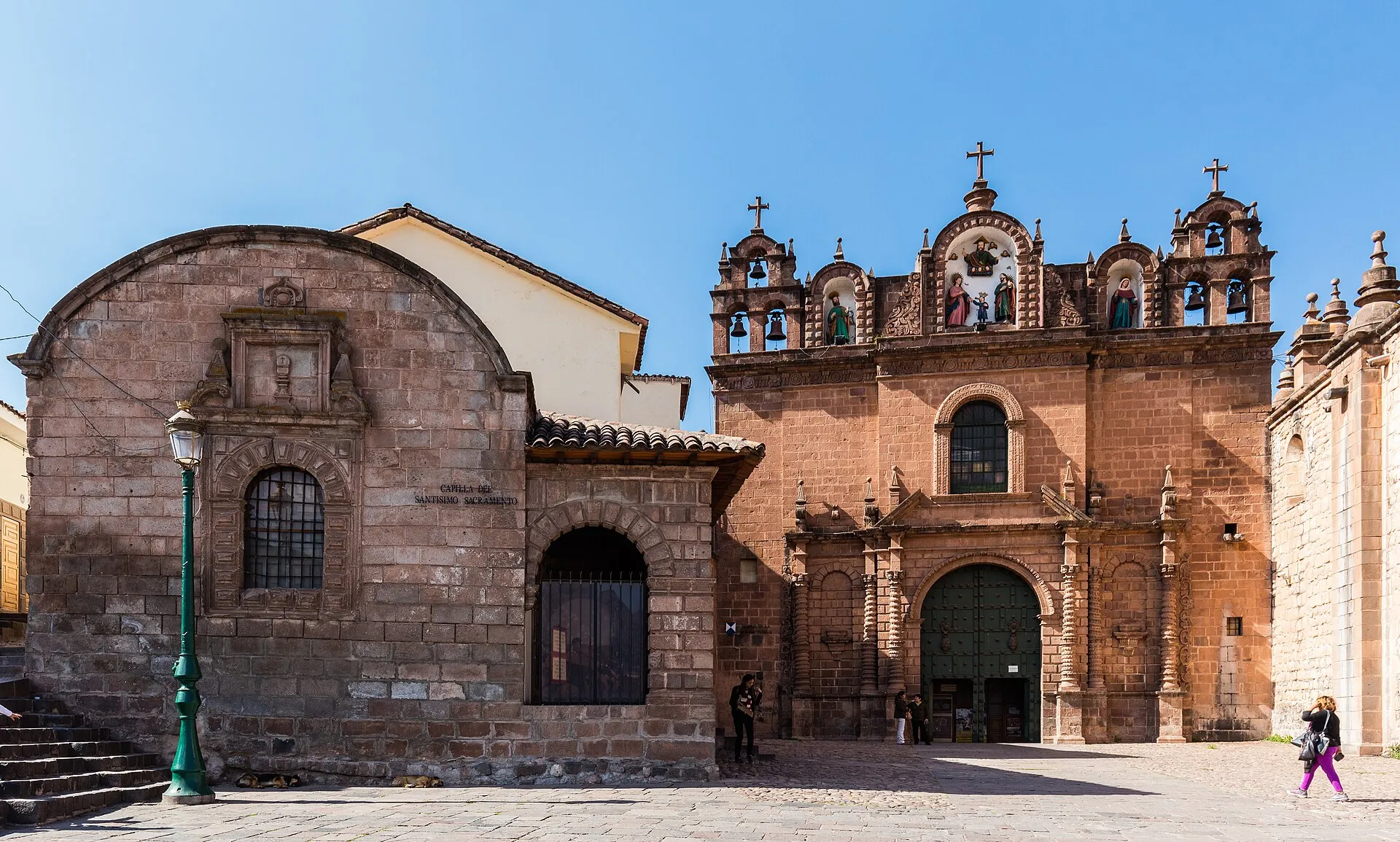
After Manco Inca's great siege was broken, the Spanish founded the Iglesia del Triunfo — Cusco's first Christian church — on the plaza to mark the victory; it still stands beside the main Cathedral.
-
Cathedral construction begins
Work started on the Cathedral over the Inca Kiswarkancha, the palace attributed to the emperor Viracocha, using andesite blocks hauled down from the fortress of Sacsayhuamán.
-
Execution of Túpac Amaru I
The last Sapa Inca of the Vilcabamba resistance was publicly executed in the plaza, a defining and traumatic moment in the end of independent Inca rule.
-
The great earthquake
A devastating earthquake shook Cusco; the procession of the dark-skinned Señor de los Temblores (Lord of the Earthquakes) is credited with calming the tremors and remains the city's most revered devotion, carried through the plaza each Holy Monday.
-
Cathedral consecrated
Nearly a century of building closed with the Cathedral's consecration, anchoring the baroque skyline of silver altars, cedar choir stalls, and Cusco School canvases that frames the square today.
-
Execution of Túpac Amaru II
José Gabriel Condorcanqui, who took the name Túpac Amaru II and led the largest indigenous uprising of the colonial era, was put to death in the plaza — the same ground that had seen his namesake fall.
-
UNESCO World Heritage listing
The historic centre of Cusco, with the Plaza de Armas at its core, was inscribed as a UNESCO World Heritage Site, protecting the layered Inca-and-colonial townscape travellers come to read.
Architecture
Andean Last Supper: The Cathedral's Cusco School painting of the Last Supper, attributed to Marcos Zapata, features cuy and chicha — a startling cultural fusion found nowhere else. Inca foundations: Look at the base of colonial buildings along Calle Loreto and Calle Hatun Rumiyoc to see perfectly fitted Inca stonework supporting Spanish walls. La Compañía facade: The Jesuit church's ornate baroque frontispiece was so extravagant that the Bishop of Cusco complained to the Pope that it upstaged the Cathedral. Señor de los Temblores: The Cathedral's dark-skinned "Lord of the Earthquakes" is the patron of Cusco, credited with halting the 1650 quake and paraded through the plaza each Holy Monday. Night illumination: Both churches and the arcaded buildings glow golden after dark, creating one of the most atmospheric city squares in South America. Cedar choir stalls: The Cathedral's carved cedar stalls depict saints, angels, and Catholic iconography mixed with Andean symbolism. Arcaded colonnades: The covered walkways — the Portal de Panes and its neighbours — surround the plaza with a continuous colonial arcade of restaurants, tour agencies, and shops.
Historical Significance
The Plaza de Armas sits at the intersection of two civilisations: the Inca Empire that made Cusco its capital and the Spanish colonial order that rebuilt the city on Inca foundations. The original Huacaypata was far larger than today's plaza — it extended west to join the adjoining Kusipata across the Saphy river — and served as the ceremonial heart of an empire stretching from Colombia to Chile. It was here that Inca emperors presided over the Inti Raymi sun festival, and here that Túpac Amaru I, the last Sapa Inca of the Vilcabamba resistance, was executed by the Spanish in 1572; two centuries later, in 1781, the rebel leader Túpac Amaru II met the same fate on the same ground. The Cathedral, built between 1559 and 1654 over the Inca Kiswarkancha and using stones pillaged from Sacsayhuamán, contains silver altars, gilded chapels, and the Cusco School paintings that represent the most significant fusion of European and Andean artistic traditions in the colonial world. In 1983 UNESCO inscribed the historic centre of Cusco as a World Heritage Site, with this plaza at its core. Walk to the San Pedro Market for a culinary immersion in the living culture that descends from both traditions, then climb to Sacsayhuamán to see the Inca engineering that preceded everything in the plaza below.
When to Visit
Plaza: Open 24 hours — liveliest between 10 AM and 9 PM. Cathedral: Monday-Saturday 10 AM - 6 PM, Sunday 2 PM - 6 PM. La Compañía church: Monday-Saturday 9 AM - 5:30 PM. Best: Early morning (8-9 AM) for photography before the tour groups arrive; evening for the illuminated facades and people-watching. Sunday mornings bring a flag-raising ceremony and occasional parades across the square, while Holy Week and the June festival season turn the plaza into an open-air stage — arrive early on those days to claim an arcade vantage point.
Admission and Costs
Cathedral entry: S/25 ($7) — separate from the Boleto Turístico and includes the adjoining Triunfo and Sagrada Familia chapels. La Compañía: S/15 ($4). A combined religious-circuit ticket covering the Cathedral, the San Blas church, and the Religious Art Museum runs about S/30 ($8). Guided plaza + Cathedral tour: S/50-100 ($14-27) per person, 1-1.5 hours. Private half-day Cusco walking tour: S/100-200 (~$27-54) covering the plaza, Cathedral, San Blas, and the Inca walls of Sacsayhuamán. Note that the plaza and its street life cost nothing — the fees apply only to entering the churches.
The Case for a Guide
The Plaza de Armas rewards a guide more than almost any single square in Peru, because so much of its meaning is invisible without one. A licensed Cusco guide reads the stonework for you — pointing out where Inca andesite ends and Spanish adobe begins along Calle Loreto, explaining why the Jesuits were ordered to tone down La Compañía, and decoding the Andean symbols hidden in the Cathedral's choir stalls and canvases. Inside the Cathedral, where photography is banned, a guide is your only way to understand the Señor de los Temblores, the Marcos Zapata Last Supper with its roasted cuy, and the solid-silver altar most visitors walk straight past. Guides also keep you oriented in a city laid out as a puma and steer you clear of the aggressive touts who work the arcades. Booking matters:
- Hire licensed guides (they carry an official DIRCETUR/MINCETUR credential) rather than the freelancers who approach you in the square.
- A good guide weaves the plaza into a wider story — linking it uphill to Sacsayhuamán, downhill to San Pedro Market, and out to the ruins of the Sacred Valley.
- Book through your hotel or a pre-researched operator, agree the price and duration up front, and confirm which churches are included.
Tips for Visitors
No photos inside the Cathedral: Photography is strictly prohibited inside — absorb the experience with your eyes and let a guide explain what you're seeing. Start your Cusco visit here: The plaza provides perfect orientation — from here you can walk uphill to Sacsayhuamán, downhill to San Pedro Market, or into the artisan quarter of San Blas, and it is where most travelers base themselves to acclimatize for a day or two before boarding the train to Machu Picchu. Balcony restaurants: Second-floor restaurants with plaza views are pricier than side-street alternatives but the panorama is worth one splurge meal. Watch for touts: Tour agency representatives in the plaza can be persistent — politely decline and book through your hotel or a pre-researched operator instead. Twelve-Angle Stone: Walk one block to Calle Hatun Rumiyoc to see the famous 12-angle Inca stone fitted perfectly into a wall — a guide explains why it matters. Free evening entertainment: The plaza often hosts live music, dance performances, and community events, especially on weekends and holidays. Altitude first: Give yourself a slow first day here before anything strenuous, and carry layers — the open square turns cold the moment the sun drops behind the Andes.
Frequently Asked Questions
What season is ideal for visiting Cusco's Plaza de Armas?
May through August is the dry season and the most reliable period, with cold but sunny days that fill the plaza with golden Andean light and make the baroque cathedral facades luminous. The Inti Raymi sun festival in late June brings Cusco's most spectacular celebration directly to the plaza. January and February are the heart of the rainy season, with heavy afternoon downpours that can drench the open square and make the steep cobblestone streets leading to it slippery.
When can visitors tour Plaza de Armas & Cathedral?
Plaza: Open 24 hours — liveliest between 10 AM and 9 PM. Cathedral: Monday-Saturday 10 AM - 6 PM, Sunday 2 PM - 6 PM. La Compañía church: Monday-Saturday 9 AM - 5:30 PM.
How much is the entrance fee for Plaza de Armas & Cathedral?
Cathedral entry: S/25 ($7) — separate from the Boleto Turístico. La Compañía: S/15 ($4). Guided plaza + Cathedral tour: S/50-100 (~$14-27) per person, 1-1.5 hours.
What should visitors know before visiting Plaza de Armas & Cathedral?
No photos inside the Cathedral: Photography is strictly prohibited inside — absorb the experience with your eyes and let a guide explain what you're seeing.
Is the Plaza de Armas a good place to acclimatise to Cusco's altitude?
Yes. The plaza sits at roughly 3,400 m (11,150 ft), so arrive gently: spend your first day or two strolling the arcades, sipping mate de coca at a balcony café, and visiting the Cathedral at an easy pace before attempting Sacsayhuamán uphill or the train down to Machu Picchu. Walk slowly, hydrate, and let the thin air settle before any strenuous climbing.