
What To Buy
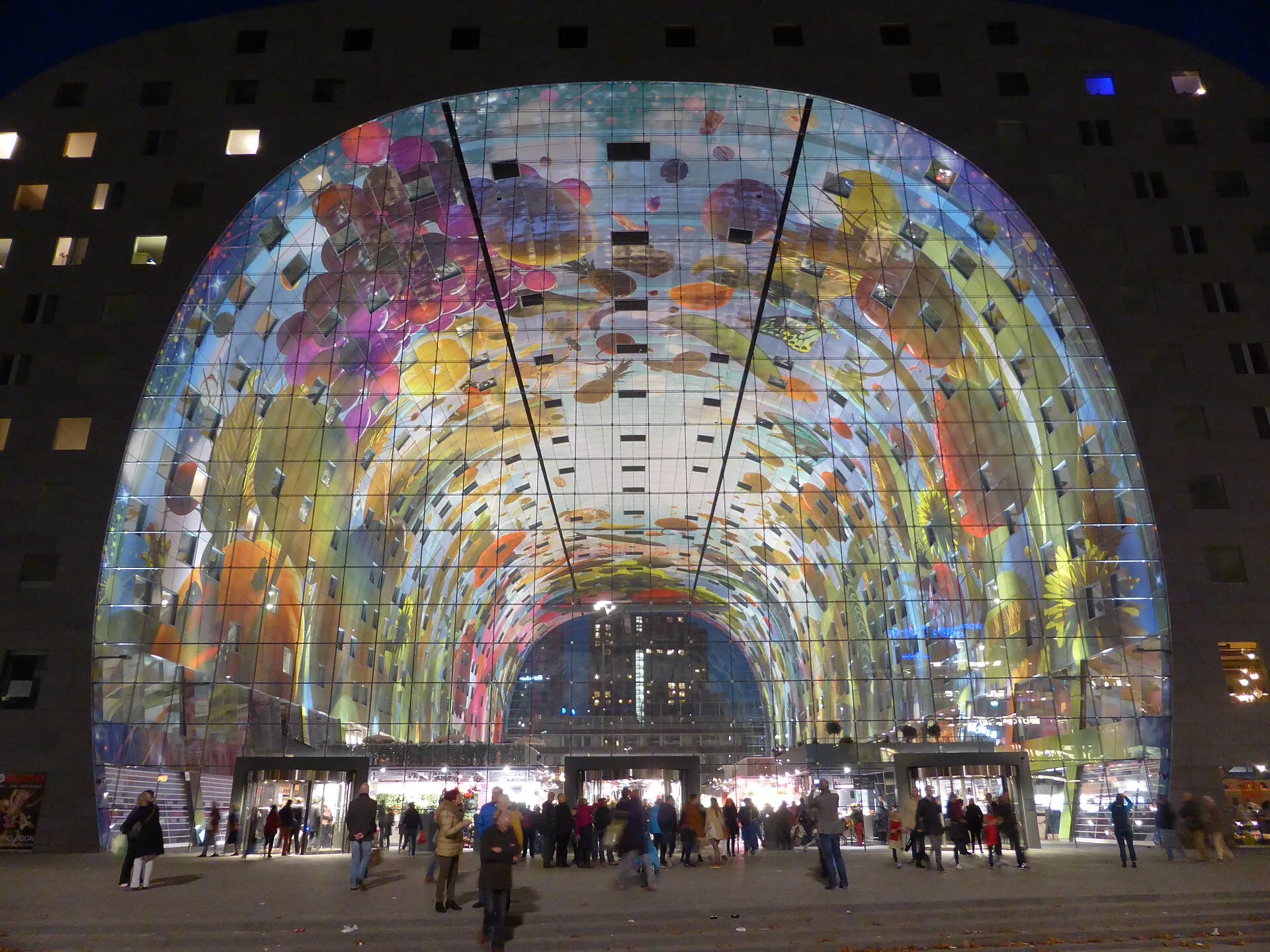
Horn of Plenty Ceiling: Arno Coenen's 11,000-square-meter digital print is the largest artwork in the Netherlands — fruits, flowers, and sea creatures scaled to surreal proportions across the arch's interior. Dutch Cheese Stalls: Sample aged Gouda, Leyden cumin cheese, and young farmer's cheese from multiple vendors — each has different suppliers and specialty selections. Apartment Integration: The 228 apartments built into the arch have windows facing both outward and inward — residents literally live inside the market hall, a concept unprecedented at this scale. Tijdtrap ("Time Stairs"): A free exhibition in the underground car park displays objects excavated during construction — the medieval settlement of Rotta that existed before wartime bombing erased the city center. Global Food Selection: The market's diversity mirrors Rotterdam's population — Surinamese, Turkish, Chinese, Middle Eastern, and traditional Dutch cuisines operate alongside each other.
Food Stalls
The Markthal's nearly 100 vendors span Dutch staples and global cuisines. Dutch herring sandwiches (broodje haring) from the fishmonger near the east entrance draw office workers at lunch — the queue is a sign of quality. Aged Gouda from dedicated cheese stalls ranges from creamy young varieties to crystalline 36-month aged wheels. Surinamese roti and pom reflect Rotterdam's deep ties to its former colony. Turkish lahmacun and pide from the bakeries near the center offer affordable, filling meals. Fresh stroopwafels made to order provide the quintessential Dutch street snack — watch the syrup being spread between warm waffle layers. For sit-down options, seafood restaurants along the arch's ground floor serve North Sea catches, while wine bars offer Dutch and European vintages by the glass. A food-focused guide navigates the stall numbering system, recommends the vendors with the highest turnover (freshness indicator), and explains the cultural stories behind Rotterdam's multicultural food scene.
When to Visit
Market stalls: Monday-Saturday 10:00-20:00; Sunday 12:00-18:00. Restaurants: Many open later than the market stalls, serving until 22:00-23:00. Best: Weekday lunch (12:00-14:00) for the full market atmosphere without weekend crowds. Busiest: Saturday afternoons. Archaeological display: Visible through the glass floor during market hours.
Admission and Costs
Entry: Free — the market is a public building. Food stalls: Snacks €3-8, lunch dishes €8-15, specialty items vary widely. Restaurants: Meals €15-40 depending on establishment. Guided architecture tours: €15-25 per person (combined with Cube Houses and surrounding landmarks).
The Case for a Guide
A market can look self-explanatory, yet Markthal rewards context that a good local guide supplies. The practical gain is navigational: guides read the stall numbering system that confuses first-timers, steer you to the vendors with the fastest turnover — the freshness signal that separates a working market from a tourist trap — and translate the menu boards at the Surinamese, Turkish, and Persian counters. The deeper value is interpretive. A guide unpacks the engineering MVRDV pulled off — how 228 apartments were built around cooking smells and the hall's evening closing-time noise — walks you down to the Tijdtrap archaeological display in the car park, and explains why the "Horn of Plenty" mural was rendered with film-studio software rather than painted. Pairing the hall with the adjacent Cube Houses and a stop at the Erasmus Bridge turns a quick lunch stop into a compact tour of how Rotterdam rebuilt itself after 1940.
Why a guide helps here:
- Menu translation at the multicultural counters, so you order confidently rather than pointing at pictures
- Freshness reads — which stalls turn over stock fastest and which are set-dressing for tourists
- Architecture context on the arch, the inward-facing apartments, and the acoustic aluminium ceiling
- The hidden layer — the free Tijdtrap exhibition and the medieval Rotta finds most visitors walk past
- A logical loop linking Markthal, the Cube Houses, and Blaak station in one walk
Tips for Visitors
Combine with Cube Houses: The Cube Houses are directly adjacent — you can visit both in a single 90-minute outing. Eat before you shop: The market's food stalls are geared toward eating on the spot. Arrive hungry, sample from multiple vendors rather than committing to one. Look up: Many visitors focus on the food stalls and miss the ceiling artwork. Stand in the center of the market and look directly up for the full impact of the mural. Supermarket below: A regular Albert Heijn supermarket occupies the basement level — locals use it for everyday groceries, so prices there are normal rather than tourist-inflated. Photography: The interior is spectacular to photograph, especially the ceiling from ground level. Wide-angle lenses capture the full curve of the arch.
Frequently Asked Questions
When is the best time to shop at Markthal?
Market stalls: Monday-Saturday 10:00-20:00; Sunday 12:00-18:00. Restaurants: Many open later than the market stalls, serving until 22:00-23:00. Best: Weekday lunch (12:00-14:00) for the full market atmosphere without weekend crowds.
What prices should visitors expect at Markthal?
Entry: Free — the market is a public building. Food stalls: Snacks €3-8, lunch dishes €8-15, specialty items vary widely. Restaurants: Meals €15-40 depending on establishment.
What tips help visitors make the most of a Markthal visit?
Combine with Cube Houses: The Cube Houses are directly adjacent — you can visit both in a single 90-minute outing. Eat before you shop: The market's food stalls are geared toward eating on the spot.
How do you get to Markthal?
Markthal sits on Blaak square in central Rotterdam. Blaak station is directly outside, served by metro lines A, B, and C and by local and Intercity trains — roughly 25 minutes from Rotterdam Centraal by a short walk or one tram stop. The adjacent underground car park (which also houses the free Tijdtrap exhibition) is the most convenient parking, though driving into central Rotterdam is rarely necessary.