
Observation Spots
Formation
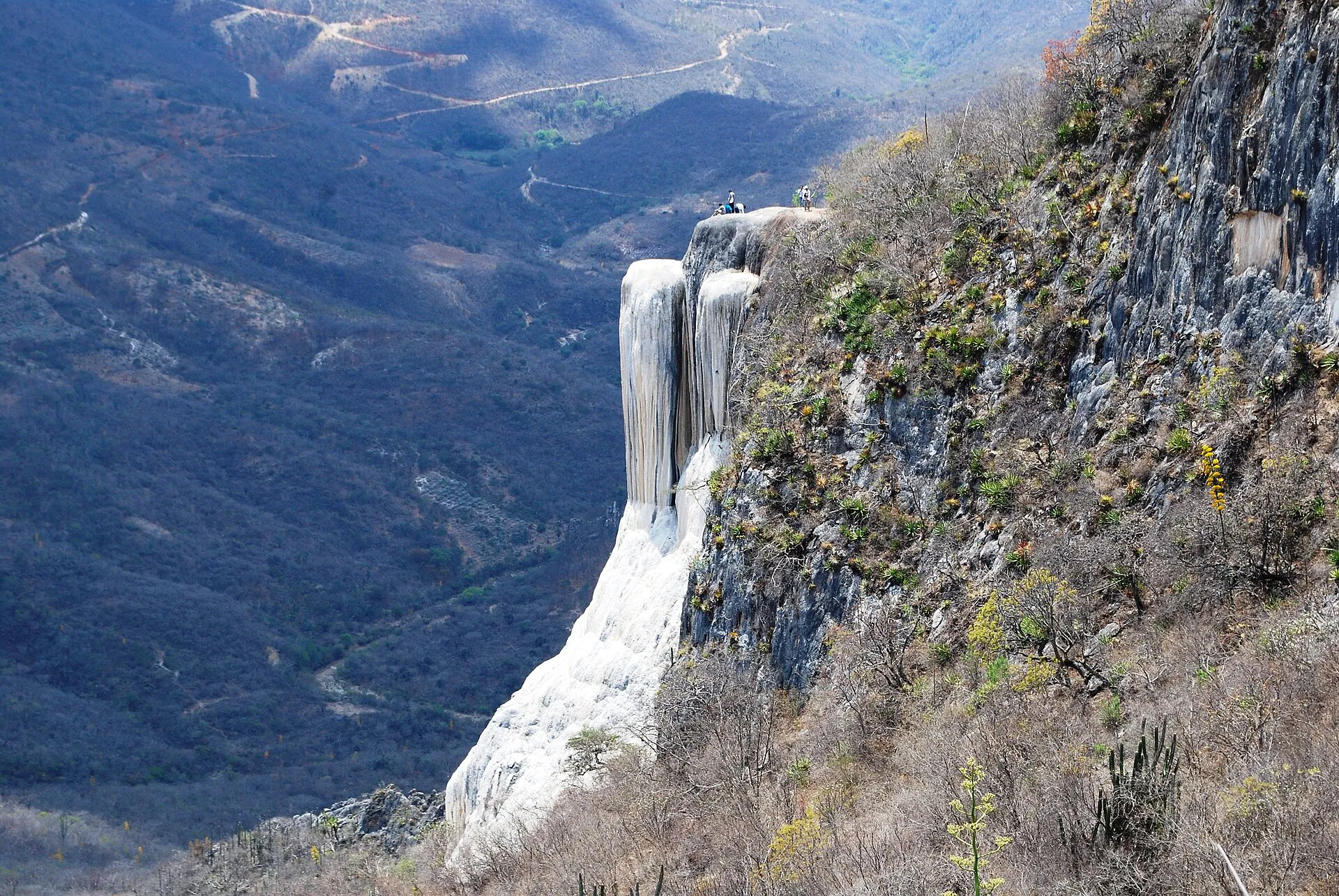
Hierve el Agua is a travertine landscape — the same rock that builds cave stalactites and hot-spring terraces, here shaped in the open air. Rainwater percolating through the surrounding limestone dissolves calcium carbonate and magnesium on its way underground, then re-emerges at the cliff-top springs supersaturated with those minerals. As the water surfaces and spills over the edge, dissolved carbon dioxide escapes into the air; that loss of pressure forces the calcium carbonate out of solution, and it precipitates as a thin crust of stone. Repeated over thousands of years, layer upon layer, that crust has accreted into the two great "petrified waterfalls" you see today.
The process here is unusual in one key respect. Most of the world's famous travertine formations — Pamukkale in Turkey, Mammoth Hot Springs in Yellowstone — are built by hot, volcanic springs. Hierve el Agua's springs run cold, so the mineral load is driven by geochemistry and CO₂ degassing rather than heat. The effervescent bubbling that gives the site its name is dissolved gas escaping, not boiling water. A few useful things to picture as you look at the cliff:
- The formations are living rock, not fossils — where the springs still flow, new travertine is forming right now, just imperceptibly slowly.
- The blue-green tint of the pools comes from suspended mineral particles scattering light, the same optical trick that colors glacial lakes.
- The white "curtains" are mineral drapery, sculpted by how the water sheeted over the lip during different flow regimes across the millennia.
- The pool bottoms feel chalky and crusted underfoot because you are literally standing on fresh calcium-carbonate deposit.
The springs are also what made the site habitable in the first place: the same dissolved minerals that build the stone made the water useful for the Zapotec terraces below, which is why the geology and the archaeology here are two halves of a single story rather than separate curiosities.
Trails
The site is compact but rewards an hour or two of walking. The marquee experience is infinity-pool swimming — wading into mineral pools perched on the cliff edge with nothing but valley and sky ahead, one of the most extraordinary natural swimming experiences in all of Mexico. From the top, the walking options fan out:
- Cascada Grande overlook — The main petrified waterfall, a 30-meter curtain of white calcium-carbonate deposits built up over millennia. A short walk from the pools gives the classic cliff-top view down its striated face.
- Cascada Chica trail — A 20-minute descent to the smaller formation, or a longer loop of roughly an hour round trip that lets you look up at the underside of the deposits from the valley below — the single best angle for grasping the site's scale.
- Mountain panoramas — The site sits at 1,800 meters with uninterrupted views across the Sierra Madre del Sur to distant peaks; the open ledges beyond the pools are the quietest viewpoints.
- Ancient irrigation — Zapotec-era water channels carved into the hillside reveal how this spring fed terraced agriculture for over two millennia; ask a guide to point out the eroded canal lines that are easy to miss.
Underfoot, expect desert flora — cacti, agave, and hardy scrubland surround the pools, contrasting sharply with the lush green valleys below. Wear grippy shoes: the travertine is slick where the springs keep it wet, and the descent trails are loose and stony.
Wildlife
The semi-arid landscape surrounding Hierve el Agua supports species adapted to the Sierra Madre del Sur's unique ecology. Hummingbirds — particularly the berylline hummingbird and white-eared hummingbird — hover around flowering agave and cacti along the cliff edges. Lizards of several species sun themselves on the warm mineral-encrusted rocks near the pools. The surrounding scrub forest shelters white-tailed deer, coatis, and gray foxes, though these are most active at dawn and dusk when visitors are scarce. The pools themselves are largely devoid of aquatic life due to the high mineral concentration, but the spring-fed streams below the formations support small freshwater ecosystems. Raptors, including red-tailed hawks and crested caracaras, soar on thermals above the valley — binoculars from the cliff-edge viewpoint offer excellent birding opportunities, and the afternoon updrafts off the warm rock make the panorama ledges the best place to watch them circle.
Hierve el Agua timeline
- c. 500 BCE
Zapotec engineers tap the springs
Pre-Hispanic farmers cut an extensive network of canals and stone-lined terraces into the hillside to spread the mineral springs across their fields — among the earliest documented irrigation systems in Mesoamerica.
- Over 2,500 years
The travertine keeps growing
Across the same span that humans have used the springs, calcium carbonate has precipitated layer on layer, building the two "petrified waterfalls" that give the site its fame.
-
A management dispute closes the site
Hierve el Agua shut for months when neighbouring communities clashed over who controls access and revenue — a reminder to confirm the gate is open before setting out.
- Today
Community stewardship
The springs are managed by the local community of San Lorenzo Albarradas, which collects the entry fee at the gate and maintains the trails, parking, and comedores.
When to Visit
Open: Daily 7:00 AM - 6:00 PM. Best time: Arrive by 9:00 AM to beat the tour buses that roll in from Oaxaca mid-morning and have the pools largely to yourself; the light is also softer for photography before midday. Duration: Allow 2-3 hours for swimming, hiking to the Cascada Chica viewpoint, and exploring. Season: The dry season (October through April) offers the clearest views, the calmest pools, and the most reliable road conditions. From June to September afternoon storms can green the valley beautifully but also muddy the access track and briefly cloud the pools, so aim for a morning arrival in the wet months. The site sits at altitude, so mornings can be cool before the sun climbs — layers help. One practical catch to plan around: the last colectivos back toward Mitla leave well before closing, so a late-afternoon arrival can strand you — if you want the quieter dusk light, arrange a private driver to wait.
Admission and Costs
Entry fee: MX$50 (~$3 USD), collected by the community at the gate. Parking: MX$30 ($2). Colectivo from Mitla: MX$50-70 per person (shared van, irregular schedule — expect to wait for it to fill). Private driver from Oaxaca: MX$800-1,200 ($45-68) round trip including wait time, the most flexible option for a small group. Organized tour from Oaxaca: MX$600-1,000 ($34-57) per person, typically bundled with Mitla and a mezcal stop. There are no ATMs or card machines at the site, so carry enough small pesos in cash for entry, parking, and a bite at the comedores. Because the fee is a direct community levy rather than a national-park ticket, it can be adjusted locally and is occasionally suspended entirely when access is closed, so treat the figures above as a guide and confirm on the day.
The Case for a Guide
Hierve el Agua rewards a guide or a knowledgeable driver far more than a first glance suggests. The site is genuinely remote, the road is the trickiest part of the day, and much of what makes the place extraordinary — the geology, the 2,500-year-old canals — is invisible without someone to explain it.
- The road is the real obstacle: A driver who knows the winding, part-unpaved route from Mitla saves you the stress of navigating it yourself and knows when rains or community closures have made access unwise
- Reading the landscape: A guide traces the eroded Zapotec irrigation channels and explains the travertine chemistry, turning a pretty swim into a lesson in geology and pre-Hispanic engineering
- A logical full day: The best guides build a loop that pairs the springs with the ruins of Mitla and a mezcal palenque in Matatlán, so you cover geology, archaeology, and Oaxaca's signature spirit without backtracking
- Connecting the valley's stories: A good guide links the irrigation here to the Zapotec achievement on display at Monte Alban and in the museum beside Santo Domingo Temple, so the day reads as one narrative rather than three stops
- Timing the crowds: Locals know exactly when the tour buses arrive and can slot your visit into the quiet window before or after them
- Supporting the community: Guides who work with San Lorenzo Albarradas steer your spending toward the families who manage and maintain the site
Tips for Visitors
Road conditions: The road from Mitla is winding, unpaved in sections, and narrow — allow at least 1.5 hours from Oaxaca city and consider a driver who knows the route. Bring swimsuit and water shoes: The pool bottoms are rocky mineral deposits; water shoes make the experience far more comfortable and safer on the slick travertine. Combine your trip: The route passes through Mitla (a Zapotec archaeological site with stunning geometric mosaics) and the mezcal-producing town of Matatlán — a guide can build a full day around all three. Food and water: Small comedores (food stalls) operate at the site entrance, but selection is limited; bring your own water and snacks. Confirm before you go: Access is occasionally suspended during community management disputes (the site closed for months in 2019), so check that it is open before committing to the drive. Community management: The site is managed by the local community of San Lorenzo Albarradas — respect posted rules and buy from local vendors to support the community. Mind the edge: The infinity pools sit at an unfenced cliff lip, so keep children close and watch your footing. Sun and timing: There is little shade at the top — apply reef-safe sunscreen well before entering the pools, as the mineral-rich water is part of a delicate geological system, and reapply after your swim.
Frequently Asked Questions
When is Hierve el Agua open, and what time of day is best?
Open: Daily 7:00 AM - 6:00 PM. Best time: Arrive by 9:00 AM to beat tour groups and have the pools largely to yourself. Duration: Allow 2-3 hours for swimming, hiking to Cascada Chica viewpoint, and exploring. Late afternoon light before closing is quieter and photogenic, but the last colectivos back to Mitla leave earlier than you may expect.
How much does it cost to access Hierve el Agua?
Entry fee: MX$50 (~$3 USD). Parking: MX$30 ($2). Colectivo from Mitla: MX$50-70 per person (shared van, irregular schedule). Private driver from Oaxaca: MX$800-1,200 ($45-68) round trip including wait time. Carry small pesos in cash — there are no card machines or ATMs at the site.
What to know about roads and getting to Hierve el Agua?
Road conditions: The road from Mitla is winding, unpaved in sections, and narrow — allow at least 1.5 hours from Oaxaca city and consider a driver who knows the route. In the June-September rains it can wash out; access is occasionally suspended during community management disputes, so confirm the site is open before setting out.
Is it safe to swim in the Hierve el Agua pools, and can children join?
Yes — the spring-fed infinity pools are shallow, cool rather than hot, and calm, which makes them family friendly, but the bottoms are slippery mineral rock and the outer edge drops straight off the cliff. Keep children within arm's reach at the rim, wear water shoes for grip, and treat the ledge with respect. There are no lifeguards on duty.
What else can I combine with a trip to Hierve el Agua?
The classic full-day loop pairs Hierve el Agua with the Zapotec archaeological site of Mitla and a mezcal palenque in Santiago Matatlán, the self-styled world capital of mezcal. In the city, the site rounds out an Oaxaca itinerary alongside the ruins of Monte Alban and the gilded Santo Domingo Temple, giving you geology, archaeology, and colonial art in a single visit.