
Castelvecchio Museum timeline
-
Scaliger fortress begun
Cangrande II della Scala began the castle and bridge as a fortified escape route across the Adige.
-
Venetian garrison
Verona fell to Venice, which used the fortress as a military stronghold for centuries.
-
Scarpa restoration
Carlo Scarpa began the modern museum intervention that made Castelvecchio a design landmark.
Fortification History
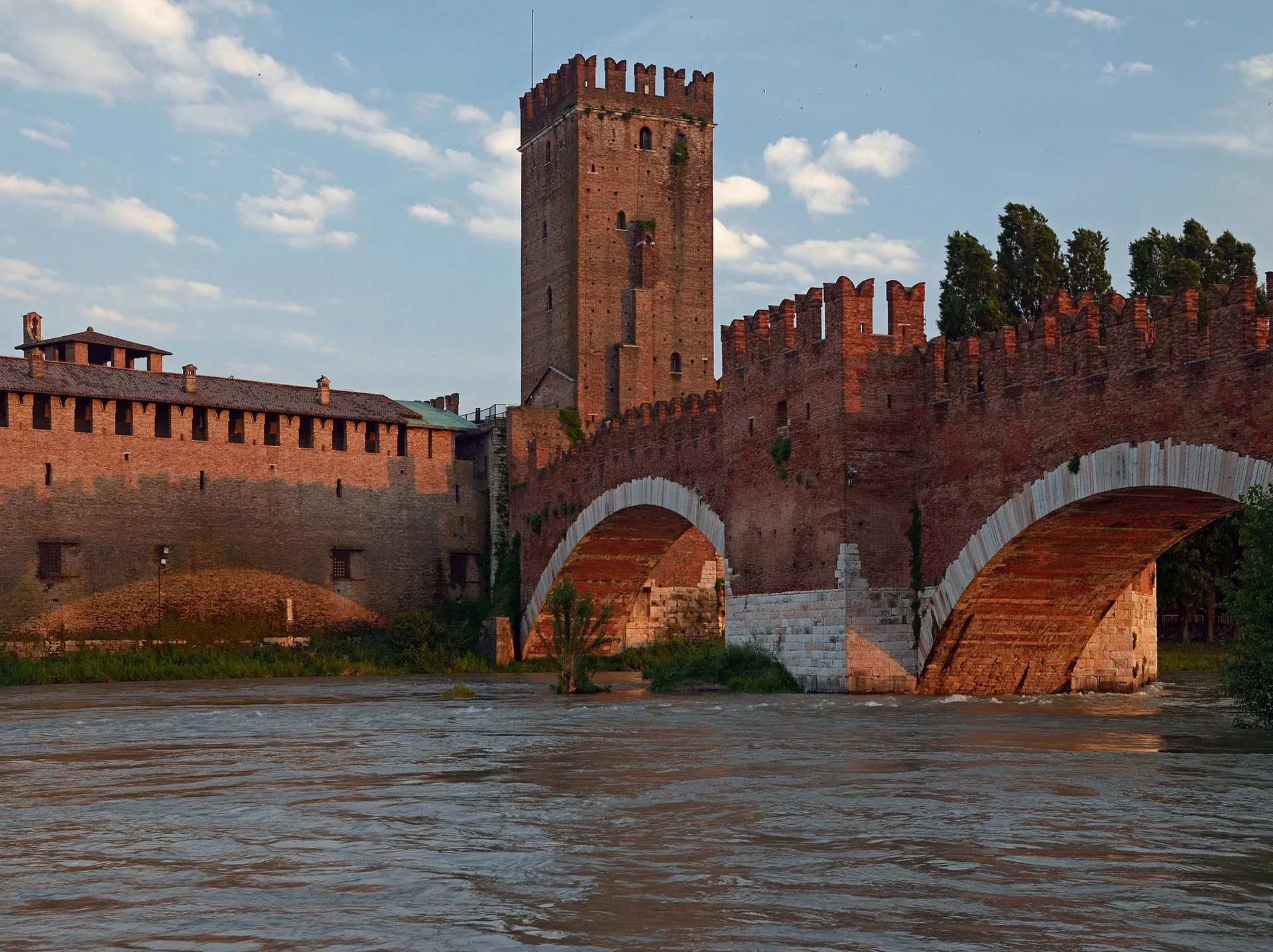
Built in the 1350s by Cangrande II della Scala, the fortress was designed as both a seat of power and a bolt-hole -- the Ponte Scaligero fortified bridge let the ruling family flee across the Adige if the city turned hostile. The castle is split by the river-facing wall into two zones: the Corte d'Armi (courtyard of arms) toward the city, and the fortified residence and keep on the river side, linked to the bridge. The bridge itself was a feat of medieval engineering; its central arch, at nearly 49 metres, is often cited as the widest bridge span in the world at the time it was raised.
After Verona passed to Venice in 1405, the castle became a garrison and arsenal. Napoleonic engineers converted it into a barracks around 1797, adding the long block along the Corte d'Armi and driving a road through the complex; the Austrians later kept it as a military depot. That layered military afterlife is exactly what Scarpa had to unpick. His restoration stripped away the romantic, faux-Gothic additions that director Antonio Avena had installed in the 1920s, revealing the genuine medieval fabric beneath and then setting his own modern insertions in frank dialogue with it.
The Ponte Scaligero carries its own wartime scar: retreating German troops blew it up in 1945, and it was patiently rebuilt between 1949 and 1951 using original bricks and stone dredged from the river -- so the swallowtail Ghibelline battlements you cross today are the medieval material re-set in place. Walk the wall-walk and you can still read how the whole ensemble was meant to work: control the bridge, and the ruling family always had a way out.
Notable Rooms
Cangrande Statue: the museum's signature moment, where the equestrian monument of Verona's greatest ruler is displayed on Scarpa's iconic raised concrete pedestal at the pivot between the two wings. Suspended in an open recess, the statue -- with its famously broad, almost unsettling smile -- can be studied from below, from the side, and from an upper walkway, so the visitor circles it exactly as Scarpa intended. Sculpture Gallery: medieval and Renaissance stonework presented on minimalist steel and stone supports that appear to float clear of the ancient floor.
Painting Galleries (the Reggia): the upper rooms hold the heart of the collection -- Pisanello and Stefano da Verona's luminous International Gothic panels, Andrea Mantegna's tender Holy Family, works by Giovanni Bellini, and later canvases by Paolo Veronese, Tintoretto, and Tiepolo, each lit with Scarpa's carefully angled daylight. The Sala Boggian and the armoury display arms and armour from the castle's centuries as a garrison.
The galleries also carry a modern tale worth knowing: in November 2015 thieves made off with seventeen paintings, including works attributed to Mantegna, Pisanello, Rubens, and Tintoretto. In a story that gripped Italy, all seventeen were recovered the following year and returned to their frames -- so nearly every masterpiece you admire here has, quite literally, come home.
When to Visit
Tuesday-Sunday: 10 AM - 6 PM. Monday: 1:30 PM - 7:30 PM (the museum opens in the afternoon only). Closed: January 1 and December 25. The ticket desk closes before the galleries, so arrive at least an hour ahead of closing to see the collection unhurried. Plan on 90 minutes to two hours: roughly half for Scarpa's architecture and the courtyards, half for the painting and sculpture galleries.
Best time is a weekday morning, when low, raking light suits both the brick courtyards and Scarpa's daylit galleries. The building is a working fortress, so expect stairs, ramps, and uneven historic floors; Scarpa's interventions added ramps and level changes that ease some routes but not all, and visitors with limited mobility should ask staff about the accessible circuit on arrival. Photography is permitted without flash or tripods. Crossing the Ponte Scaligero is free and open long after the museum shuts, so save it for golden hour.
Admission and Costs
Full entry: €6, with a reduced rate of around €4.50 and youth concessions of roughly €1; because civic-museum tariffs change, confirm current prices on the official Comune di Verona museum site. The VeronaCard includes free admission and pays for itself quickly if you are also visiting the Arena di Verona and other civic sites. Guided tour: €35-50 per person (1.5 hours). Architecture-focused tour: €50-80 per person. Private guide: €120-200 for up to 6 people.
The Case for a Guide
Castelvecchio rewards the visitor who understands its two overlapping stories -- a medieval fortress and a twentieth-century masterclass in museum design -- and a knowledgeable guide is what braids them together.
- Reading Scarpa's language: a guide points out how each concrete beam, brass rail, and pane of glass is detailed to stay legible against the old brick, turning what can look like bare walls into a deliberate architectural argument
- The della Scala backstory: understanding why Cangrande II built an escape bridge into his own home makes the plan of courtyards, keep, and wall-walk suddenly click into place
- Decoding the collection: from Pisanello's Gothic gold grounds to Veronese's theatrical Renaissance, a guide sequences the rooms so the leap across two centuries of Veronese painting reads clearly
- The Cangrande set-piece: the staging of the equestrian statue is the single most analysed moment in the building; a guide explains the sightlines Scarpa engineered and why the placement is considered revolutionary
- Layers of reuse: knowing which stones are Scaliger, which are Napoleonic barracks, and which are Scarpa's inserts transforms a simple walk-through into a lesson in how buildings accumulate history
Tips for Visitors
Architecture fans should allow extra time to study Scarpa's details -- the design rewards close attention, and the best single view of the Cangrande statue is from the upper wall-walk, framed in its purpose-cut opening. For the classic exterior photograph, cross Ponte Scaligero and drop to the riverbank on the far side for the fortress, its swallowtail battlements, and the Adige in one frame. Combine the visit with the Arena di Verona -- both are walkable in the city centre -- and it makes a calmer, more rewarding stop than the crowded Juliet's House. Photography is allowed without flash or tripods, and the museum shop stocks excellent Scarpa monographs worth the detour on your way out.
Frequently Asked Questions
Which months are ideal for visiting Castelvecchio Museum?
June through September is the peak period, with warm weather perfect for crossing the fortified Ponte Scaligero bridge and exploring Carlo Scarpa's masterful courtyard interventions in natural light. April, May, and October are equally rewarding with fewer visitors, allowing quiet appreciation of Scarpa's modernist architectural details within the medieval fortress. The indoor galleries are excellent year-round, and the quiet winter months from November through February let you have the Cangrande statue and the painting rooms almost to yourself.
When can visitors explore Castelvecchio Museum?
Tuesday to Sunday: 10 AM - 6 PM. Monday: 1:30 PM - 7:30 PM (the museum opens only in the afternoon). Closed January 1 and December 25. The ticket desk stops selling admission before the galleries close, so arrive at least an hour ahead. Best time: weekday mornings for quiet appreciation of Scarpa's details.
What is the admission price for Castelvecchio Museum?
Full entry: €6, with a reduced rate of around €4.50 and concessions of about €1 for young visitors; check the official Comune di Verona museum site for current rates. The VeronaCard includes free entry. Guided tour: €35-50 per person (1.5 hours). Architecture-focused tour: €50-80 per person. Private guide: €120-200 for up to 6 people.
What should visitors know when exploring Castelvecchio Museum?
Architecture fans should allow extra time to study Scarpa's details. Cross Ponte Scaligero for photos of the castle and river, and step onto the wall-walk to see the Cangrande statue framed in its dramatic opening. The fortress combines well with the Arena di Verona and Juliet's House, all walkable in the compact city centre.