
Spiritual Significance
Behind the tourism, the Duomo is a living cathedral and the seat of the Archbishop of Milan, heir to the Ambrosian rite that St. Ambrose established here in the 4th century.
The most venerated relic is the Santo Chiodo — a nail held to come from the True Cross — kept high above the apse and marked by a small red light; once a year, around the 14 September feast of the Exaltation of the Cross, the archbishop is raised to retrieve it in the Rito della Nivola, using a cloud-shaped lift whose original mechanism tradition attributes to Leonardo da Vinci.
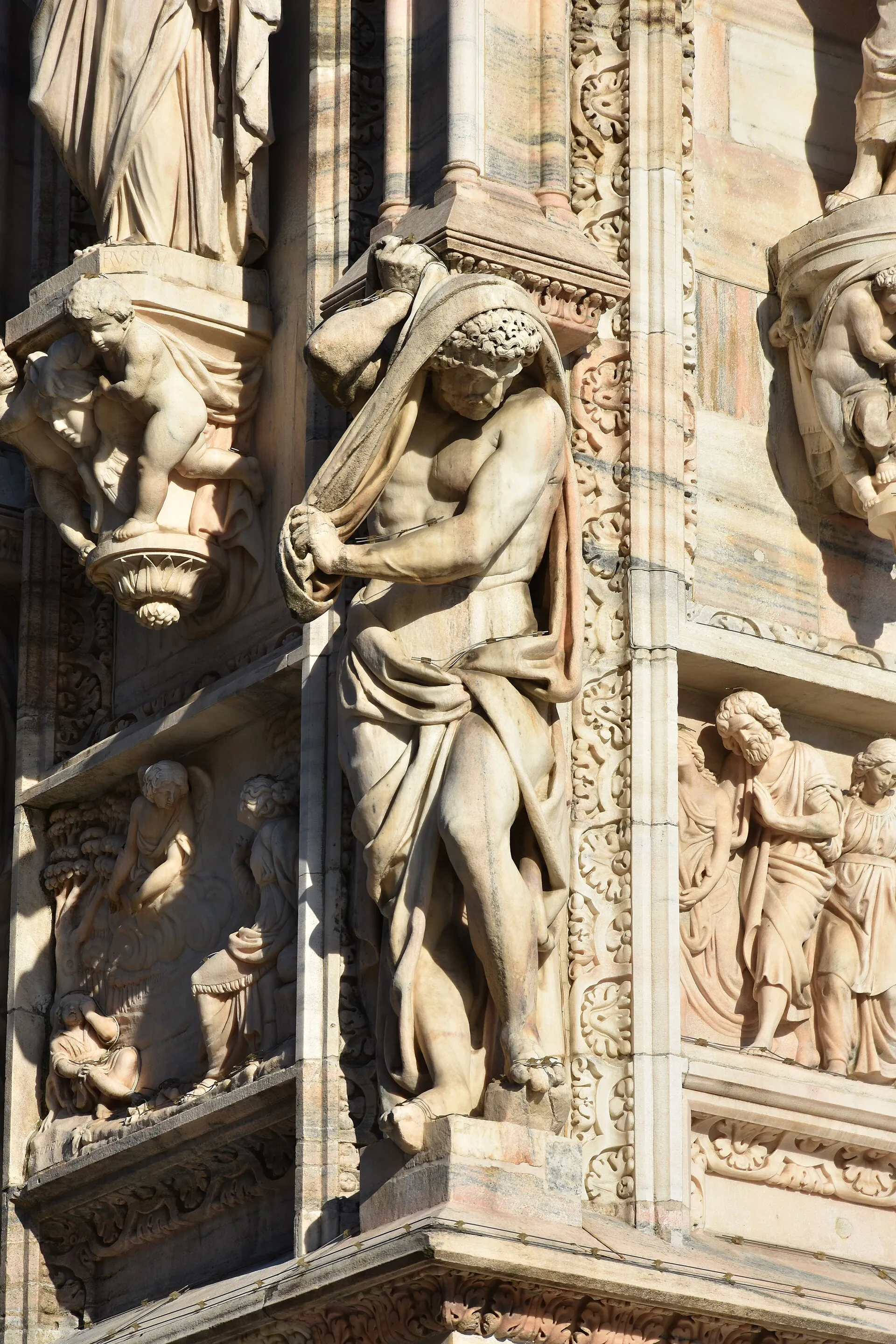
Beneath the marble floor, the archaeological area preserves the ruins of the 4th-century baptistery of San Giovanni alle Fonti, where St. Ambrose is said to have baptized St. Augustine in 387 AD — a founding moment of Western Christianity reachable on the Duomo Pass. Inside the right transept stands the St. Bartholomew Flayed by Marco d'Agrate (1562), the saint carrying his own skin like a robe, an anatomical tour de force that doubles as a meditation on martyrdom.
Visitor Etiquette
This is an active place of worship, so a dress code is enforced at the door: shoulders and knees must be covered — no shorts, short skirts, or tank tops, and a scarf or light layer solves it in summer. Keep your voice low inside and avoid walking in front of or photographing people at prayer, particularly near the altar and side chapels.
Sightseeing pauses during Mass, which fills the nave on Sunday mornings and feast days; if you arrive then, wait quietly at the back or start with the rooftop until the service ends. Large bags are screened at security, so travel light to speed the queue. On the terraces, stay behind the low parapets and off the fragile carvings — the marble you are walking on is centuries old and under constant restoration.
Milan Cathedral (Duomo di Milano) timeline
-
Foundation stone laid
Archbishop Antonio da Saluzzo and Duke Gian Galeazzo Visconti begin the cathedral on the site of the old basilica of Santa Maria Maggiore, dedicating it to Santa Maria Nascente. Visconti grants the Candoglia marble quarries to the works in perpetuity.
-
High altar consecrated
Pope Martin V consecrates the high altar while the nave is still rising, a reminder that the Duomo functioned as a working church through centuries of construction.
-
St. Charles Borromeo consecrates the cathedral
Archbishop Carlo Borromeo consecrates the completed interior, cementing the Duomo as the spiritual heart of Counter-Reformation Milan.
-
The Madonnina is raised
Giuseppe Perego's gilded copper statue of the Virgin is set atop the main spire at 108.5 meters, and Milanese custom holds that nothing in the city should stand taller than her.
- 1805–1813
Facade finished under Napoleon
Napoleon, crowned King of Italy in the Duomo with the Iron Crown of Lombardy in 1805, orders the long-stalled marble facade completed — the cost later recovered by placing his name on a statue.
-
Last bronze door hung
The final gate is installed almost six centuries after work began, a date often cited as the formal completion of the longest-running building project in Italy.
When to Visit
Cathedral: daily 9 AM - 7 PM (last entry 6:10 PM). Rooftop terraces: daily 9 AM - 7 PM (last entry 6:10 PM). Museo del Duomo: Thursday-Tuesday 10 AM - 6 PM (closed Wednesdays). The best windows are right at 9 AM opening or the final two hours before last entry, when tour groups thin out and the low sun lights the marble; midday is the busiest and hottest stretch, especially on the exposed roof.
Admission and Costs
Cathedral only: €5. Rooftop by stairs: €14 (251 steps). Rooftop by elevator: €23. The best-value option is the Duomo Pass: €25 (cathedral, rooftop by stairs, archaeological area, crypt, and the Museo del Duomo). Guided tour with skip-the-line: €40-60 per person. Private guide: €200-350 for up to 6 people. All tickets are timed-entry, so booking online ahead of your visit avoids the long walk-up queue that forms across the piazza on busy afternoons.
The Case for a Guide
The Duomo is the rare monument where a guide changes the visit entirely, because almost everything remarkable about it is hidden in plain sight and goes unexplained on a self-guided walk through.
- Reading the facade and statues: which figures are medieval and which are 19th-century, and why Napoleon's push to finish the front still shapes what you see
- The marble story: how Candoglia stone travelled the Navigli canals for six centuries, and how to spot old blocks against new restoration marble
- Finding the hidden details: the Holy Nail and its Nivola ritual, the St. Bartholomew statue, the meridian line set into the floor, and the oldest stained glass
- The archaeological layer: standing in the baptistery where St. Augustine was baptized and understanding why it matters
- Skipping the queue: guided groups clear a faster security lane, often saving more time than the tour costs on a crowded day
- Building the day: threading the Duomo together with the nearby Last Supper and La Scala into one coherent route
Tips for Visitors
Book the rooftop and cathedral online in advance — walk-up tickets are timed and the piazza queue can swallow an hour on a busy afternoon. If you can manage 251 steps, the stair climb to the roof costs less than the elevator and reveals the carvings at eye level on the way up.
Visit the Last Supper in the morning (reserve months ahead — slots sell out fast) and save the Duomo for the afternoon light, then step straight into the Galleria Vittorio Emanuele II next door, where La Scala faces the arcade on the far side. Bring a light layer for the dress code and the breezy terraces, and keep bags small to clear security faster.
Frequently Asked Questions
How do you get onto the Duomo's rooftop terraces — stairs or elevator?
The rooftop is the Duomo's signature experience, and you reach it one of two ways. The stairs cost less (€14) and climb 251 steps up a tight spiral inside a buttress; the reward is that you emerge gradually onto the lower terrace and walk up through the marble among the carvings rather than being delivered straight to the top.
The elevator (€23) is the choice if knees, time, or crowds rule out the climb, though you still cover uneven marble walkways and a few short flights once you are up there. Either way you end up strolling the same network of terraces between the guglie (spires), with the golden Madonnina overhead and, on a clear day, the Alps on the horizon. The roof closes in bad weather, so check conditions before you commit to a timed ticket.
What does it cost to visit Milan Cathedral, and which ticket should you buy?
Tickets are modular, so buy for what you actually want to see. Cathedral entry alone is €5; adding the rooftop makes it €14 by stairs or €23 by elevator. The best value for a full visit is the Duomo Pass (€25), which bundles the cathedral, the rooftop by stairs, the archaeological area and crypt, and the Museo del Duomo across the square.
A guided tour with skip-the-line access runs €40–60 per person, and a private guide €200–350 for up to six. Everything is timed-entry, so book a slot online in advance — walk-up tickets on a busy afternoon can mean an hour in the piazza queue before you even reach security.
When is the best time of year and time of day to visit the Duomo?
For the interior, any month works — the vast nave stays cool in summer and sheltered in winter. For the rooftop, which is what most visitors come for, aim for April through October, and ideally September or October, when crisp post-summer air often clears the haze and brings the Alpine peaks into view north of the city.
Whatever the season, go at opening (9 AM) or in the last couple of hours before 6:10 PM last entry: midday brings the thickest crowds and the flattest light, while early morning and the golden hour before closing give you the terraces at their quietest and most photogenic.
What are the must-see details inside and on top of the cathedral?
Inside, seek out the St. Bartholomew Flayed statue by Marco d'Agrate (1562), which shows the saint carrying his own skin like a cloak; the world's largest set of stained-glass windows, some dating to the 15th century; and, high above the apse, the red light marking the Holy Nail said to come from the True Cross.
Descend to the archaeological area beneath the floor to see the 4th-century baptistery where St. Ambrose baptized St. Augustine. On the roof, the payoff is the Madonnina, the gilded statue crowning the tallest spire at 108.5 meters, and the close-up view of the 135 pinnacles and 3,400 statues that are invisible from street level.
Is a guided tour of Milan Cathedral worth it?
For the rooftop view alone you do not need a guide, but the Duomo rewards context more than almost any monument in Italy, because nearly everything that makes it extraordinary is hidden in plain sight. A good guide decodes the symbolism of the facade, points out which statues are medieval and which are 19th-century additions, explains the Candoglia-marble logistics that kept the site working for six centuries, and walks you to interior details most visitors pass without noticing.
Guided groups also clear security through a faster queue, which on a crowded day saves more time than the tour costs. Pair the Duomo with the nearby Last Supper and La Scala and a single guide can thread the three together into one coherent morning in Milan.