
Berlin Wall Memorial timeline
-
Barbed Wire Sunday
In the early hours of 13 August 1961 East German troops sealed the border, and Bernauer Strasse became its sharpest flashpoint — the apartment buildings stood in the East while their pavement lay in the West, so residents leapt from upper-floor windows into rescue nets below. Ida Siekmann, the Wall's first recorded victim, died jumping from No. 48 on 22 August.
- 1961-1980s
The death strip hardens
Over the following years the single wall became a deep fortified corridor — an inner wall, a signal fence, an anti-vehicle trench, a lit patrol road and watchtowers manned under a shoot-to-kill order. The frontier buildings on Bernauer Strasse were bricked up and then demolished to clear fields of fire.
-
Church of Reconciliation demolished
The neo-Gothic Church of Reconciliation, stranded inside the death strip since 1961, was blown up by the GDR to widen the border's sightlines — an act that later gave the memorial its most pointed symbol of what division destroyed.
-
The Wall falls
On the night of 9 November 1989, after weeks of mass protest, the border crossings were thrown open and Berliners climbed the Wall they had been shot at for crossing. The 28-year division ended almost overnight.
-
Memorial established
With most of the Wall demolished in the reunification euphoria, the state preserved a 70-metre stretch on Bernauer Strasse as a national memorial so a complete cross-section of the border — rarely left intact anywhere else — would survive.
-
Chapel of Reconciliation consecrated
An oval chapel of rammed earth and timber was raised on the foundations of the demolished church, becoming the quiet spiritual heart of the open-air memorial.
- 2010-2014
Open-air exhibition completed
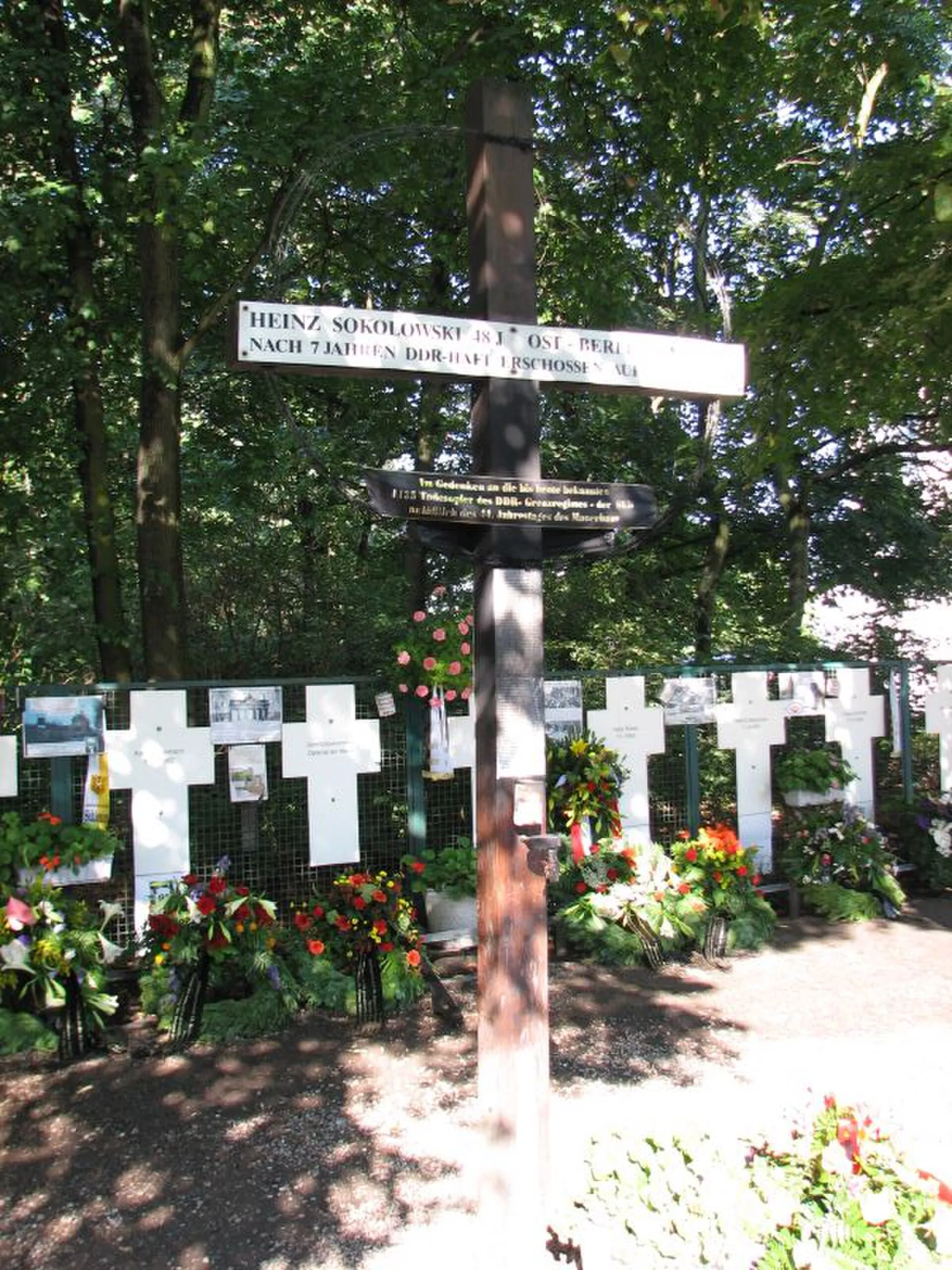
The memorial expanded into the 1.4-kilometre landscape seen today, with steel rods tracing the Wall's vanished path, the Window of Remembrance honouring those killed, and ground markers showing where escape tunnels once ran.
Historical Significance
The memorial documents the Wall's full 28-year span, from 13 August 1961 — when East German troops sealed the border overnight in the operation Berliners came to call Barbed Wire Sunday — to its fall on 9 November 1989. Bernauer Strasse carries that story with unusual force: it was here that residents jumped from their windows into the West, here that Berlin's singular status as a city divided between four occupying powers became a wall through people's front doors.
The Window of Remembrance names the people killed at the border, and guides use the site to connect the division to the wider city — a walk here pairs naturally with the Brandenburg Gate, the Reichstag Building and the collections on Museum Island.
Architecture
The surviving monument is a layered defensive system, not a single wall: an inner wall faced the East, then came the floodlit death strip with its anti-vehicle trench, signal fence and patrol road, and finally the outer wall most of the world pictures. The observation tower in the Documentation Center looks straight down onto this corridor, the clearest way to grasp how deep and deadly the border really was.
The Chapel of Reconciliation, an oval of rammed earth and timber, stands on the foundations of the neo-Gothic church the GDR demolished in 1985 to clear the strip. Elsewhere, slender steel rods mark the Wall's former line where the concrete is gone, ground plates reveal escape-tunnel routes, and a dedicated listening station plays archival border recordings across the grounds.
When to Visit
The open-air memorial is accessible 24 hours a day and is floodlit at night, so the border strip can be walked whenever you arrive. The Documentation Center opens Tuesday to Sunday, 10:00 to 18:00, and closes on Mondays; the Visitor Center near Nordbahnhof keeps longer daily hours. For quiet reflection, aim for a weekday morning before the school and tour groups arrive. Plan on two to three hours to cover the grounds, climb the observation tower and work through the indoor exhibits at a respectful pace.
Admission and Costs
Entry to everything — the open-air memorial, the Documentation Center, the observation tower and all exhibitions — is free, funded as a public memorial, and the audio guide at the Visitor Center costs nothing either. If you want expert narration, a group walking tour built around the Wall runs about €30-45 ($32-48) per person for two to three hours.
Hiring a private historian for an in-depth four-hour Cold War walk costs roughly €200-350 ($215-375) for the whole party, and some operators offer free public tours on set afternoons, so it is worth checking the memorial's schedule before you book anything paid.
The Case for a Guide
The memorial is deliberately sparse — much of its meaning lives in what is absent, so a guide is what turns bare markers into a story. A Wall-focused tour sets out the Cold War politics and the human cost in the same breath, moving from the geopolitics of a divided Germany to the neighbours who died metres apart on Bernauer Strasse. Expect a knowledgeable guide to:
- Explain how and why the border went up overnight in August 1961, and what daily life became on each side.
- Decode the death strip layer by layer — the trench, signal fence, patrol road and shoot-to-kill order.
- Tell the escape stories tied to this exact street, from window jumps to the tunnels dug beneath it.
- Draw out the meaning of the Window of Remembrance and the Chapel of Reconciliation.
- Place the memorial in the wider arc of reunification and the city you are standing in.
Tips for Visitors
Begin inside the Documentation Center so the open-air grounds make sense before you walk them, then take the free lift up its observation tower for the only aerial view of an intact death strip. Give yourself emotional room — this is heavy ground, and the Chapel of Reconciliation is the right place to pause. The free audio guide, built around survivor and escapee testimony, is worth collecting at the Visitor Center near Nordbahnhof.
Photography is welcome, though signage asks for restraint at the Window of Remembrance. For a deliberate contrast, the painted East Side Gallery in Friedrichshain shows the Wall as a canvas rather than a frontier; if you are shaping a wider itinerary, our Berlin trip-planning guide sets this memorial alongside the city's other Cold War sites.
Frequently Asked Questions
When is the most meaningful time to visit the Berlin Wall Memorial?
The anniversary of the Wall's fall on November 9 draws commemorative events and candlelit installations along Bernauer Strasse, and this is the most emotionally resonant day to come. June through August gives the longest daylight for walking the full 1.4-kilometre open-air memorial and the warmest conditions on the exposed death strip, where there is almost no shade. The Documentation Center runs year-round, and a winter visit between December and February carries its own stark poignancy as the bare memorial landscape mirrors the bleakness of the border it preserves.
What are the opening hours of the Berlin Wall Memorial?
The open-air memorial along Bernauer Strasse is accessible around the clock and is floodlit after dark, so you can walk the preserved border strip at any hour. The Documentation Center and its rooftop viewing platform open Tuesday to Sunday from 10:00 to 18:00 and close on Mondays, while the Visitor Center near Nordbahnhof keeps longer hours. A weekday morning is the quietest window for reflection; allow two to three hours to take in the grounds, the observation tower and the indoor exhibits.
How much does it cost to visit the Berlin Wall Memorial?
Admission is completely free — the open-air memorial, the Documentation Center, the observation tower and every exhibit cost nothing, and the Berlin Senate funds the site as a public memorial. The audio guide handed out at the Visitor Center is also free. If you want deeper context, group walking tours focused on the Wall run roughly €30-45 ($32-48) per person for two to three hours, while a private historian for an in-depth four-hour Cold War walk costs about €200-350 ($215-375) for the whole group.
What does a guide add to a visit to the Berlin Wall Memorial?
A good guide turns a row of concrete and steel markers into a human story. They set out the superpower politics and Berlin's split status that led to the border going up overnight in 1961, then ground it in the people who lived on Bernauer Strasse — the residents who jumped from their apartment windows into the French sector before the buildings were bricked up and demolished.
Guides decode the layers of the death strip, the guard towers and the shoot-to-kill order, and point out details at the Window of Remembrance and the Chapel of Reconciliation that are easy to walk past unexplained.