Reichstag Building timeline
-
Imperial parliament opens
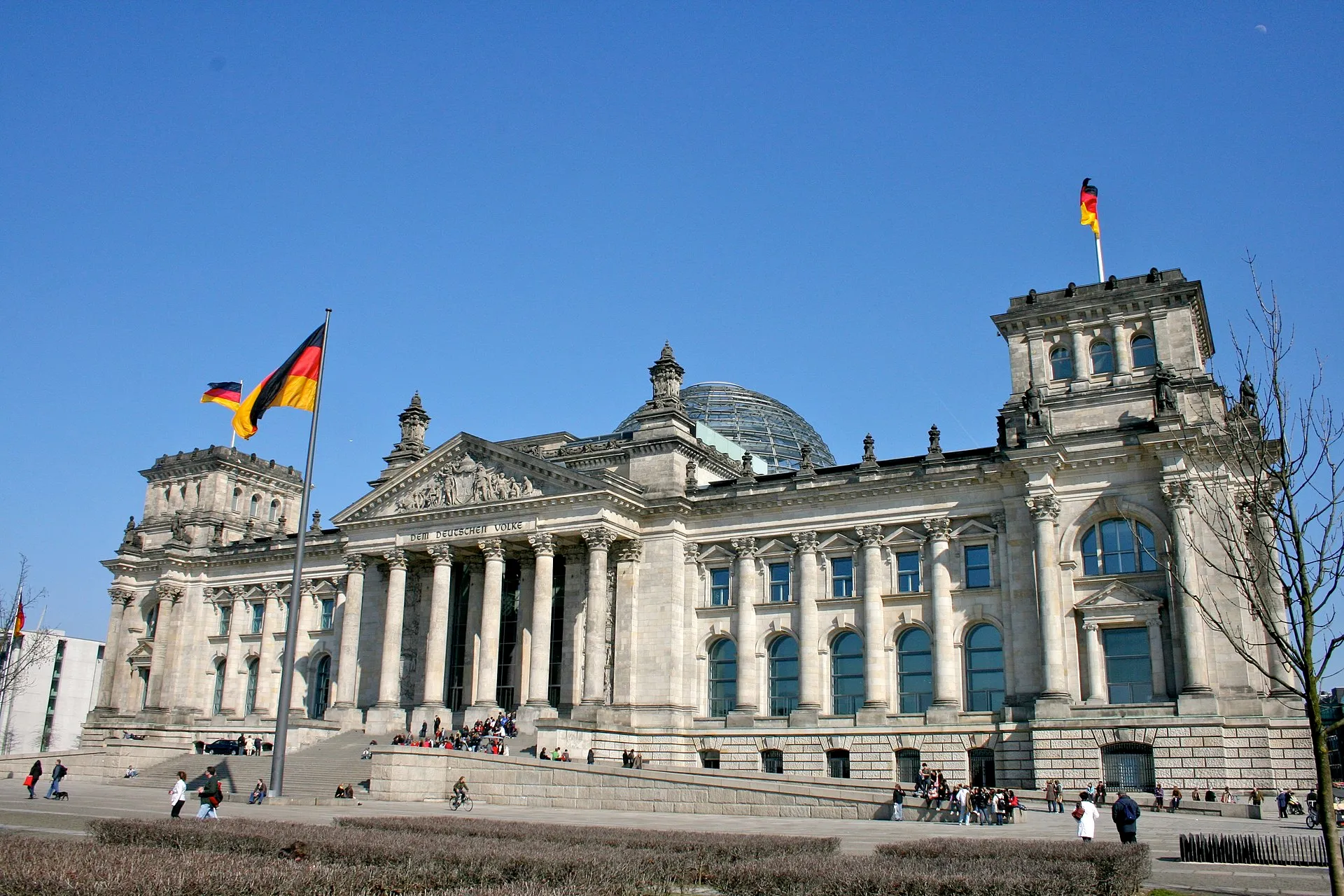
Architect Paul Wallot completed the Reichstag for the parliament of the German Empire after a decade of construction on Platz der Republik.
-
"Dem Deutschen Volke" inscribed
The bronze dedication "To the German People" was finally mounted across the west portico, its letters reportedly cast from captured French cannon.
-
Weimar Republic proclaimed
Philipp Scheidemann declared the German republic from a Reichstag window on 9 November 1918.
-
The Reichstag fire
The chamber burned on 27 February 1933; within a day the Reichstag Fire Decree suspended civil liberties and cleared the path to dictatorship.
-
Red Army flag raised
Soviet troops captured the ruined building in the Battle of Berlin; Yevgeny Khaldei's flag photograph became one of the war's defining images.
-
Christo and Jeanne-Claude wrap it
The artists sheathed the whole structure in 100,000 square metres of silvery fabric for two weeks, drawing millions before reconstruction began.
-
Foster dome, Bundestag returns
Norman Foster's glass cupola crowned the rebuilt shell and the Bundestag sat in Berlin again for the first time since reunification.
Architecture
Foster's design is an argument about democracy made in steel and glass. The cupola weighs some 1,200 tonnes and is open to the sky at its crown, letting rain and air reach a central mirrored cone clad in 360 angled mirrors that funnels daylight down into the plenary hall and vents warm air upward — a low-energy lighting and ventilation system, not merely a viewpoint. Two gently rising spiral ramps carry visitors 360° around the dome to a rooftop terrace, while a glass oculus floor looks straight down onto the parliamentary benches, so citizens literally stand above their legislators. Below, Foster stripped the interior back to Wallot's 1894 stonework and left the scars visible: pockmarks from 1945 shellfire and the Cyrillic graffiti of Soviet soldiers survive on preserved wall panels. A free audio guide, keyed to your position on the ramp, names the landmarks unfolding across Berlin — the Brandenburg Gate, the wooded Tiergarten, and the distant television tower rising over the former East.
Historical Significance
Few buildings have witnessed a nation's fortunes so directly. The empire's parliament met here from 1894, and the Weimar Republic was declared from a window in 1918. On the night of 27 February 1933 the chamber burned, and the Nazi government used the Reichstag Fire Decree to suspend civil liberties within 24 hours — a single fire that helped dismantle German democracy. In the Battle of Berlin in May 1945, Yevgeny Khaldei's photograph of a Soviet flag over the Reichstag became one of the war's defining images, and the soldiers' inscriptions inside date from those days. Through the Cold War the building stood derelict, the Berlin Wall running only metres to its east. In 1995 the artists Christo and Jeanne-Claude wrapped the entire structure in 100,000 square metres of silvery fabric for two weeks, drawing millions and marking a symbolic close to the old era before Foster's reconstruction returned the Bundestag to Berlin in 1999.
When to Visit
The dome and roof terrace are open daily, 8:00 AM to midnight, with last admission at 10:00 PM. Sunset is the standout slot, when the low sun colours the Tiergarten and the government quarter; the quietest windows are the first hour after opening (8–9 AM) and the last hour before closing.
- Allow 1–1.5 hours for the dome and roof, or around 2 hours if you add a guided tour of the building and plenary chamber
- Sunset slots book out first — reserve two to three weeks ahead in summer
- Winter still rewards — the heated, enclosed dome frames Berlin's illuminated skyline with far shorter queues from November to February
- Guided English tours of the building run several times daily and are booked separately from the dome
Admission and Costs
Visiting the Reichstag is one of Berlin's great free experiences — you pay only for optional extras and private guiding:
- Dome and roof terrace — Free, but advance online registration through the Bundestag is mandatory (passport required at the entrance)
- Guided building tours — Free English-language tours of the plenary chamber and history, in limited slots that fill quickly
- Audio guide — Free with every dome visit, available in around 20 languages
- Käfer Dachgarten rooftop restaurant — open to the public with its own free security booking; à la carte dishes typically run €20–35 ($22–38)
- Private government-quarter walking tours including the Reichstag — about €40–60 ($43–65) per person for a small-group neighbourhood walk
The Case for a Guide
Foster's dome reads as a spectacular viewpoint, but almost everything that makes the Reichstag matter is invisible until someone explains it — which is exactly where a guide earns their fee.
- The dome as a political statement: a guide explains why the public ramp was placed above the chamber and why the glass floor looks down onto the legislators — a conscious inversion of power requested after reunification, and the opposite of the opaque 1894 building
- Soviet graffiti preserved inside: Red Army soldiers signed the walls in May 1945, and Foster kept panels of it rather than erasing them; a guide translates the Cyrillic and explains why keeping enemy soldiers' marks was a deliberate choice about historical honesty
- The 1933 fire and its consequences: a guide traces how one night's arson became the legal pretext for the Reichstag Fire Decree and the end of Weimar democracy
- Reading the Berlin skyline: from the roof terrace a guide names each landmark in context — why the Brandenburg Gate lies west, and how the scar of the Wall is still faintly legible in the city
- How the Bundestag works: watching the chamber through the glass floor, a guide explains the elliptical seating, the coalition arithmetic of German politics, and which days parliament sits
Tips for Visitors
- Register weeks ahead — free dome slots at bundestag.de open about two months out, and popular times, especially sunset, fill fast
- Bring your passport — a physical ID matching your booking is checked at security; a photo on your phone will not be accepted
- Arrive 15 minutes early — airport-style screening takes time and latecomers forfeit their slot
- Travel light — large bags and backpacks are prohibited and there are no lockers nearby
- Use the free audio guide — it tracks your position on the ramp and is genuinely excellent on the dome architecture and skyline
- Pair it with the Brandenburg Gate — the Brandenburg Gate is only a five-minute walk across the government quarter
- Arrive by U-Bahn — line U5 to Bundestag station drops you 300 metres from the door, while the 100 bus and Brandenburger Tor S-Bahn link the Reichstag to Museum Island and the rest of central Berlin
- Roll-up access — a lift reaches the roof terrace and the dome ramp takes wheelchairs, so the panorama is open to visitors with limited mobility
Frequently Asked Questions
Which months are ideal for visiting the Reichstag Building?
The glass dome is worth seeing year-round, but May through September lets you enjoy the open rooftop terrace in warm weather and long daylight, with sunset the clear highlight. Winter visits from November to February are rewarding too: the dome is heated and enclosed, panoramas over Berlin's illuminated skyline are crisp, and free booking slots are far easier to secure.
What are the opening hours of the Reichstag dome?
The dome and roof terrace are open every day from 8:00 AM to midnight, with last admission at 10:00 PM. The least crowded times are the first hour after opening and the final hour before closing, while sunset is the most sought-after and books out first. Allow about 1 to 1.5 hours for the dome and roof, or roughly 2 hours if you add a building tour.
How much does it cost to visit the Reichstag dome?
No — visiting the dome, roof terrace, and guided building tours is completely free, as is the multilingual audio guide included with a dome visit. You must, however, register in advance online through the Bundestag and bring the passport or ID you booked with, because walk-up entry is not possible.
How do you book a Reichstag visit and what should you bring?
Reserve a free timed slot on the Bundestag website (bundestag.de) up to about two months ahead; sunset and weekend slots fill first. Every visitor named on the booking must show a physical passport or national ID card at the security checkpoint, arrive around 15 minutes early for airport-style screening, and travel light, since large bags and backpacks are not allowed and no lockers are available nearby.
What do guided tours of the Reichstag Building include?
Guided tours decode Norman Foster's dome design and its energy-saving mirrored cone, trace the building's history from the 1894 empire through the 1933 fire and 1945 capture to reunification, and explain how the German parliamentary system works today — often with views straight down into the plenary chamber through the dome's glass floor.
How do you get to the Reichstag by public transport?
The quickest approach is the U-Bahn line U5 to Bundestag station, which surfaces inside the parliamentary quarter barely 300 metres from the entrance. Brandenburger Tor station, five minutes' walk south, adds the S-Bahn lines S1, S2, S25 and S26. Berlin Hauptbahnhof, the main rail station, is a ten-minute walk north across the Spree, and the 100 bus — Berlin's cut-price sightseeing line between Zoologischer Garten and Alexanderplatz — stops at the Reichstag/Bundestag before continuing past the Brandenburg Gate and on toward Museum Island.
Is the Reichstag dome wheelchair accessible?
Yes. A lift carries visitors from ground level straight to the roof terrace, and the dome's gently graded spiral ramp is navigable in a wheelchair, though the continuous incline is noticeable. Accessible toilets are provided on the roof, assistance dogs are welcome, and the Bundestag can arrange step-free routes or sign-language guiding if you note your requirements when you register online.