
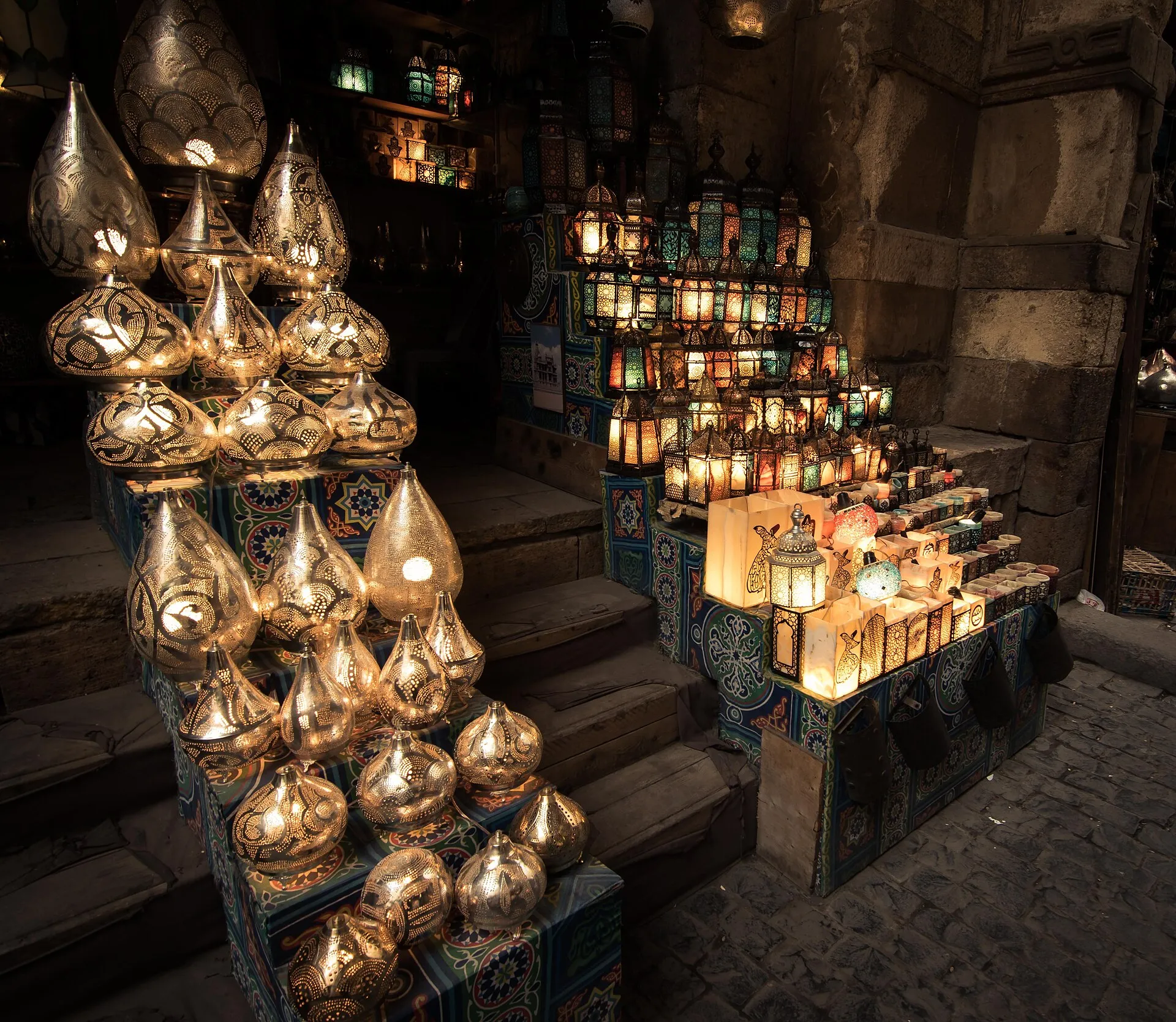
What To Buy
The bazaar rewards specificity: rather than browsing aimlessly, arrive knowing what interests you and let your guide lead you to the appropriate specialists.
- Brass and copper lanterns: Seek the workshops off the main tourist lanes where artisans still punch geometric patterns by hand. Small table lamps start around EGP 200 ($4) and large hanging fixtures climb into the thousands. Quality pieces show crisp, even perforations and smooth soldering.
- Spices and dried goods: The spice lanes brim with saffron, cumin, dried hibiscus (karkadeh), and Egyptian molokhia leaves measured from burlap sacks. Reputable vendors let you smell before buying and will recommend blends for specific dishes.
- Gold and silver jewellery: The Sagha quarter prices precious metals by weight at daily rates, making custom pieces surprisingly affordable. Specify a design, choose your stones, and return in a few hours while craftsmen work — a cartouche engraved with your name in hieroglyphs is the classic commission.
- Leather goods: Hand-stitched journals, bags, and belts come from workshops where the tanning smell still lingers. Examine the stitching closely; machine work lacks the slight irregularity that marks genuine handcraft.
- Perfume essences: Oil-based perfumes sold by the gram let you blend custom scents. Bring a reference fragrance and a skilled perfumer will approximate it from a wall of essence bottles.
Food Stalls
Eating your way through Khan El-Khalili is half the reason to come. The anchor is El-Fishawi, which has served coffee from the same mirror-walled premises since 1773, making it one of the oldest continuously operating cafes in the world. Naguib Mahfouz wrote scenes from his Cairo Trilogy in these rooms, and his regular corner is still pointed out to visitors. Order a mint tea, a thick Turkish coffee, or a sahlab (warm orchid-root milk) in winter and settle in among the backgammon players and shisha smoke; a glass costs roughly EGP 30-50 ($0.60-1).
For a full meal, the stalls fanning out from Al-Hussein Square serve Cairo's defining street food. Koshari — layered rice, lentils, macaroni, and fried onions under a spiced tomato sauce — is the national comfort dish and a filling bowl runs about EGP 40-70 ($0.80-1.50). Taameya, Egypt's fava-bean take on falafel, and hawawshi, spiced minced meat grilled inside baladi bread, make quick handheld lunches. Finish with feteer meshaltet, a flaky layered pastry served sweet or savoury, or a cup of fresh sugarcane juice pressed at the corner stands. A guide steers you to the stalls locals actually queue at rather than the tourist-priced counters nearest the bus parking.
Khan El-Khalili timeline
- Pre-1382
A Fatimid burial ground
The site held the Turbat az-Zafaran, a cemetery where the Fatimid caliphs were buried. Its clearance to make way for a market severed the quarter's dynastic past and remains a point raised in Cairo's historiography.
-
Djaharks El-Khalili builds the caravanserai
The Mamluk emir Djaharks El-Khalili, master of the horse to Sultan Barquq, erected a large khan (caravanserai) to lodge merchants on the trans-Saharan and Indian Ocean trade routes, giving the district its name.
-
Sultan al-Ghuri rebuilds the market
Qansuh al-Ghuri, the penultimate Mamluk sultan, demolished much of the old khan and raised the grand gateways and commercial streets that still frame the bazaar, cementing its place as Cairo's mercantile core.
-
El-Fishawi coffeehouse opens
The mirror-walled El-Fishawi begins serving coffee off the lanes beside Al-Hussein, growing into one of the world's oldest continuously operating cafes and, two centuries on, a haunt of novelist Naguib Mahfouz.
-
Historic Cairo joins UNESCO's World Heritage list
Khan El-Khalili falls within Historic Cairo, inscribed by UNESCO in 1979 for one of the densest concentrations of Islamic architecture anywhere, spanning Fatimid through Ottoman periods.
When to Visit
Most shops open daily from 9:00 AM until 11:00 PM, with the bazaar technically accessible around the clock — the surrounding streets never fully close. Friday mornings are the exception: many merchants attend congregational prayers at nearby Al-Azhar Mosque, so activity drops noticeably between roughly 11:00 AM and 1:00 PM. The most atmospheric hours come after sunset, when hanging lanterns cast geometric shadows across the alleys and the heat of the day dissipates; the bazaar feels most alive from 7:00 to 10:00 PM. Avoid summer midday (June–August) when temperatures routinely exceed 38°C in the narrow covered lanes. The annual moulid of Imam al-Hussein, held nearby, draws enormous crowds and transforms the surrounding streets. Allow 2–3 hours for a thorough exploration; dedicated shoppers or visitors with a guide may spend half a day.
Admission and Costs
Entry to Khan El-Khalili is free — it is a working market, not a ticketed site, so your only costs are what you choose to buy and whether you hire a guide. A shared small-group walking tour of the bazaar and wider Islamic Cairo typically runs $30-50 per person for two to three hours, while a private licensed guide costs $60-100 for a half-day; many Cairo guides fold Khan El-Khalili into a combined itinerary with the Saladin Citadel or the Egyptian Museum.
Budget for the bargaining culture: the opening price quoted to tourists usually runs two to four times the realistic final price, and walking away is the most effective way to find the true floor. Small refreshments are cheap — tea or coffee at EGP 30-50 ($0.60-1), a koshari bowl at EGP 40-70 ($0.80-1.50) — while big-ticket crafts like inlaid boxes, large lanterns, or gold run into the hundreds or thousands of pounds. Carry cash in Egyptian pounds: almost all vendors are cash-only, and the nearest reliable ATMs sit on Al-Azhar Street rather than inside the lanes. Shops can arrange international shipping for bulky purchases, usually quoted separately by weight.
The Case for a Guide
Khan El-Khalili can overwhelm first-timers — the touts near the entrance are loudest, the prices opaque, and the genuine workshops hidden down lanes most visitors never find. A guide who knows Islamic Cairo turns that chaos into a purposeful few hours.
- Bargaining backup: Your guide tells you a fair price band before you enter a shop and coaches the back-and-forth, so you neither overpay nor insult a vendor with a lowball offer.
- Finding the real artisans: Locals know which coppersmiths, perfumers, and goldsmiths still work by hand and welcome observers, steering you past machine-made imports sold as handicraft.
- Historical context: A guide reads the Mamluk gateways, the restored wikala caravanserais, and the trade-by-trade layout that most visitors walk straight past, connecting the bazaar to the wider story of Cairo's Islamic quarter.
- Language and logistics: Few artisans speak much English; a guide translates techniques and prices, secures access to workshops under restoration, and knows when to pause for tea — the moments when genuine cross-cultural exchange actually happens.
Tips for Visitors
Bargaining follows unwritten rules that separate friendly negotiation from an insulting offer: counter at roughly half the opening price, stay good-humoured, and treat walking away as your strongest tool — genuine final prices often materialise only when you reach the doorway. Wear comfortable closed-toe shoes, since the stone alleys are uneven and you will be on your feet for hours, and carry small bills (EGP 10, 20, and 50 notes) because vendors rarely have change for large denominations. Keep valuables zipped away in the densest crowds, as the lanes get shoulder-to- shoulder after dark. Beyond the shopping, seek out the restored wikala al-Ghuri, a 16th-century caravanserai that now hosts craft workshops and evening Sufi (tannoura) performances in its galleried courtyard. For a fuller day, the Saladin Citadel sits a short taxi ride to the east and the Egyptian Museum lies about two kilometres west, making combined itineraries easy to arrange.
Frequently Asked Questions
When is Khan El-Khalili open and what are the best hours to visit?
The bazaar operates daily, with most shops open from 9 AM until 11 PM, and the surrounding lanes never fully close. The most atmospheric hours fall after sunset, roughly 7 to 10 PM, when hanging lanterns light the alleys and the daytime heat fades. Friday mornings are quietest, as many merchants attend congregational prayers at nearby Al-Azhar Mosque between about 11 AM and 1 PM.
How much does it cost to visit Khan El-Khalili?
Entry to the bazaar is free. A shared small-group walking tour of Islamic Cairo runs about $30-50 per person for two to three hours, while a private licensed guide costs $60-100. Expect to haggle on goods: opening prices quoted to tourists typically run two to four times the realistic final price. A mint tea at El-Fishawi is around EGP 30-50 ($0.60-1).
How do you get to Khan El-Khalili and where should visitors enter?
The bazaar sits in Islamic Cairo between Al-Azhar Mosque and Al-Muizz Street, about 2 km east of downtown. Uber and Careem are the easiest way in; the nearest Metro stops, Bab El Shaaria and Ataba on Line 2, are a 15-minute walk away. Most visitors enter from Al-Hussein Square beside the mosque, though the quieter craft lanes lie deeper inside.
What are the best things to buy and eat at Khan El-Khalili?
The market is organised by trade: hand-hammered brass and copper lanterns, loose spices and dried hibiscus, gold jewellery weighed to order in the Sagha quarter, leather goods, and custom perfume essences. For food, sample koshari, taameya (Egyptian falafel), and grilled hawawshi from the stalls around Al-Hussein Square, then finish with coffee at the 18th-century El-Fishawi cafe.