
Observation Spots
Formation
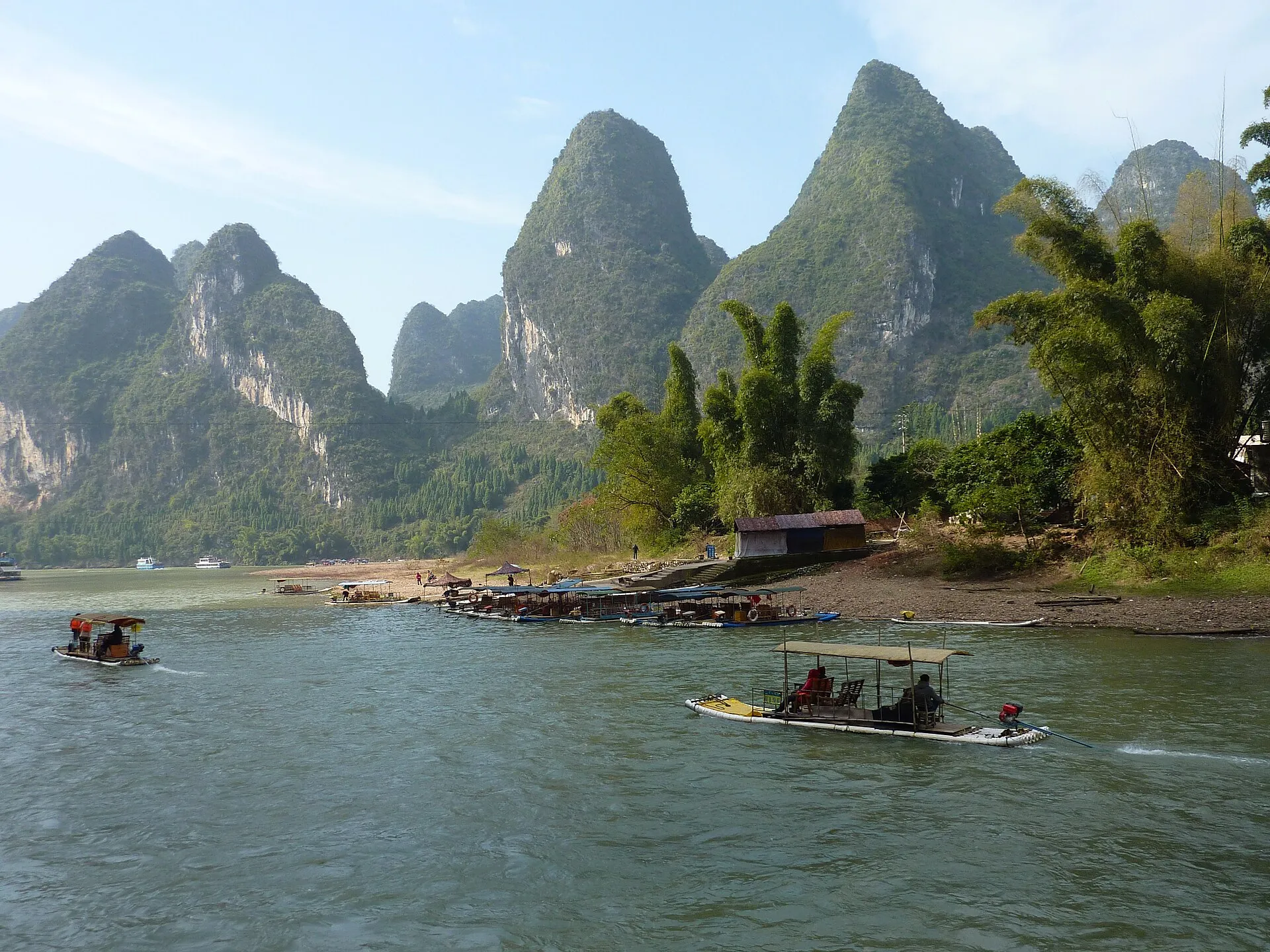
Guilin's peaks are the eroded remains of a Devonian and Carboniferous seabed laid down more than 300 million years ago, when this part of southern China lay beneath a warm, shallow ocean. Thick beds of pure limestone built up from coral and shell, were later uplifted, and then fractured. Mildly acidic rainwater and the Li River itself spent millions of years dissolving the soluble rock along those fractures, carving the flat-floored valley and leaving the most resistant blocks standing as isolated towers. Geologists call the result tower karst (fenglin), the mature end-stage of karst weathering; the denser clusters of conical summits are the earlier fengcong, or "peak cluster," stage.
The scenery depends completely on water and season. Guilin sits in a subtropical monsoon climate — hot, wet summers and cool, dry winters — with most of its roughly 1,900 millimeters of annual rain falling between April and August. High summer water floats the largest boats but occasionally rises far enough to suspend sailings for safety, while late autumn and winter drop the river low and clear yet can strand the shallow bamboo rafts on the upper reaches. The mist that softens the peaks into receding grey silhouettes — the effect prized by classical ink painters — is heaviest in spring, when warm air meets the cool river surface.
Trails
The most photogenic 20-kilometer stretch runs from Yangdi wharf down to Xingping, where the peaks crowd closest to the water; if you take a bamboo raft rather than a big boat, this is the section to choose. Landmarks to watch for downstream:
- Nine Horses Fresco Hill — a cliff streaked with dark mineral stains said to form nine galloping horses; guides help you spot them all
- 20-Yuan View at Xingping — the Huangbu Shoal bend that lines up the exact peaks and reflections engraved on the banknote
- Cormorant fishermen — near Xingping and Yangshuo, elderly fishermen still pose with trained birds, especially at dusk
- Xingping Ancient Town — a preserved Song-dynasty river town at the midpoint with cobblestone lanes and riverside cafés
- Water buffalo crossings — herds wade the shallows between villages, unfazed by passing boats
- Bamboo grove tunnels — thick stands of bamboo arch over narrow tributary mouths, forming emerald-lit corridors
Wildlife
The Li River corridor is a living farmscape as much as a wild one. Water buffalo graze the riverside flats and wade belly-deep to cool off between villages, while domestic ducks paddle the margins. At dawn and dusk little egrets and Chinese pond herons stalk the shallows, and white-breasted kingfishers and black kites patrol the open water above the reflections. In the subtropical canopy draping the karst cliffs, cuckoos, orioles, and bulbuls call through spring and summer, and swifts nest in the higher rock crevices. The cormorants that fishermen still keep near Xingping are great cormorants, historically trained to dive from bamboo rafts and surface with fish held in the throat — a practice now sustained largely for visitors rather than the catch.
When to Visit
Departure: Large tourist boats board at the Mopanshan and Zhujiang piers — about a 40-minute transfer south of central Guilin — from around 8:00 AM, casting off together between 9:30 and 10:30 AM. Because the upper river near the city runs too shallow to navigate reliably, essentially all downstream cruises now start from these piers rather than from Guilin itself. Duration: 4 to 4.5 hours downstream to Yangshuo, one way; the boats do not return, so arrange onward transport from Yangshuo. Best light: The earliest departures catch mist burning off the peaks into layered silhouettes. Seasonal cautions: July and August bring the highest water, which occasionally suspends sailings; spring delivers the most atmospheric mist but wet decks, so pack a light rain layer.
Admission and Costs
Standard cruise ticket: ¥210 ($30) on the economy deck up to ¥360 ($50) for a VIP upper deck with buffet lunch; the fare is fixed by the local authority and includes the boat and a basic meal. Bamboo raft, Yangdi–Xingping section: around ¥118 ($17) per person for the shorter scenic-highlight stretch, a good-value option if you cannot spare the full morning. Return transport, Yangshuo to Guilin: ¥25–50 ($4–7) by public bus, roughly 90 minutes, or more by private car. Guide surcharge: many private guides fold the ticket into a day rate — expect Guilin's half-day guiding rate of roughly ¥300–600 ($40–85) on top of, or inclusive of, the ticket, so confirm exactly what is covered before you pay.
The Case for a Guide
On paper the cruise is a single ticket, but a licensed guide changes what you actually get from four hours on the water. Onboard commentary is usually in Mandarin only, so without a guide the passing landmarks — Nine Horses Fresco Hill, the banknote viewpoint, the old river towns — slide by unexplained. A guide names the peaks, unpacks the karst geology and the classical poetry the scenery inspired, and knows which side of the deck to stand on for each bend.
The practical gains are just as real:
- Logistics — securing the fixed-price ticket, timing the pier transfer, and arranging onward travel from Yangshuo, where signage and drivers work largely in Mandarin.
- The raft alternative — booking a legitimate Yangdi–Xingping bamboo raft at a fair rate rather than an unlicensed operator on the bank.
- The wider region — chaining the cruise with Reed Flute Cave and the Longji Rice Terraces into a coherent itinerary rather than three disconnected day trips.
Tips for Visitors
Book the upper deck: The VIP deck offers unobstructed photography and more room than the crowded economy cabin; for a once-only trip it is worth the difference. Sit on the right going downstream: Many signature peaks and the banknote view fall on the boat's right (west) side. Bring your own food and water: Economy lunch is basic and onboard prices climb, so pack fruit, snacks, and a full water bottle. Carry a power bank: Outlets are scarce on most boats and you will photograph constantly. Overcast is not a write-off: Grey, drizzly days deepen the greens and thicken the mist into the layered effect of classical ink paintings. Stay the night in Yangshuo: Rather than rushing back to Guilin, spend the evening for cycling, rock climbing, and Zhang Yimou's open-air Impression Sanjie Liu light show on the river.
Frequently Asked Questions
What are the departure times and duration of the Li River Cruise?
Large tourist boats board at the Mopanshan and Zhujiang piers, about a 40-minute transfer south of central Guilin, from roughly 8:00 AM and cast off together between 9:30 and 10:30 AM. The downstream run to Yangshuo takes 4 to 4.5 hours, and the boats do not sail back — plan onward transport from Yangshuo.
How much does the Li River Cruise cost?
Standard cruise tickets run ¥210 ($30) on the economy deck up to ¥360 ($50) for a VIP upper deck with buffet lunch; the fare is set by the local authority and includes the boat and a basic meal. A bamboo raft for the shorter Yangdi–Xingping highlight is about ¥118 ($17), and the return bus to Guilin costs ¥25–50 ($4–7).
Should I take the big cruise boat or a bamboo raft?
Take the four-hour cruise boat for the full Guilin-to-Yangshuo panorama, a covered deck, and lunch. Choose a motorised bamboo raft on the Yangdi–Xingping section if you have only a morning or want to sit lower and closer to the water on the most scenic 20 kilometres — but note high or low water can suspend the rafts.
What should visitors know before booking the Li River Cruise?
Book the upper deck for unobstructed photography and more space, and sit on the right (west) side going downstream, where the banknote view and most signature peaks appear. Onboard lunch is basic, so pack fruit, water, and a power bank, and consider staying overnight in Yangshuo rather than rushing back.