
Walking Route
Walking Routes
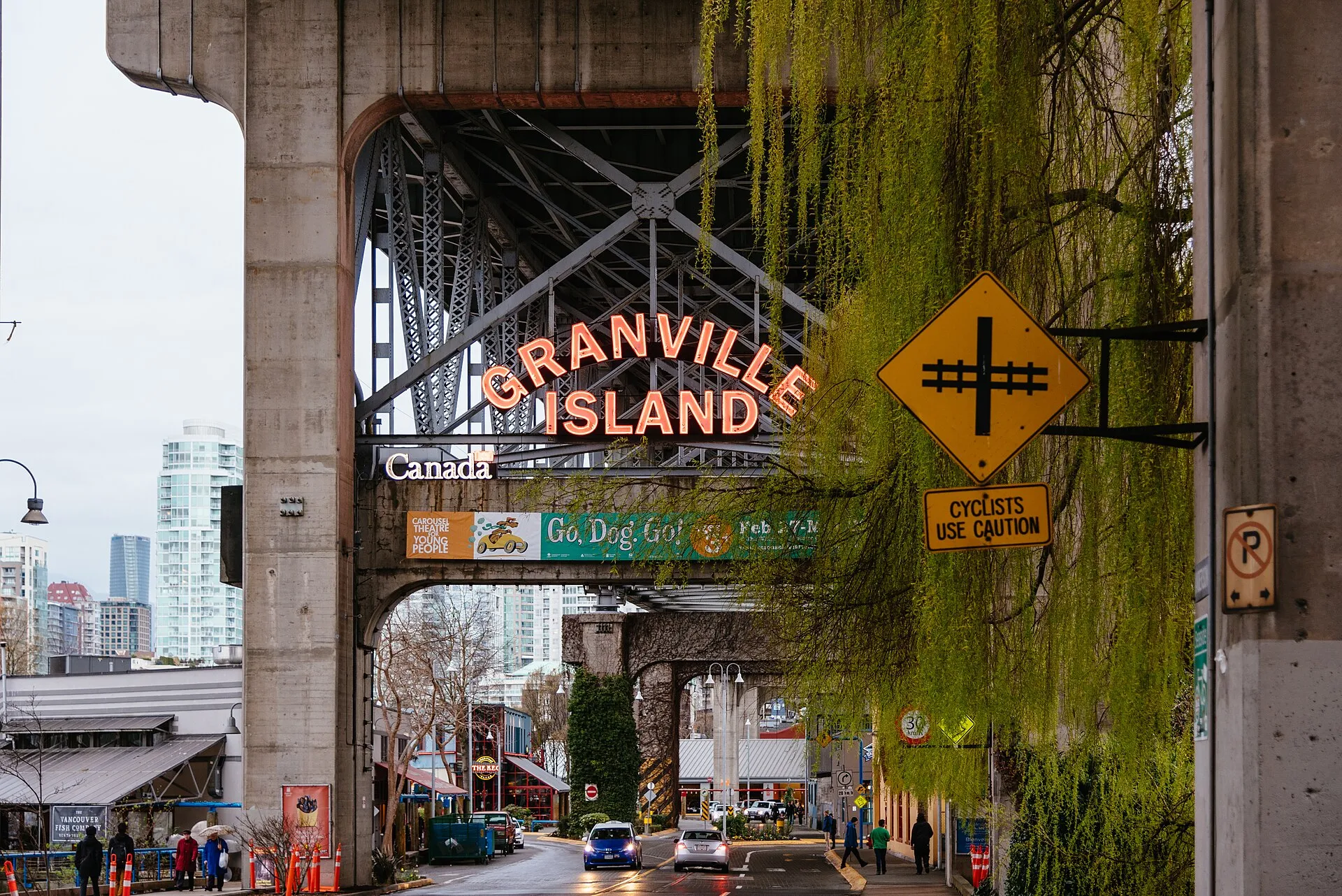
The island is compact enough to cover on foot in a single loop, and the most rewarding circuit begins at the Public Market entrance off Johnston Street, where the causeway from the mainland deposits most arrivals. From there, follow Johnston Street clockwise past the Net Loft and the Kids Market, then duck south into Railspur Alley, a narrow lane of glassblowing, textile, and ceramics studios laid along the island's original rail spurs. Carry on to the Ocean Concrete plant — still a working cement operation, its silos painted as six towering cartoon figures by the Brazilian street artists Os Gêmeos for the Vancouver Biennale in 2014, and the island's single best photo backdrop — before looping back along Old Bridge Street past Granville Island Brewing. For the classic skyline shot, walk out onto the public dock behind the market or pick up the False Creek seawall on the island's southern edge, where a paved waterfront path threads past the former Emily Carr footprint and continues west toward Vanier Park and Kitsilano Beach, a scenic thirty-minute walk hugging the same continuous seawall that rings Stanley Park further north. For photographers, the island rewards close work as much as wide views: the neon-lit produce stalls and tin-roof rafters inside the Public Market, the painted doorways and glassblowers' furnaces of Railspur Alley, and the Aquabus's squat rainbow-hulled ferries crossing beneath the Granville Street Bridge all frame better in the soft, even light of an overcast West Coast morning than under harsh midday sun. Circling the full perimeter takes under an hour at an unhurried pace, with constant views back across the inlet to downtown Vancouver's towers.
Local Life
Beyond the tourist crush of the market, Granville Island runs on the daily rhythm of its roughly 300 businesses and the makers who actually work here. Mornings belong to the studio crowd along Railspur Alley, where glassblowers fire their furnaces and printmakers open their doors before the first ferries dock, and to regulars who slip into the market for a coffee and a Lee's Donuts classic before the aisles fill. The Emily Carr University of Art and Design occupied the island for decades and left a lingering student-and-maker culture even after its 2017 move to a new campus at Great Northern Way, still visible in the theatres, rehearsal spaces, and independent galleries tucked between the sheds. Afternoons draw buskers to the waterfront boardwalk — many are seasoned, genuinely world-class performers who audition for their permit spots — while the Improv Centre, Carousel Theatre, and Vancouver TheatreSports League keep evenings lively year-round. For a quieter corner, locals climb the grassy knoll of Ron Basford Park on the island's eastern tip — named for the federal minister who championed the redevelopment — to picnic above the False Creek Ferries dock and watch the boats shuttle across to Science World and the Olympic Village shoreline. Craft breweries and the food stalls of the Public Market anchor the social scene, and the seawall benches serve as an open-air living room for anyone happy to trade the crowds for the water view.
When to Visit
- Public Market: Daily 9 AM - 7 PM, though a handful of vendors close earlier on Sundays and around statutory holidays.
- Artisan studios: Most keep 10 AM - 6 PM hours, but times vary workshop to workshop, so check the door if a specific maker is your reason for coming.
- Best time: Weekday mornings between 9 and 11 AM, when vendors are freshly stocked and the aisles are not yet shoulder-to-shoulder; by noon on summer weekends the market and the causeway both jam.
- Evening draw: Thursday through Saturday nights bring live performances at the Improv Centre, the Vancouver TheatreSports League, and the family-oriented Carousel Theatre, so the island rewards a return after dark — when the food stalls have closed but the theatres and breweries are in full swing.
The market and studios are strongly seasonal: our month ratings peak from June through September, when long, dry evenings pull buskers and patio crowds to the waterfront, and dip to their lowest in the grey, rain-soaked stretch from November through February, when the covered aisles make the island a reliable wet-weather bolthole rather than a sunny outing.
Admission and Costs
- Island entry: Free — there is no gate or admission charge to wander the island, browse the studios, or watch the buskers.
- Aquabus ferry: CA$3.75 (~US$2.75) one way from downtown docks at Hornby Street or David Lam Park; the rival False Creek Ferries charges a comparable fare from the Aquatic Centre and Yaletown.
- Market grazing budget: CA$20-40 (~US$15-30) buys generous samples of cheese, charcuterie, baked goods, and a cup of chowder.
- Brewery flight: CA$12-18 (~US$9-13) at Granville Island Brewing or a neighbouring microbrewery.
- Paid parking: roughly CA$3-5 (~US$2-4) per hour in the island's lots, capped at three hours — one more reason most locals arrive on foot, by bike, or by boat.
The Case for a Guide
A stroll through the Public Market shows you the surface of Granville Island; a good guide unlocks the working island underneath it. Because the site is a lived-in community of artisans rather than a ticketed attraction, much of what makes it interesting — which studios welcome visitors, when the glassblowers pour, how the industrial past shaped every shed — is easy to walk straight past without someone to point it out.
- Food-and-market guides turn the Public Market's overwhelming choice into a curated tasting route, introducing the vendors, the Fraser Valley producers behind the stalls, and the smartest order in which to graze.
- Art-and-craft guides know which Railspur Alley studios are open, when demonstrations happen, and the stories behind the resident glassblowers, potters, and printmakers.
- History and architecture guides read the island's industrial bones — the rail spurs, the working Ocean Concrete plant, the salvaged tin sheds — and explain how a derelict factory zone became a national model for urban renewal.
- Photography guides chain the best light, from the Os Gêmeos silos to the skyline reflections off the False Creek seawall.
For a first visit, a two-hour guided walk keeps you from treating Granville Island as just a food hall and reveals the creative, still-industrial neighbourhood that Vancouver locals prize.
Tips for Visitors
- Skip the car. Parking is infamously scarce and capped at three hours — take the Aquabus or False Creek Ferries from downtown, cycle in along the False Creek seawall, or ride TransLink bus 50 to the island's edge.
- Eat in stages. The market rewards grazing over sit-down meals; pick up a samosa here, a crêpe there, and finish with a Lee's Donuts classic.
- Come on a rainy day. Most of the market and studios sit under cover, making Granville Island one of the best wet-weather outings in a city that sees plenty of rain.
- Catch the free buskers. Licensed street performers play the waterfront daily through summer — some are genuinely world-class acts.
- Roll straight in. The Public Market, Net Loft, and main streets are flat and step-free with accessible parking and washrooms nearby, so strollers and wheelchairs manage easily; the step-down ferry docks are the one awkward spot, and TransLink bus 50 is the smoother arrival for anyone with mobility needs.
- Chain it with the seawall. The waterfront path continues west toward Vanier Park and Kitsilano Beach, a scenic thirty-minute walk, or east by Aquabus to Gastown and the downtown shoreline. Add the rainforest loop of Stanley Park or the North Shore canyon of Capilano Suspension Bridge and you have a full car-free day across Vancouver's waterfront.
Frequently Asked Questions
What are the opening hours for Granville Island's market and studios?
Public Market: Daily 9 AM - 7 PM, though some vendors close earlier on Sundays and around statutory holidays. Artisan studios: Most open 10 AM - 6 PM, but hours vary workshop to workshop, so check the door if a specific maker is your reason for coming.
What prices should visitors expect at Granville Island?
Island entry: Free — there is no gate or admission charge to wander the island. Aquabus or False Creek Ferries: about CA$3.75 (US$2.75) one way from downtown docks. Market grazing: CA$20-40 (US$15-30) covers generous samples; a brewery flight runs CA$12-18 (~US$9-13).
What practical tips should visitors know before going to Granville Island?
Come hungry and graze rather than sitting down — the Public Market rewards a samosa here and a crêpe there over one big meal. Most of the market and studios sit under cover, making it a strong rainy-day pick, and weekday mornings from 9 to 11 AM are the calmest window before the summer-weekend crush fills the aisles.
Where are the best photo spots on Granville Island?
The six giant painted figures on the Ocean Concrete silos — created by Os Gêmeos for the 2014 Vancouver Biennale — are the island's signature shot. For the downtown skyline mirrored in False Creek, head to the public dock behind the Public Market or the southern seawall; Railspur Alley's studio doorways reward close-up detail.
How do you get to Granville Island without a car?
Leave the car behind. The Aquabus and False Creek Ferries cross from downtown docks at Hornby Street, David Lam Park, and Yaletown for a few dollars each way, TransLink bus 50 stops at the island edge, and the False Creek seawall lets you cycle or walk in from downtown or Kitsilano.
Is Granville Island accessible for wheelchairs and strollers?
Mostly yes. The Public Market, Net Loft, and main streets are flat and step-free, with accessible parking and washrooms near the market. The Aquabus uses step-down docks that can be awkward for wheelchairs, so travellers with mobility needs may prefer the bus, and some older Railspur Alley studio thresholds vary.
What is the history of Granville Island?
It is a man-made island: the Vancouver Harbour Commissioners dredged sand from False Creek to build up some 38 acres of industrial land between 1913 and 1916, originally called Industrial Island. Sawmills, iron works, and rope factories ran there until the 1950s and '60s, when the sheds fell derelict. In the early 1970s a federal renewal led by minister Ron Basford kept the industrial buildings and filled them with artists and food vendors; the Public Market opened in 1979, and the Canada Mortgage and Housing Corporation still administers the site.
What are the best things to eat at the Granville Island Public Market?
Graze rather than commit to one meal. Longtime favourites include a maple-glazed classic from Lee's Donuts, cured meats from Oyama Sausage Co., artisan loaves from Terra Breads and A Bread Affair, and a hot cup of chowder or fresh seafood at the Public Market's counters. Pick up BC cheese at Benton Brothers, then finish with a craft flight at Granville Island Brewing, Canada's first modern microbrewery.