
Observation Spots
Formation
Iguazu Falls exists because the Iguazu River reaches the edge of a vast sheet of ancient lava. The whole region sits on the Paraná Plateau, a stack of basalt flows that erupted across southern South America roughly 130 million years ago, as the supercontinent of Gondwana tore apart and the South Atlantic began to open. The river flows placidly across the top of this hard volcanic rock for hundreds of kilometers, then arrives at a step in the plateau and pours over it — the falls mark the lip of that basalt escarpment rather than a single cliff.
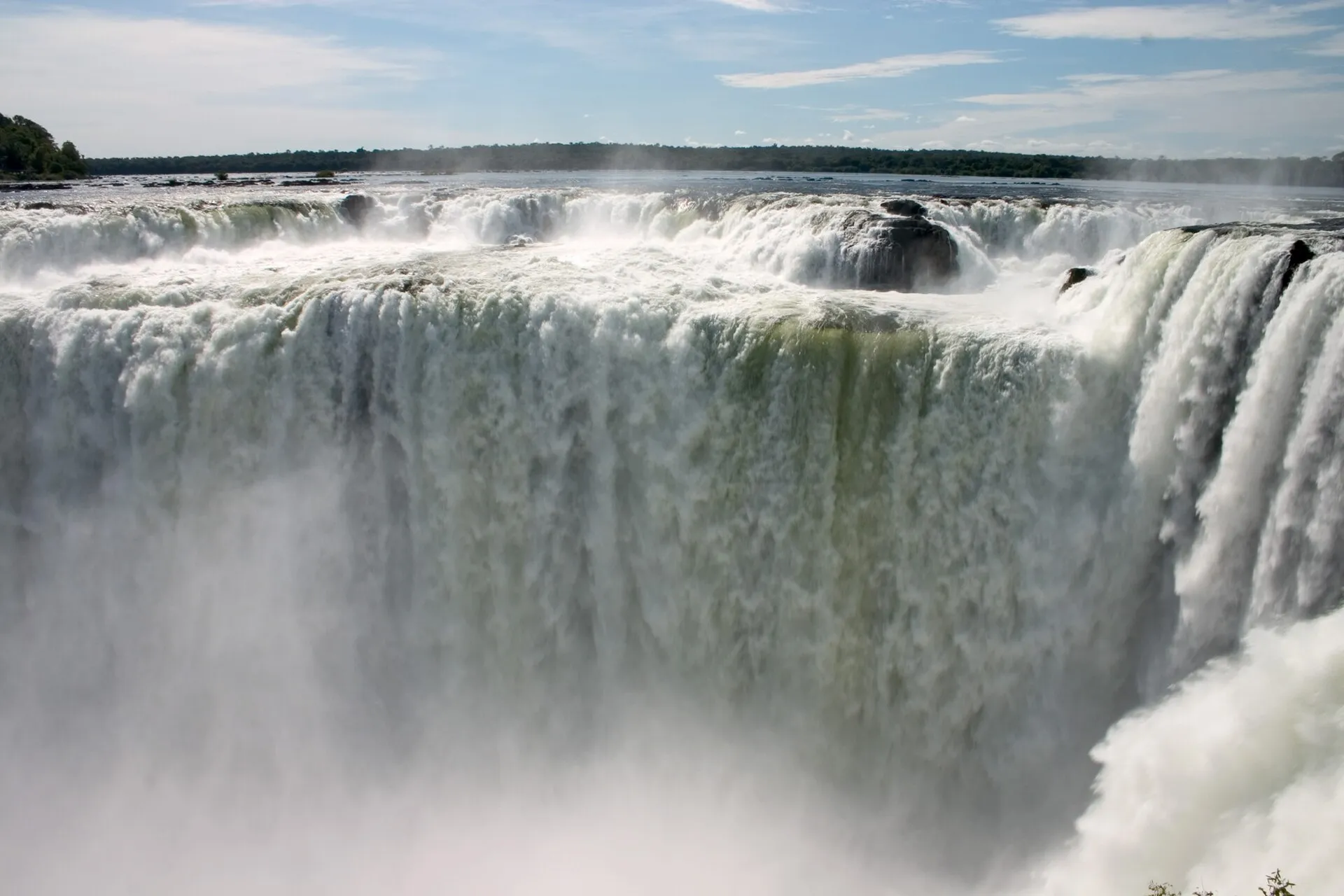
The shape of the falls is still changing. The upper basalt layers are harder than the rock beneath them, so the plunging water scours out the softer strata at the base, undercuts the ledge, and periodically collapses it — the same headward-erosion process that drives Niagara. Over tens of thousands of years this has pushed the cataract slowly upstream and carved the great U-shaped amphitheatre of the Garganta del Diablo, a chasm roughly 80 meters deep and 150 meters wide where the international border between Argentina and Brazil runs straight down the middle of the falling water. The Guaraní, the region's first inhabitants, explained the gorge with a legend still recounted along the catwalks: a forest deity, enraged when the mortal Tarobá fled downriver with the woman Naipí he meant to claim, split the river in fury and condemned the lovers to an eternal fall.
All of this is safeguarded on the Argentine side within Iguazú National Park, established in 1934 as one of Argentina's first national parks and still managed as a stronghold of the Upper Paraná Atlantic Forest — one of the most threatened rainforest ecoregions on the continent.
Trails
Garganta del Diablo: Stand on the platform at the edge of the U-shaped cascade where 50% of the river's water plunges into a narrow chasm — the sound, the mist, the rainbow arcing through the spray overwhelm every sense simultaneously. Lower Circuit: Catwalks bring you to the base of several cascades, close enough to feel the wind created by falling water — the Salto Bossetti viewpoint is the most photogenic. Gran Aventura boat ride: A Zodiac inflatable powers directly into the cascade zone for a drenching that provokes involuntary screaming and laughter — you will be completely soaked. Permanent rainbows: The mist from the falls generates rainbows that persist for hours when the sun is right — morning light on the Lower Circuit and afternoon light on the Upper Circuit produce the best arcs.
Wildlife
The surrounding Atlantic Forest makes Iguazu one of the most biodiverse spots in Argentina. Great dusky swifts nest behind the waterfalls themselves, darting through the spray at breakneck speed. Toco toucans perch in ceibo trees along the trails, their oversized orange bills unmistakable against the green canopy. Coatís patrol every picnic area with brazen confidence — entertaining but best observed from a distance. Butterflies number in the thousands: over 250 species have been recorded in the park, and on warm mornings they congregate in clouds along the trail edges. Caimans bask on the riverbanks below the falls, and lucky visitors may spot the tracks of jaguars — the park is part of the Green Corridor, one of the last jaguar habitats in Argentina. A naturalist guide transforms a waterfall visit into a wildlife safari.
When to Visit
Park hours: Daily 8 AM - 6 PM (last entry 4:30 PM). Best: Arrive at 8 AM to walk the Devil's Throat before the first tour buses arrive around 10 AM. Water volume: Highest during rainy season (November through March) — more dramatic but wetter. Dry season (June through September) has less mist, clearer views. Full moon walks: Available on select nights around the full moon — book through the park's official site weeks ahead. Duration: 5-7 hours to walk all three circuits comfortably.
Admission and Costs
Park entry (foreigners): AR$20,000-30,000 ($20-30) — prices update frequently. Ecological train (within park): Included with entry. Gran Aventura boat ride: AR$25,000-40,000 ($25-40) — takes you directly under the falls. Guided full-day tour with transport: AR$50,000-90,000 ($50-90). Two-day pass (Argentine side only): 50% discount on second-day entry if purchased at the gate.
The Case for a Guide
- Reading the river — a guide explains why the falls formed here, how the basalt ledge is quietly retreating upstream, and what the Devil's Throat's roar actually represents, turning a photo stop into a lesson in deep time
- Beating the crowds — the order in which you walk the three circuits decides whether you share the Devil's Throat platform with ten people or two hundred; a guide sequences train, catwalks, and boat so light and crowds both work in your favor
- Spotting the forest — toucans, coatís, caimans, and clouds of butterflies hide in plain sight along the catwalks, and a naturalist picks out wildlife most visitors walk straight past
- Crossing the border — many guides run both the Argentine and Brazilian sides across two days, handling the frontier crossing and explaining why each country's view of the same falls is completely different
- Guaraní and natural history — the falls sit in Guaraní ancestral land inside the Upper Paraná Atlantic Forest, and a local guide connects the cascades to the people and the ecology that surround them
Tips for Visitors
Waterproof everything: At the Devil's Throat and on the boat ride, you will get soaked. Bring a dry bag for your phone, camera, and wallet — or accept the drenching and pack a change of clothes. Do the Devil's Throat first: Take the Ecological Train directly to the Garganta station at park opening. By 10:30 AM, the boardwalk is clogged with tour groups. Two days is worth it: The Argentine side alone has three distinct circuits. Adding the Brazilian side (wider panoramic views) requires a second day and sometimes a visa. Don't feed coatís: These raccoon-like animals are aggressive around food — they will snatch bags, unzip backpacks, and scratch if provoked. Keep food sealed and bags closed. Boat ride timing: Book the Gran Aventura for the afternoon after you've walked the catwalks — it's a wet, wild finale that leaves you grinning for hours. Visit San Martín Island: The free boat service from the Lower Circuit takes you to a jungle island with dramatic up-close cascade views and far fewer people.
Frequently Asked Questions
How do the Argentine and Brazilian sides of Iguazu Falls differ?
The Argentine side puts you inside the falls — three circuits of catwalks plus the Devil's Throat boardwalk let you stand directly above and beside the cascades, and it needs a full day. The Brazilian side, reached by crossing the border, gives you one panoramic walkway that frames the whole falls in a single sweeping view and takes about half a day. Travellers with time do both — Argentina for immersion and Brazil for the postcard.
How many days do you need for the Argentine side of Iguazu Falls?
One full day covers the Argentine park comfortably — the Upper Circuit, the Lower Circuit, the free boat to San Martín Island, and the Ecological Train to the Devil's Throat together take five to seven hours of walking. If you want to add the Gran Aventura speedboat, a wildlife-focused jungle walk, or a second pass in different light, budget two days; the gate sells a consecutive-day ticket at a 50% discount.
Is Iguazu Falls wheelchair accessible?
The Argentine park is more accessible than its jungle setting suggests. The Ecological Train and the long metal catwalks — including the Devil's Throat boardwalk — are largely flat and step-free, so much of the Upper Circuit and the Garganta del Diablo trail can be managed by wheelchair users with assistance. The Lower Circuit has stairs in several stretches, and the free boat to San Martín Island involves a steep climb that is not step-free.
When is the best time of year to visit Iguazu Falls?
April to May and August to October hit the sweet spot — strong water flow paired with milder temperatures and less of the summer's crushing heat and humidity. The wet months of November through March deliver the most thunderous volume but also 35°C-plus heat and heavier crowds over the southern-hemisphere holidays. The cooler winter months bring clearer skies and somewhat gentler flow.
Do you get wet at the Devil's Throat and on the Gran Aventura boat ride?
Yes — soaked, in both cases. The Devil's Throat platform sits in a permanent cloud of mist thrown up by the cascade, enough to drench clothing within minutes, and the Gran Aventura speedboat drives deliberately into the spray zone beneath the falls. Carry a dry bag for your phone, camera, and documents, and either pack a change of clothes or accept the drenching as part of the fun.