
Pittock Mansion timeline
-
Construction begins
Henry and Georgiana Pittock hired San Francisco architect Edward T. Foulkes to design the hilltop estate.
-
The Pittocks move in
The 22-room, 16,000-square-foot house is completed after five years of work.
-
Georgiana Pittock dies
The rose enthusiast who helped inspire Portland's Rose Festival dies four years after moving in.
-
Henry Pittock dies
The Oregonian publisher dies at 84, leaving the mansion to his descendants.
-
The family leaves
The last Pittock relatives move out and the estate is put up for sale.
-
Columbus Day Storm
A ferocious windstorm batters the vacant, deteriorating house, deepening talk of demolition.
-
The city steps in
A citizen campaign persuades Portland to buy the property for $225,000 rather than let it fall.
-
Opens as a museum
The restored house welcomes the public for the first time as a City of Portland historic house museum.
Architecture
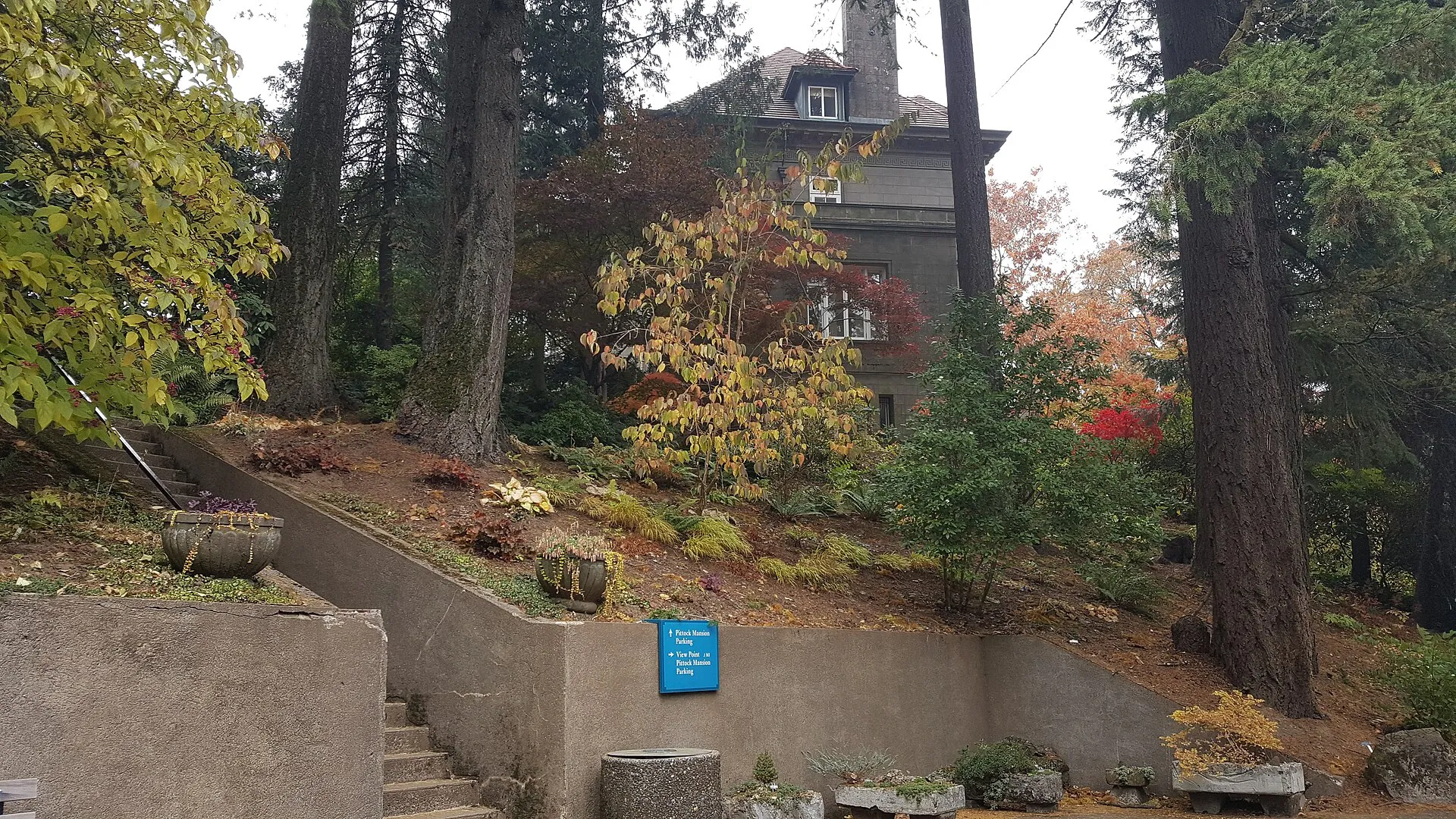
Architect Edward T. Foulkes designed the mansion in a restrained French Renaissance Revival style, wrapping a modern steel-and-concrete frame in warm Tenino sandstone quarried across the Columbia in Washington. The 22 rooms fan out around a central sandstone staircase and a curved, glass-roofed marble stair hall that pulls daylight deep into the plan. Foulkes gave nearly every principal room its own character: a formal French drawing room, an oak-panelled library in the English manner, and — most unexpectedly — a Turkish smoking room finished in intricate Ottoman-style woodwork, a nod to the era's fashion for the exotic. For all its period grandeur the house was quietly futuristic, wired for a central vacuum system, an elevator, a household intercom, indirect electric lighting, and a walk-in refrigerator when most Portland homes still burned wood and gas. The sloping 46-acre site was as deliberate as the building: Foulkes oriented the principal rooms and the east lawn toward the Cascade volcanoes, turning the whole hilltop into a stage set for the view.
Historical Significance
The Pittock story is the story of Portland's rise. Henry Pittock (1835–1919) arrived with nothing, took over The Oregonian in 1860, and spent six decades shaping opinion, banking, real estate, and industry across the region. Georgiana Burton Pittock (1845–1918) was equally consequential in her own sphere: an avid gardener, she championed the rose shows and horticultural societies whose civic enthusiasm grew into the Portland Rose Festival that still defines the city each June. Both died within a few years of moving into the house they had waited a lifetime to build. Their descendants kept the estate until 1958, after which it stood empty and vulnerable — a fate sealed, it seemed, when the 1962 Columbus Day Storm tore through the neglected property. That the mansion is standing at all is a monument to civic activism: rather than see a landmark demolished, Portlanders rallied to have the city purchase and restore it, reopening the house to the public in 1965. It remains a case study in how a community chooses to keep its history.
When to Visit
House museum: open daily 10 AM to 4 PM, last entry 3:30 PM, closed for all of January for maintenance and on Thanksgiving and Christmas Day. Grounds and viewpoint: open daily 5 AM to 9 PM year-round and free. Best for views: clear mornings from late June through September, before the marine layer or afternoon haze rolls in, offer the sharpest look at Mount Hood and its fellow volcanoes. Quietest visits: Tuesday and Wednesday mornings see the thinnest crowds inside the house. Festive season: late November through December fills the rooms with elaborate holiday decorations, a local tradition that draws the year's heaviest crowds.
Admission and Costs
Mansion interior (self-guided): $14 adults, $12 seniors 65+, $8 youth aged 6–18; children under 6 free. Grounds and the viewpoint terrace: free at all times, including sunrise and sunset. Combined history-and-hiking outings with an independent Portland guide, walking up through Forest Park to the estate, are typically $150–250 for a small private group and must be arranged ahead. Note that admission covers the house only; there is no charge to park at the summit lot or to enjoy the lawns.
The Case for a Guide
The rooms of Pittock Mansion look like a wealthy family's home, but read as a coded biography of Portland's founding class — a guide is what turns the furniture back into a story.
- Reading the eclectic room styles: The jump from a French drawing room to an English library to a Turkish smoking room feels arbitrary on a self-guided walk; a guide explains how the Pittocks and Foulkes used each style to script a different social ritual, from formal entertaining to private retreat.
- The hidden 1914 technology: The central vacuum, elevator, intercom, and walk-in refrigerator are easy to walk past; a guide points out the surviving fixtures and explains why a newspaperman's house was a showcase for domestic engineering decades ahead of its neighbours.
- The Pittock and Oregonian backstory: Guides connect the house to Henry Pittock's climb from Oregon Trail orphan to press baron and to Georgiana's role in the rose culture behind the Portland Rose Festival, so the estate stops being anonymous grandeur.
- The preservation drama: The 1958 abandonment, the 1962 storm, and the 1964 citizen rescue are barely signposted inside; a guide walks you through how close the landmark came to demolition and what the restoration reversed.
- Hiking guides who approach on foot: Nature-and-history guides lead the Wildwood Trail climb from Washington Park through old-growth Douglas fir, arriving at the estate the way the Pittocks' carriage guests once did rather than by car.
Tips for Visitors
Driving: a winding road climbs to a free summit parking lot about 15 minutes from downtown, but it fills fast on summer weekends and during the holiday-decoration season — come early or hike in. Hiking access: the Wildwood Trail links the mansion to Washington Park and the Portland Japanese Garden via a moderate 1.5-mile forest walk. No interior photography: photos are not allowed inside to protect the historic furnishings, so save your camera for the grounds and the east-lawn panorama. Footwear: the lawns are steep and the approach trails stay muddy from October through May, so wear sturdy shoes. Bringing a dog: leashed dogs are welcome on the grounds and trails but not inside the house, so the viewpoint doubles as a scenic dog walk while one of your party tours the rooms. Step-free access: the house's original elevator reaches all three floors and the paved path to the east-lawn overlook avoids the staircase, so the panorama stays within reach for visitors who cannot manage stairs. Combine visits: pair the mansion with a morning at the Japanese Garden or an afternoon among the Pearl District galleries and the stacks of Powell's City of Books back downtown.
Frequently Asked Questions
What is the best month to visit Pittock Mansion for the views?
Clear mornings from late June through September give the sharpest chance of seeing Mount Hood, Mount St. Helens, Mount Adams, and Mount Rainier lined up behind the downtown skyline from the east lawn. Portland's marine cloud often burns off by mid-morning in summer, so arrive when the grounds open at 5 AM through mid-morning for the crispest air. Autumn frames the hilltop in colour but brings the low cloud and rain that hide the peaks from October onward; the mansion interior itself closes for all of January.
What are Pittock Mansion's opening hours?
The house museum is open daily 10 AM to 4 PM, with the last entry at 3:30 PM. It closes for the whole of January for annual maintenance, as well as Thanksgiving and Christmas Day. The 46-acre grounds and the east-lawn viewpoint are separate: they stay open daily from 5 AM to 9 PM year-round and are free to enter even when the house is closed.
How much does it cost to visit Pittock Mansion?
A self-guided tour of the mansion interior is $14 for adults, $12 for seniors 65 and over, and $8 for youth aged 6 to 18; children under 6 enter free. The grounds and the famous viewpoint terrace cost nothing at any time. Private guided history-and-hiking tours booked through independent Portland guides run higher and should be arranged in advance.
How do you get to Pittock Mansion, and can you hike there?
By car it is about a 15-minute drive from downtown up a winding road to a free summit parking lot that fills quickly on summer weekends. On foot, the Wildwood Trail links the mansion to Washington Park and the Portland Japanese Garden through roughly 1.5 miles of Forest Park's Douglas fir — a moderate, often muddy climb of about 800 feet that arrives at the estate the scenic way.
How much time should you set aside for Pittock Mansion?
Plan on roughly 45 minutes to an hour to walk the three furnished floors of the house museum at a relaxed pace, reading the room interpretation as you go, then another half-hour to circle the grounds and settle on the east-lawn viewpoint — longer at sunrise or a clear sunset. Visitors who climb the Wildwood Trail up from Washington Park instead of driving should block out a half-day round trip. There is a gift shop inside the house but no café on the estate, so carry water and a snack if you intend to linger for the panorama.
Is Pittock Mansion worth visiting in December?
December is one of the most popular times to tour the interior: every year volunteers dress the 22 rooms in an elaborate themed holiday display, a long-running Portland tradition of decorated trees and period trimmings that draws the heaviest crowds of the year. Book a weekday-morning entry if you can, and expect the winding approach road and summit lot to back up on weekends. Weigh the trade-off with the view, though — the marine layer and rain that settle in from October usually hide Mount Hood, and the house then closes for the whole of January, so come for the rooms rather than the volcanoes.
Is Pittock Mansion wheelchair accessible?
The historic house keeps its original 1914 elevator in service, so visitors who cannot manage the grand sandstone staircase can reach all three furnished floors rather than being limited to the entry level. Because it is a period cab it is small, though, and may not fit every powered chair or larger mobility device, so it is worth calling ahead to confirm the fit before you plan the trip around it. The main door, the gift shop, and the paved path out to the east-lawn viewpoint are step-free, which means the free panorama over downtown and Mount Hood is reachable without stairs. The wider 46-acre grounds turn steep and often muddy away from that paved overlook, so a companion helps on the softer trail sections and after rain.
Can you bring a dog to Pittock Mansion?
Leashed dogs are welcome across the 46-acre grounds and on the wooded trails that climb to the estate, so the free hilltop doubles as one of Portland's most scenic dog walks at sunrise. They are not permitted inside the house museum, so plan a grounds-only visit if you are travelling with a pet, or take turns with a companion if you also want to tour the interior. There is no café on the summit and drinking water is limited, so carry enough for both of you, especially on warm summer afternoons.