
Collection Highlights
The Rocky Steps and Rocky statue
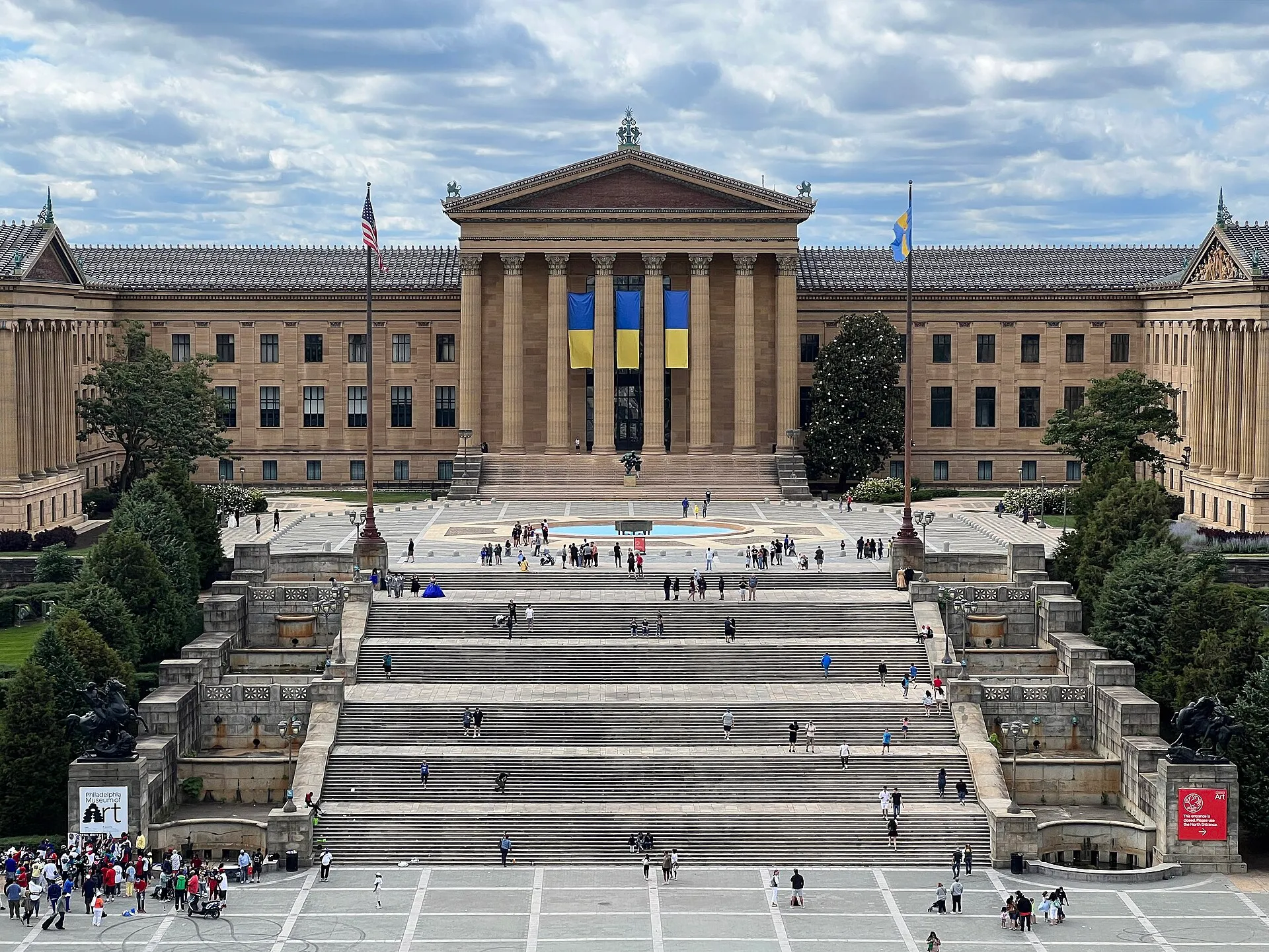
The 72 stone steps to the east entrance became world-famous when Sylvester Stallone sprinted up them in the 1976 film, and visitors still jog to the top to raise their fists over the Benjamin Franklin Parkway. The bronze Rocky statue by A. Thomas Schomberg, commissioned for Rocky III, now stands at the base near the northeast corner.
Diana by Augustus Saint-Gaudens
The gilded, thirteen-foot weathervane figure that once crowned the second Madison Square Garden in New York now poises on tiptoe at the top of the Great Stair Hall, bow drawn, greeting everyone who climbs the grand interior staircase. It is one of the most photographed sculptures in the building.
Étant donnés by Marcel Duchamp
Duchamp assembled his enigmatic final work in secret over twenty years and revealed it only after his death in 1968. Viewers peer through two small holes in an old Spanish wooden door at a startling three-dimensional tableau, a piece that anchors the world's largest public collection of Duchamp's art.
Nude Descending a Staircase, No. 2 by Marcel Duchamp
Painted in 1912, this cascade of overlapping mechanical forms scandalized New York's 1913 Armory Show and became a landmark of early modernism. It hangs among the Louise and Walter Arensberg holdings alongside Duchamp's Large Glass, making Philadelphia the essential stop for anyone tracing his career.
The Large Bathers by Paul Cézanne
The largest of Cézanne's three great bather compositions, this monumental canvas of arched trees and simplified nude figures bridges Impressionism and the geometry that would inspire Cubism. It is a cornerstone of the museum's European painting galleries.
Sunflowers by Vincent van Gogh
Van Gogh's blazing still life of sunflowers in a simple earthenware vase is among the most beloved paintings in the collection, its thick impasto and saturated yellows radiating the warmth he associated with the south of France. It hangs with works by Renoir, Monet, and Degas.
The Gross Clinic by Thomas Eakins
Painted in 1875 by Philadelphia's own Thomas Eakins, this unflinching portrait of surgeon Samuel Gross operating before students was once deemed too graphic for polite audiences. The city rallied in 2007 to keep it local, and it is now shared between the museum and the nearby Pennsylvania Academy of the Fine Arts.
Arms and Armor galleries
The Carl Otto Kretzschmar von Kienbusch collection fills the galleries with complete suits of jousting and parade armor, edged weapons, and firearms from medieval and Renaissance Europe. Mounted knights on armored horses make it one of the museum's most family-friendly stops.
The Sunkaraku Japanese teahouse
Designed by tea master Ōgi Rodō and reassembled inside the Asian art galleries, the Sunkaraku (Evanescent Joys) teahouse offers a moment of quiet amid the vast building. It sits near a Chinese palace reception hall and a South Indian pillared temple hall, three architectural interiors transported whole.
The medieval cloister and Fairmount hilltop views
A reconstructed twelfth-century French cloister with carved stone columns transports visitors to Romanesque Languedoc, while the terrace outside frames the city's finest urban panorama down the Parkway toward City Hall. The building itself, a Greek temple in Minnesota dolomite, opened on Fairmount hill in 1928.
Collections Highlights
The main building rewards a plan of attack more than a lap of every gallery, and knowing its geography saves an hour of backtracking:
- First floor — Asian art dominates, including the Sunkaraku Japanese teahouse, a Chinese palace reception hall, and a South Indian pillared temple hall, alongside the Kienbusch Arms and Armor galleries and the contemporary collection.
- Second floor — the European and American paintings most visitors come for: Cézanne's Large Bathers, Van Gogh's Sunflowers, and rooms of Renoir, Monet, and Degas, plus the Duchamp galleries built from the Arensberg collection and the American painting that leads to Thomas Eakins.
- Ground level — medieval and Renaissance galleries with a reconstructed Romanesque cloister, period rooms, and the door concealing Duchamp's Étant donnés.
Two spaces beyond the main building are covered by the same ticket: the Perelman Building across the street, which rotates costume, textiles, photography, and design, and the Rodin Museum on the Parkway, home to the largest collection of Auguste Rodin's work outside France. Save either for a second day — every admission is valid for two consecutive days.
Guided Tours
A good highlight tour is really an editing service for a collection too large to absorb in one visit. Expert guides tailor routes to your interests — the Impressionist rooms, the Arms and Armor galleries, the Duchamp holdings, or the American wing's colonial period rooms — and pace the visit so the final work resonates rather than exhausts.
- Art-historical context: why the Salon-era academies mattered and how Cézanne and Duchamp broke from them.
- Efficient navigation: three floors of galleries reward prioritisation over completeness.
- Hidden connections: guides link the medieval cloister, the Asian period rooms, and the modern galleries into one story of how art travels across centuries and continents.
- Local grounding: the museum's founding at the 1876 Centennial, Julian Abele's design, and the Gehry renovation, told on the spot.
- Timing the crowds: which galleries are quietest at opening and how to combine the visit with the Rodin Museum and a walk down the Parkway.
When to Visit
Open: Wednesday through Monday, 10:00 AM to 5:00 PM, with Friday evenings extended to 8:45 PM. Closed: Tuesdays, Thanksgiving, December 25, and January 1. Best time: Wednesday and Thursday mornings see the lightest crowds, giving you space to linger before paintings without jostling. Friday evenings bring a relaxed atmosphere, live music in the Great Stair Hall beneath Saint-Gaudens's Diana, and special programming. The exterior Rocky Steps and Rocky statue are accessible 24 hours a day, free of charge — sunrise and dusk give the best Parkway light for photos.
Admission and Costs
General admission: $25 for adults, $23 for seniors (65+), $14 for students and youth (13-18), free for children 12 and under. Pay-what-you-wish: the first Sunday of each month and every Friday evening from 5:00 PM to 8:45 PM. Two-day ticket: every admission is valid for a second consecutive day and also covers the Perelman Building and the Rodin Museum on the Parkway. Guided group tours: $35-65 per person for 2-hour highlight tours with an art historian. Private museum guide: $250-500 for a 2-3 hour personalized tour tailored to your interests.
The Case for a Guide
Two hundred galleries and 240,000 objects defeat most visitors within an hour — a guide who knows the building's rhythms turns an overwhelming institution into a sequence of memorable encounters and adds the context that terse wall labels leave out.
- Decoding Étant donnés: Without context you simply peer through two peepholes at a strange tableau; a guide explains why Duchamp built it in secret over twenty years, why he revealed it only after his death, and how it answers the readymade urinal that redefined what art could be.
- The Arensberg modernism story: The museum owns the world's largest Duchamp collection because collectors Louise and Walter Arensberg entrusted it to Philadelphia; a guide traces how the Large Glass, the Nude Descending a Staircase, and Étant donnés hang together as one artist's lifelong argument.
- Philadelphia's own painters: Guides connect Thomas Eakins's Gross Clinic to the city's medical and art academies and explain the 2007 public campaign that kept the picture in town, shared with the Pennsylvania Academy of the Fine Arts.
- Period rooms as time machines: The Japanese teahouse, the Indian temple hall, and the Romanesque cloister are empty rooms until someone explains how and why entire interiors were shipped across oceans and reassembled here.
- Building and city history: From the 1876 Centennial founding to Julian Abele's Greek-temple design and Frank Gehry's 2021 excavation of hidden space, a guide reads the museum itself as an exhibit.
Tips for Visitors
- Start with the steps. Run (or walk) the Rocky Steps first, enjoy the view, then head inside while your energy is high.
- Pick a focus. Choose two or three collections rather than trying to cover everything; the American, Impressionist, and Asian galleries each deserve at least an hour.
- Use the Parkway. Walk the Benjamin Franklin Parkway from LOVE Park to the museum, stopping at the Rodin Museum (included with your ticket) along the way, and combine the day with nearby Reading Terminal Market for lunch.
- Come Friday night. The pay-what-you-wish evening sessions offer a more intimate experience with live music in the Great Stair Hall.
- Plan food and parking. The museum restaurant offers a sit-down meal with a view, while the café near the east entrance is quicker; a garage sits behind the building, but the Parkway walk from Center City is far more scenic.
- Accessibility. The museum is wheelchair accessible throughout, with elevators connecting all levels and wheelchairs available for loan at the information desk.
Frequently Asked Questions
What are the opening hours at Philadelphia Museum of Art?
Open: Wednesday through Monday, 10:00 AM to 5:00 PM, with Friday evenings extended to 8:45 PM. Closed: Tuesdays, Thanksgiving, December 25, and January 1. The Rocky Steps and Rocky statue outside are free and open 24 hours.
What does admission to Philadelphia Museum of Art cost?
General admission: $25 for adults, $23 for seniors (65+), $14 for students and youth (13-18), free for children 12 and under. Every ticket is valid for two consecutive days and also covers the Perelman Building and the Rodin Museum on the Parkway. Pay-what-you-wish applies the first Sunday of each month and every Friday from 5:00 PM.
What tips help visitors make the most of Philadelphia Museum of Art?
Run the Rocky Steps first while your energy is high, then head inside and pick two or three collections rather than trying to see everything. The American, Impressionist, and Asian galleries each reward at least an hour, and a Friday evening visit trades daytime crowds for live music in the Great Stair Hall.