
Observation Spots
Formation
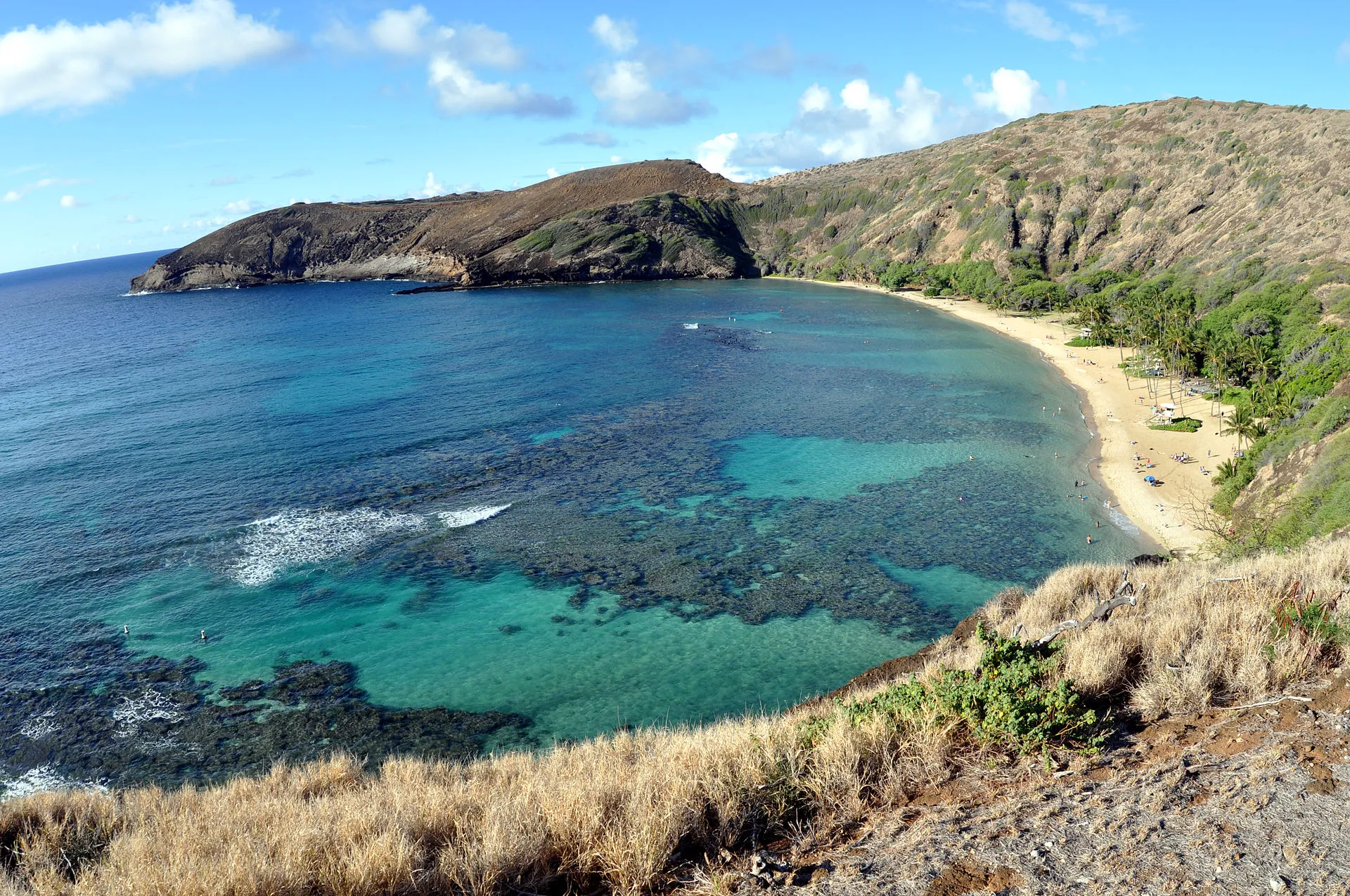
Hanauma Bay belongs to the Koko rift, the last gasp of volcanic activity on Oahu, which built a chain of tuff cones along the island's southeastern tip roughly 32,000 years ago — far younger than the main shield volcano that forms most of Oahu. Like neighbouring Diamond Head, Hanauma is a tuff cone: not a lava mountain but a rampart of compacted volcanic ash flung up in a brief, violent phreatomagmatic eruption, when rising magma hit shallow seawater and flash-boiled it into steam that shattered the magma into fine ash.
Two forces then turned that dry crater into a snorkelling paradise:
- The sea broke in. Waves eventually wore through the lowest, seaward section of the crater wall, and the ocean flooded the basin to create the sheltered half-moon lagoon seen today — the crater's missing wall is the open mouth of the bay.
- Coral moved in. Once seawater filled the caldera, reef-building coral polyps colonised the shallow basin floor over thousands of years, raising the fringing reef that now shelters the inner lagoon and feeds its extraordinary fish density.
A trained guide can trace this history in the rock, pointing out the layered tan palagonite tuff of the crater walls, the fossil marine terraces cut by ancient sea levels, and the dredged Keyhole channel — cut in 1956 to lay a trans-Pacific telephone cable — that now funnels deeper water through the centre of the reef.
Wildlife
Snorkelling guides identify species in real time, distinguishing Moorish idols from pennant butterflyfish, pointing out octopuses camouflaged in reef crevices, and directing attention to cleaning stations where small wrasses groom parasites from larger fish waiting patiently in line. Over 400 species inhabit these waters — among them the yellow tangs, saddle wrasses, convict tangs, and the reef triggerfish (humuhumunukunukuapua'a) that Hawaii named its state fish — and a guide's trained eyes reveal creatures that untrained visitors swim past without noticing.
The bay also shelters green sea turtles (honu), which graze on algae inside the lagoon and surface for air near snorkellers, and spinner dolphins occasionally rest in the deeper water beyond the reef. Guides explain the federal and state protections that cover these animals, enforce the 10-foot viewing distance, and teach turtle etiquette so observation never becomes harassment.
Safety in the water improves dramatically with expert guidance: guides ensure proper mask fit, demonstrate efficient fin kicks, identify the current patterns within the bay, and keep inexperienced swimmers clear of the Keyhole channel and outer reef where rip currents form.
Trails
The bay rewards a planned route through its distinct zones rather than aimless paddling; a few spots stand out:
- Inner reef: The shallow fringing reef (3–10 feet deep) holds the densest fish populations; float motionless over a coral head and dozens of species swirl within arm's reach.
- Keyhole Lagoon: The sandy-bottomed channel dredged through the centre of the reef in 1956 offers the clearest swimming lane and the easiest entry for beginners.
- Witches Brew: On the bay's western side, swirling currents stir nutrient-rich water that draws larger fish — a spot for confident snorkellers only, and best observed when seas are calm.
- Backdoor and outer reef: Beyond the inner reef the water deepens to 15–25 feet, bringing encounters with bigger fish and occasional eagle rays; strong currents make this expert territory.
- Toilet Bowl: At the eastern edge, a natural rock pool rises and falls with each wave; swimming in it is now banned for safety, but it remains a fascinating feature to watch from the rocks above.
- Green sea turtles: Honu graze on algae throughout the bay and surface near snorkellers; maintain a 10-foot distance and let them approach you rather than chasing them.
Hanauma Bay Nature Preserve timeline
- c. 32,000 BP
A tuff cone erupts on the Koko rift
A short, explosive phreatomagmatic blast at the eastern end of Oahu's Koko volcanic rift built the ash rampart that now cradles the bay.
- Over the millennia
The sea breaches the crater wall
Waves wore through the seaward rim and flooded the caldera, turning the dry crater into a sheltered lagoon where coral slowly colonised the basin floor.
- Pre-contact Hawaii
A fishing ground named Hanauma
Hawaiians fished and held canoe-wrestling contests here; the name is often read as "curved bay" or linked to hana (bay) and uma (arm-wrestling).
-
A telephone cable is laid through the reef
The Keyhole channel through the centre of the reef was dredged to carry the first trans-Pacific telephone cable, leaving the deep slot snorkellers still follow today.
-
Hawaii's first Marine Life Conservation District
Fishing and the taking of marine life were banned, making Hanauma the state's earliest protected marine area and letting fish populations rebound.
-
Designated a Nature Preserve
The city capped daily visitors and later added mandatory education, reversing the reef damage caused by crowds that once topped 10,000 people a day.
-
The Marine Education Center opens
A hillside visitor centre introduced the nine-minute orientation film every guest must watch, pairing conservation rules with exhibits on reef ecology.
When to Visit
The preserve is open Wednesday through Sunday, 6:45 AM to 4:00 PM (last entry at 1:30 PM) and closes entirely on Mondays and Tuesdays for conservation and reef recovery — this is non-negotiable, and arriving on a closed day means turning back. Non-resident visitors must hold a timed-entry reservation booked online through the City and County of Honolulu system; slots release two days in advance at 7:00 AM Hawaii time and the earliest morning windows sell out within minutes. Hawaii residents with valid ID enter without a reservation.
The daily visitor cap is approximately 1,000 people, and the parking lot fills well before the gate opens, particularly in summer; plan to arrive no later than 6:30 AM to secure a spot and the calmest water, since winds typically build through the morning and bring the sharpest light and most active fish behaviour at dawn. All visitors must watch a 9-minute environmental education video before descending to the beach — factor this into your schedule.
Allow 2–3 hours for a thorough snorkelling session in the inner reef zone. The bay is open year-round, though winter swells from November to March can occasionally bring rougher surf and reduced visibility, which is why those months rate slightly lower for snorkelling.
Admission and Costs
- Admission: $25 per person for non-residents aged 13 and over; free for Hawaii residents and children 12 and under, paid at the entrance gate.
- Parking: $3 per vehicle, but the lot fills early and overflow parking is very limited.
- Snorkel-gear rental: about $20 for mask, snorkel, and fins from the concession near the beach; bringing your own saves money and guarantees a leak-free fit.
- Shuttle tram: $1.25 each way between the parking lot and the beach — the walk down is easy, but the steep uphill return makes the tram worth it.
- Guided in-water snorkel tour: $35–50 per person for a session with a marine naturalist who identifies fish species and finds the creatures camouflaged in the reef.
- Private half-day tour with transport: $120–200 for a small-group outing from Waikiki that bundles the reservation, round-trip transport, gear, and guiding.
The Case for a Guide
Most visitors snorkel Hanauma Bay blind — floating over the reef, enjoying the colours, and missing nearly everything a trained eye would catch. A guide turns the same inner lagoon into a reading of a living ecosystem and a volcanic landscape.
- Species you would swim past: Guides distinguish Moorish idols from pennant butterflyfish, spot octopuses folded into reef crevices, and direct your attention to cleaning stations where wrasses groom parasites off larger fish waiting in line.
- A crater you can decode: They explain the phreatomagmatic eruption that built the cone, how the sea breached the wall to flood it, and how coral colonised the basin — the same geological story that shaped nearby Diamond Head.
- Turtle etiquette done right: Guides explain the federal protections for green sea turtles (honu), enforce the 10-foot distance rule, and teach you to let the animal approach rather than chase it.
- Safer water: They check mask fit, demonstrate efficient finning, and read the current patterns that separate the calm inner reef from the Keyhole channel and outer reef.
- Logistics handled: Securing the scarce two-day-advance reservation, timing arrival around the parking crunch, and pairing the bay with Waikiki Beach or a Diamond Head sunrise is exactly the friction a guide removes.
Tips for Visitors
- Reserve early: Non-resident reservations release two days ahead at 7 AM Hawaii time and vanish within minutes for morning slots — set an alarm and book the moment they open.
- Bring your own gear: Rental equipment is available, but a well-fitting mask prevents leaks and frustration; anti-fog solution and prescription masks are worth the investment.
- Reef-safe sunscreen only: Hawaii law prohibits oxybenzone and octinoxate; apply reef-safe sunscreen before arriving, as sand and water make application messy at the beach.
- Never stand on coral: The reef is alive and fragile — standing on it destroys decades of growth in seconds. Float or swim, and rest in the sandy channels between coral heads.
- Getting there: Drive east on Kalanianaole Highway (Route 72) from Waikiki, about 25 minutes; TheBus Route 22 also serves the bay but runs infrequently and does not guarantee a timed entry.
- Pack water and a snack: The concession offers only basic supplies, the beach has almost no shade, and the uphill walk back is hot — a litre of water per person is sensible.
Frequently Asked Questions
What are the opening hours and days at Hanauma Bay Nature Preserve?
The preserve is open Wednesday through Sunday, 6:45 AM to 4 PM, with last entry at 1:30 PM. It closes every Monday and Tuesday so the reef can recover from visitor pressure. Aim to arrive right at opening, as the daily visitor cap of about 1,000 people is often reached by mid-morning.
Do I need a reservation to visit Hanauma Bay Nature Preserve?
Yes. Non-resident visitors must book a timed-entry reservation online through the City and County of Honolulu system; slots are released two days in advance at 7 AM Hawaii time and sell out within minutes for prime morning windows. Hawaii residents with valid ID enter without a reservation.
How much does it cost to access Hanauma Bay Nature Preserve?
Admission is $25 per person for non-residents aged 13 and over; Hawaii residents and children 12 and under enter free. Parking is $3 per vehicle, snorkel-gear rental runs about $20, and the beach tram costs $1.25 each way. Bring cash and card, as the lot fills long before the gate opens.
What should visitors bring when visiting Hanauma Bay Nature Preserve?
Bring a well-fitting mask and snorkel (your own prevents the leaks that plague rental gear), reef-safe sunscreen free of oxybenzone and octinoxate as required by Hawaii law, drinking water, and a rash guard for sun protection. There is almost no natural shade on the beach, so a hat and a small towel help too.
Is Hanauma Bay good for beginner snorkellers and families?
It is one of the best beginner sites in Hawaii. The inner reef sits in calm, waist-to-chest-deep water protected by the crater walls, lifeguards are on duty, and the mandatory nine-minute orientation video explains safe, reef-friendly behaviour before you enter. Strong currents only appear near the outer reef and the Keyhole channel.