
Real Alcázar of Seville timeline
-
A Muslim fortress rises by the Guadalquivir
Governors of the Córdoba caliphate raise the first walled enclosure (*Dar al-Imara*) on the site, guarding the river port that supplied the city.
- 11th century
The Abbadid taifa kings build a palace-fortress
Seville's independent Muslim rulers enlarge the citadel into a genuine royal residence, laying out the first courtyards and irrigated gardens.
-
Ferdinand III takes Seville for Castile
The Christian conquest ends five centuries of Muslim rule; rather than demolish the Islamic architecture, Castilian kings adopt the Alcázar as their own palace.
- 1364-1366
King Pedro I builds the Mudéjar palace
Pedro I imports Mudéjar craftsmen — some loaned by his Nasrid ally in Granada — to raise the *Palacio de Don Pedro*, widely judged Europe's finest Mudéjar building.
-
Charles V marries Isabella of Portugal here
The emperor celebrates his wedding in the Alcázar and adds Renaissance rooms and tapestry halls above the medieval core.
-
UNESCO World Heritage inscription
Listed together with Seville Cathedral and the Archivo de Indias as a monument to eight centuries of cultural exchange.
-
Game of Thrones films the Water Gardens of Dorne
The gardens and the Mercury Pool double as Dorne across seasons 5 and 6, drawing a new generation of visitors.
- Today
Still a working royal palace
The upper floor remains an official Seville residence of the Spanish royal family, making the Alcázar the oldest royal palace still in use in Europe.
Historical Significance
More than a beautiful palace, the Alcázar is the oldest royal residence still in active use anywhere in Europe — the Spanish royal family keeps official apartments on its upper floor to this day. It also sits at the hinge of the Age of Discovery: from 1503 the palace housed the Casa de Contratación, the crown's House of Trade that licensed and taxed every voyage to the Americas — voyages Columbus had first pitched years earlier to the Catholic Monarchs at the Alcázar de los Reyes Cristianos in Córdoba, before Seville became the New World's clearing-house. In the Cuarto del Almirante (Admiral's Hall) hangs Alejo Fernández's Virgin of the Navigators (about 1531–1536), long regarded as the first painting to depict the discovery of the New World, with Columbus and indigenous Americans sheltered beneath the Virgin's cloak. Layered over five centuries of Muslim rule and the Castilian conquest, this unbroken continuity — river fortress, caliphal citadel, Mudéjar palace, colonial nerve-centre, and working royal home — is why UNESCO inscribed the Alcázar in 1987 alongside the Cathedral and Giralda and the Archivo de Indias.
Architecture
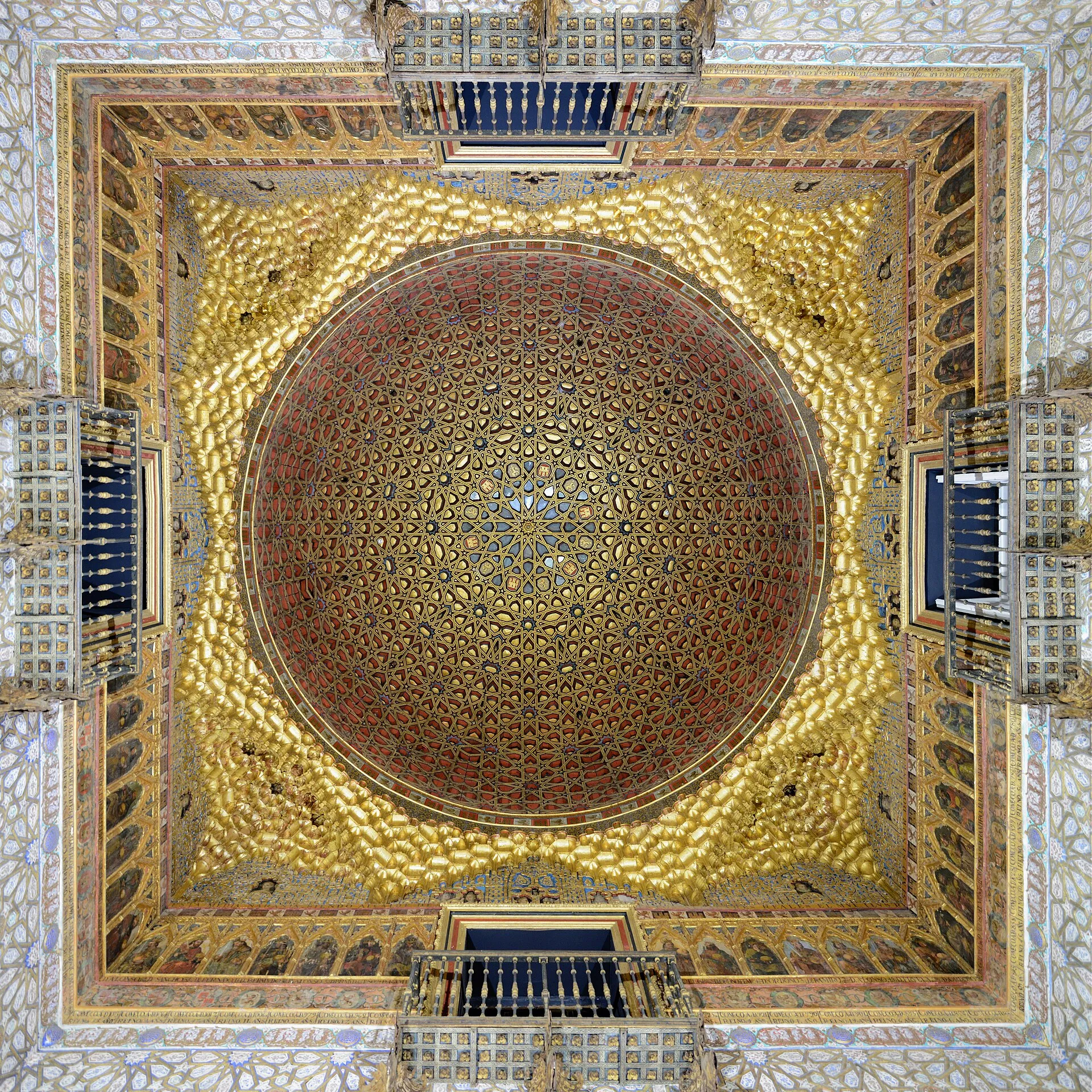
The ceremonial heart of the Palacio de Don Pedro is the Patio de las Doncellas (Courtyard of the Maidens), a long reflecting pool framed by scalloped arches, carved stucco, and zellige tilework; a 2004 restoration lifted a Renaissance marble floor to reveal the original sunken garden that now flanks the water. Off it opens the Salón de Embajadores, the palace's throne room, crowned by a gilded half-orange dome of interlaced muqarnas meant to evoke the vault of heaven. Deeper inside, the intimate Patio de las Muñecas (Courtyard of the Dolls) served the family's private quarters, its slender columns salvaged from the ruins of Roman Itálica and Córdoba's Medina Azahara. Beneath the palace, the vaulted Baños de Doña María de Padilla are rainwater cisterns whose still surface and pointed arches are among the site's most photographed corners. Outside, roughly seven hectares of gardens descend in terraces — orange groves, clipped box-hedge mazes, peacocks, and the Renaissance Estanque de Mercurio, the pool that doubled as Dorne's Water Gardens on screen. A few paces away, the austere Gothic Palace raised after the conquest throws Pedro's Mudéjar jewel-box into sharp relief.
When to Visit
The Alcázar opens daily at 9:30 AM, closing at 5 PM from October to March and at 7 PM from April to September; it shuts only on January 1, January 6, Good Friday, and December 25. Because entry is by timed slot, the two calmest windows are the 9:30 AM opening — before the coach groups spill over from the neighbouring Cathedral and Giralda — and the final slot roughly an hour before closing, when the low sun sets the zellige tilework glowing. Monday-to-Wednesday mornings in winter are the quietest of all, while the gardens peak in April and May, when the orange blossom and roses are in bloom. The entrance is the Puerta del León on the Plaza del Triunfo, a two-minute walk from the cathedral, with the T1 tram stopping at Archivo de Indias just outside the gate.
Admission and Costs
General admission is €14.50 (about $16). Students under 17 and visitors over 65 pay a reduced €6 ($6.50), and an optional audio guide adds another €6 ($6.50). The Cuarto Real Alto — the upper royal apartments the Spanish crown still uses — needs a separate timed ticket at €5.50 ($6) with limited daily capacity, so reserve it alongside your main entry. Licensed skip-the-line group tours run €38–55 ($42–60) per person for about 90 minutes, while a private guide costs €160–280 ($175–305) for up to six people and does not include the entrance ticket. A limited number of free slots are released for the final hour on Mondays, and they vanish online within minutes of going live.
The Case for a Guide
The Real Alcázar is Europe's finest Mudéjar building, where Muslim craftsmen created an Islamic masterpiece for a Christian king — and the theological and political paradoxes embedded in every tile, arch, and inscription are only visible with expert guidance. It is the single most rewarding site in Seville to tour with a licensed guide, and skip-the-line access alone often justifies the fee on a busy spring morning.
- Mudéjar craftsmen's Christian patron paradox: King Pedro I hired Muslim Mudéjar artisans in 1364 to build a palace covered in Quranic inscriptions and Islamic geometric patterns — a guide decodes the Arabic phrases running along the walls (many praise Allah), explains why a Christian king accepted this, and what it reveals about medieval Iberian cultural exchange
- Game of Thrones filming locations: The gardens served as Dorne's Water Gardens across multiple seasons — a guide identifies exact filming spots including the Mercury Pool and specific garden archways, and explains what the production team changed versus what was left as found
- Underground baths access: The Baños de Doña María de Padilla are vaulted underground cisterns beneath the palace that most visitors either miss or don't understand — a guide leads you inside and explains their original function as part of the palace's water management system
- Admiral's Hall maps and New World errors: The Sala de Almirantes was where Columbus's voyages were planned and where early maps of the Americas were drawn — a guide identifies the cartographic errors on display (misplaced continents, imagined coastlines) and explains what explorers actually believed they had found
- Maze garden hidden center: The hedge maze in the gardens has a central pavilion that most visitors circle without finding — a guide leads you to the center and then up the viewing platform where the maze's geometry becomes visible from above
Tips for Visitors
Buy a timed ticket online well ahead of your visit — spring and summer slots routinely sell out days in advance, and the on-site queue can swallow an hour on a busy morning. Arrive about 15 minutes early for the security check, as the site admits visitors strictly at the printed time. Allow two to three hours: the palace itself needs an hour to 90 minutes, and the seven hectares of gardens deserve at least another hour on their own. Photography is welcome without flash or tripods, and the palace's thick medieval walls stay cool even when Seville bakes above 40°C in July and August. If you want to see the upper royal apartments, book that ticket at the same time — same-day availability is rare.
Frequently Asked Questions
Which season offers the best experience at the Real Alcázar of Seville?
April, May, and October are the most rewarding months, when the palace gardens are in full bloom, temperatures allow leisurely exploration of the outdoor courtyards, and the Mudéjar tilework glows in warm afternoon light. July and August should be avoided if possible, as Seville's extreme heat above 40°C makes the sun-exposed gardens nearly unbearable and the palace's narrow corridors feel stifling with summer crowds.
When can visitors tour Real Alcázar of Seville?
Hours: October-March: 9:30 AM-5 PM | April-September: 9:30 AM-7 PM | Open daily except January 1, January 6, Good Friday, December 25. Best time: 9:30 AM opening or last entry slot (1 hour before closing).
How much is the entrance fee for Real Alcázar of Seville?
General admission: €14.50 ($16). Students (under 17): €6 ($6.50). Seniors (65+): €6 ($6.50). Audio guide: €6 ($6.50) additional. Guided tours: €38-55 ($42-60) per person (skip-line + expert guide, 1.5 hours). Private guide: €160-280 ($175-305) for up to 6 people (doesn't include tickets)
How do I get to the Real Alcázar, and where is the entrance?
The Alcázar sits in Seville's historic centre on the Plaza del Triunfo, sharing the square with the Cathedral and the Archivo de Indias. Visitors enter through the Puerta del León (Lion's Gate) on that square. The T1 tram line stops at Archivo de Indias a minute away, and the Prado de San Sebastián tram and bus interchange is a short walk east; most people simply arrive on foot through the Santa Cruz quarter.
What do guided tours of Real Alcázar of Seville include?
Guided tours explain the fusion of Islamic art and Christian symbolism in Mudéjar architecture, navigate 1,000+ years of history from Moors to modern royals, and help decode Arabic inscriptions, geometric patterns, and hidden garden grottos.