
Voortrekker Monument timeline
-
The Battle of Blood River
On 16 December a Voortrekker laager on the Ncome River repels a Zulu army; the victory becomes the founding event the monument was later built to commemorate, and its date fixes the annual sunbeam ritual.
-
Centenary trek and cornerstone
Nine symbolic ox-wagons retrace the Great Trek routes for its centenary, and the monument's foundation stone is laid on 16 December before an estimated crowd of 100,000 on the hill south of Pretoria.
-
Inauguration of the monument
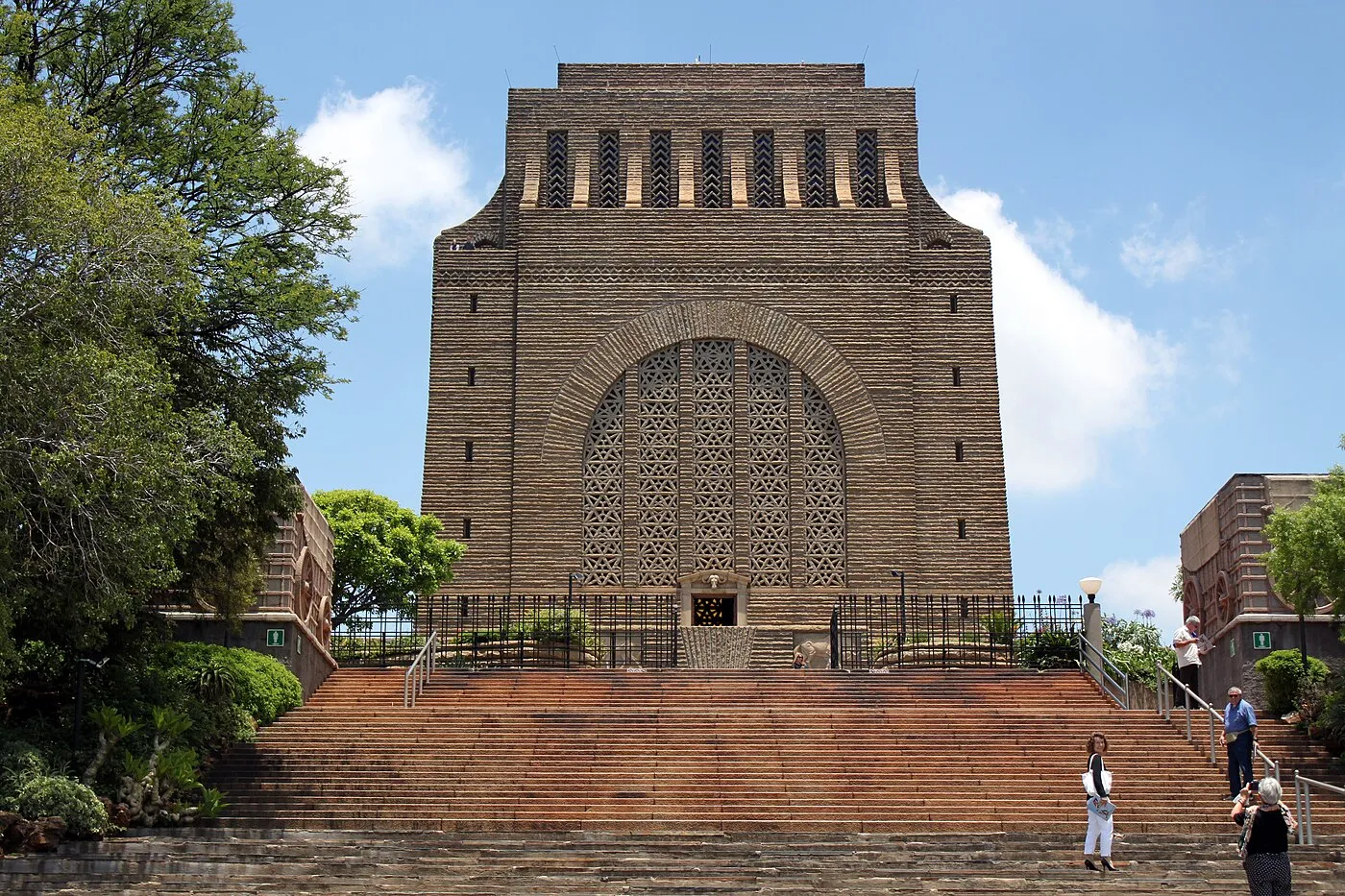
Gerard Moerdijk's granite design is opened on 16 December after roughly a decade of work; the 40-metre structure, its Hall of Heroes frieze, and the encircling wall of 64 carved ox-wagons are unveiled together.
-
A heritage foundation takes over
As apartheid ended, management passed to a private heritage trust, beginning the site's shift from state symbol to a museum that increasingly presents the Great Trek within a fuller national history.
-
16 December becomes the Day of Reconciliation
Democratic South Africa reclaims the Blood River anniversary — long observed by Afrikaners as the Day of the Vow — as the Day of Reconciliation, reframing the monument's founding date around a shared future rather than one community's victory.
-
Declared a National Heritage Site
The South African Heritage Resources Agency formally protects the monument, cementing its status as a landmark to be preserved and interpreted rather than celebrated uncritically.
Architecture
- Marble frieze — 27 panels of Italian marble, together forming what is often called the world's largest marble frieze, depicting the Great Trek in extraordinary narrative detail around the Hall of Heroes
- The sunbeam on the cenotaph — at noon on 16 December, light pierces an opening in the dome to illuminate the words Ons vir jou, Suid-Afrika on the cenotaph below
- Wall of ox-wagons — a granite laager of 64 carved wagons rings the base, mirroring the defensive circles the Voortrekkers formed on the trail
- Entrance bronze — Anton van Wouw's statue of a Voortrekker woman shielding her two children stands at the foot of the steps, the sculptor's tribute to the women and children of the Great Trek
- Corner sentinels — four marble figures at the building's corners stand for the pioneer leaders Piet Retief, Andries Pretorius, Hendrik Potgieter, and an unnamed fourth representing all who led the trek
- Rooftop panorama — 360-degree views of Pretoria and the Magaliesberg range from the observation deck, reached by stairs through the structure
- Fort Schanskop — a restored Anglo-Boer War fort on the same hilltop grounds, offering a second layer of South African military history
Historical Significance
The monument commemorates the Great Trek of the 1830s–40s, when parties of Dutch-descended farmers left the Cape Colony rather than live under British rule, moving north and east into the interior. Its emotional centre is the Battle of Blood River of 16 December 1838, where a Voortrekker laager defeated a Zulu army — an event framed here as the fulfilment of a religious vow and woven through the building's design, from the frieze to the sunbeam.
Conceived in the 1930s and opened in 1949, the monument became closely associated with Afrikaner nationalism and, soon after, the apartheid government that took power in 1948. Since 1992 a heritage foundation has run the site, and it is best understood today as a document of how one community chose to remember its past. That is precisely why guides pair it with Freedom Park: the older monument tells the pioneers' story, while the newer memorial answers with the fuller, multi-voiced history of South Africa.
When to Visit
Daily: 8 AM – 5 PM, with extended hours on 16 December (the Day of Reconciliation), when crowds gather for the noon sunbeam on the cenotaph. Allow 90 minutes to two hours to take in the Hall of Heroes frieze, the Cenotaph Hall below, the rooftop, and the surrounding nature reserve.
- For the sunbeam — only near midday on 16 December does light strike the cenotaph; on any other day guides explain the effect using the dome opening overhead
- For quiet — arrive at opening, before the tour-bus window builds through late morning
- For the view — the rooftop observation deck is open during museum hours, and late afternoon gives the best light over Pretoria and the distant Magaliesberg
Admission and Costs
Adult entry: R100 (about $6). Children: R35. A private guided tour of the monument typically runs R200–400 per person, while a combined Voortrekker Monument + Freedom Park heritage tour costs roughly R800–1,500 ($45–85) private. A broader Pretoria landmarks day tour that folds in the Union Buildings generally runs R1,500–2,500. Entry to the surrounding nature reserve and Fort Schanskop is included in the ticket; confirm current fees on the official monument website before you travel, as prices shift around public holidays.
The Case for a Guide
The Voortrekker Monument is built to be read, and its meaning shifts sharply depending on who narrates it. Left alone, most visitors photograph the frieze and climb to the roof without grasping the theological and nationalist program carved into the stone — or the complicated legacy the building carries. A well-informed guide earns the R200–400 fee by making the site legible and honest:
- Reading the frieze — walking the 27 marble panels in sequence so the Great Trek reads as a continuous story rather than disconnected carvings, and flagging where the 1940s sculptors editorialised the history.
- Explaining the symbolism — the encircling wall of 64 ox-wagons, the female figure and wildebeest in the design, and why every element points back to 16 December 1838.
- Timing the sunbeam — planning a 16 December visit around the noon shaft of light on the cenotaph, the one day the building's central ritual actually occurs.
- Giving the other side — connecting the monument to Freedom Park opposite, so visitors weigh Afrikaner memory against a more inclusive national account.
- Efficient routing — sequencing the Hall of Heroes, Cenotaph Hall, rooftop, and Fort Schanskop with a wider Pretoria itinerary that can reach Johannesburg by Gautrain in about 35 minutes.
Tips for Visitors
- Bring a guide — the monument presents a single perspective, and a knowledgeable guide supplies the multiple viewpoints and historical context the building itself omits
- Getting there — the monument sits just south of central Pretoria, an easy drive of about 15 minutes with free parking inside the reserve gate; without a car, a metered taxi or ride-hail from the city or a Johannesburg day tour is simplest, as no train stops at the hill
- Pair with Freedom Park — the two memorials face each other across the valley and only make sense as a pair
- Wear flat shoes — narrow spiral stairs climb to the rooftop deck, so sandals and heels are a poor choice
- Photography — interior photography is permitted without flash, but tripods are not allowed inside the halls
- Explore the grounds — the ticket covers a 340-hectare nature reserve with game and walking trails, plus the restored Anglo-Boer War Fort Schanskop
- Heritage status — declared a National Heritage Site in 2011, the monument is preserved for its craftsmanship regardless of its political associations
Frequently Asked Questions
What is the best season to visit the Voortrekker Monument?
The most comfortable months are March through May and September through November, when Pretoria enjoys mild temperatures in the low 20s Celsius and minimal rainfall, ideal for exploring the monument's outdoor amphitheatre and surrounding nature reserve. Winter months (June-August) are dry but chilly mornings may catch visitors off guard, while the summer wet season from December to February brings afternoon thunderstorms that can interrupt outdoor exploration.
When can visitors tour Voortrekker Monument?
Daily: 8 AM - 5 PM (extended hours on 16 December). Best: Midday for the sunbeam effect on the cenotaph (only near 16 December); mornings for quieter visits. Rooftop: Open during museum hours; sunset views are exceptional
How much is the entrance fee for Voortrekker Monument?
Adult entry: R100 ($6). Children: R35. Guided monument tour: R200-400 per person. Combined Voortrekker + Freedom Park tour: R800-1,500 private
What should visitors know before visiting Voortrekker Monument?
Bring a guide: The monument's narrative reflects a single perspective; a well-informed guide presents multiple viewpoints and historical context.
How do I get to the Voortrekker Monument?
The monument stands on a hill just south of central Pretoria, roughly a 15-minute drive with free parking inside the nature-reserve gate. No train or Gautrain station serves the hill itself, so without a car the easiest options are a metered taxi or ride-hail from Pretoria, or a guided day tour from Pretoria or Johannesburg that folds it in with Freedom Park and the Union Buildings.
Is the Voortrekker Monument worth visiting?
Yes, especially for anyone interested in South African history. The 40-metre granite structure holds the world's largest marble frieze, a 340-hectare game reserve, the restored Fort Schanskop, and rooftop views over Pretoria. Because it is a contested Afrikaner-nationalist symbol, it rewards a visit that pairs it with Freedom Park across the valley for the fuller national story.