
Walking Route
Photo Spots
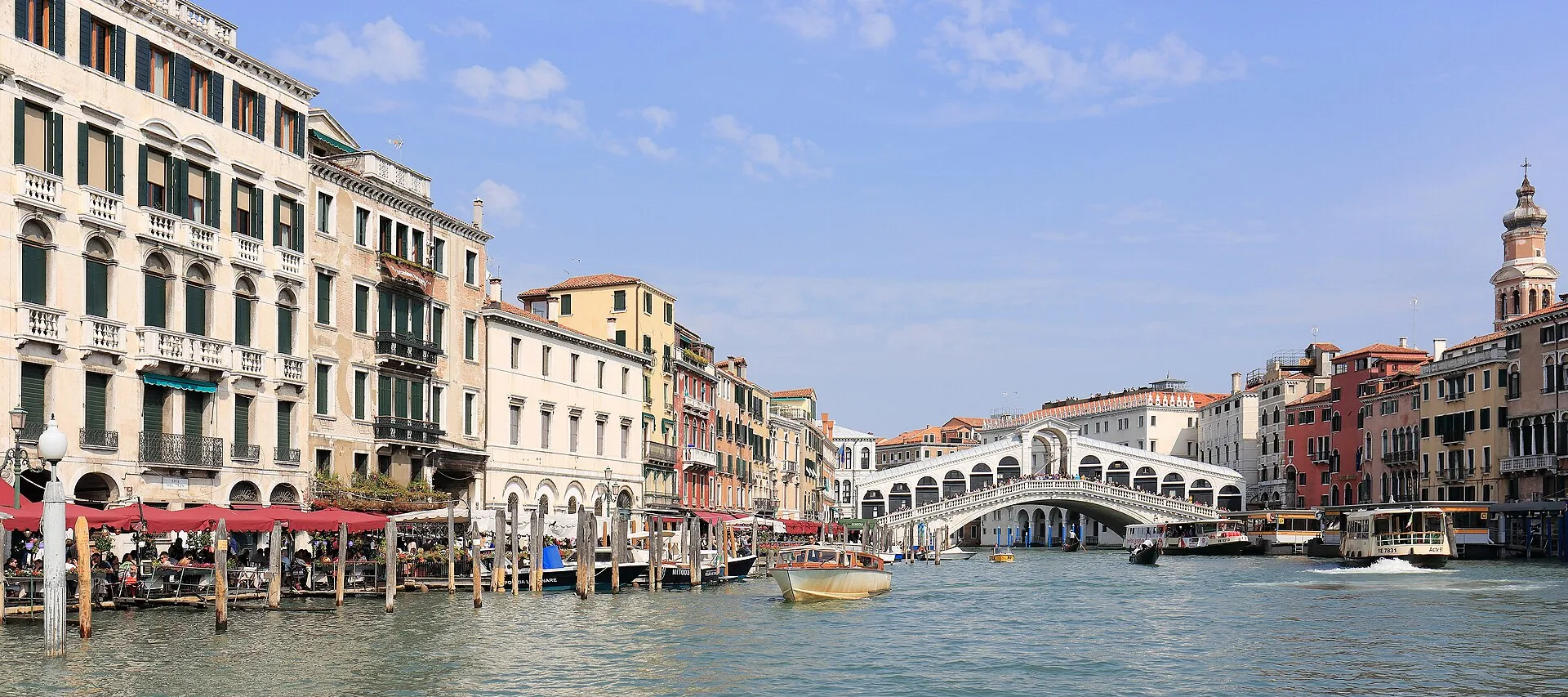
Ponte di Rialto: the iconic 16th-century stone bridge, the oldest of the canal's four crossings, with shops lining its covered walkway and the classic canal view from its steps. Ca' d'Oro: the most beautiful Gothic palace, the "House of Gold" for its once-gilded tracery, now a fine-art museum whose loggia frames the water. Santa Maria della Salute: the Baroque church at the canal's southern mouth, best shot at sunset from the Accademia bridge. Ca' Rezzonico: a Baroque palace, now the Museum of 18th-Century Venice, reflected in the water at dusk. The Fondaco dei Tedeschi: the former German trading post, now a department store whose free rooftop terrace (book a slot ahead) gives the single best elevated panorama of the canal's great bend.
Landmarks Along
Ca' d'Oro: the finest Venetian Gothic palace, its delicate tracery marking the peak of the style. Ponte di Rialto: designed by Antonio da Ponte and completed in 1591, it was the only crossing of the canal for nearly 300 years and still straddles its narrowest, busiest point. Ca' Rezzonico: a Baroque palace, now a museum of 18th-century Venetian life. Santa Maria della Salute: Baldassare Longhena's Baroque masterpiece, built on over 1 million wooden piles after the 1630 plague. Palazzo Grassi: an 18th-century palace, now a contemporary-art museum owned by François Pinault. Fondaco dei Tedeschi and the Fondaco dei Turchi: the German and Turkish trading houses that marked where foreign merchants lived and dealt, a reminder that the canal was a working port long before it was a postcard.
Grand Canal timeline
- 5th century
First settlers on the Rialto islands
Refugees from the mainland settle the high, firm ground of Rivoalto beside the future canal - the nucleus from which Venice grew.
-
The Rialto market opens
Venice moves its main market to the Rialto bank, fixing the Grand Canal as the city's commercial spine for the next seven centuries.
-
Ca' d'Oro completed
The Contarini family finishes the "House of Gold," the peak of Venetian Gothic, its facade once picked out in real gold leaf.
-
The stone Rialto Bridge is finished
Antonio da Ponte's single-span bridge replaces a wooden drawbridge and stays the only crossing of the canal for nearly 300 years.
-
Santa Maria della Salute consecrated
Baldassare Longhena's Baroque church, built on over a million timber piles in thanks for the end of the 1630 plague, closes the canal's mouth.
-
The Calatrava bridge opens
The Ponte della Costituzione becomes the fourth and newest bridge over the canal, a glass-and-steel span linking the station to Piazzale Roma.
When to Visit
Ride early -- 8-10 AM -- and the canal is worked by delivery barges rather than tour groups, so a Line 1 window seat is easy to hold. Golden hour is the other prime slot: as the sun drops, the raking light turns the palazzo facades warm amber, the exact effect Canaletto painted. After dark the palaces along the water are floodlit and the canal empties. Skip the crush from roughly noon to 3 PM, when day-trippers and cruise arrivals fill every boat. By season, May, June and September are the sweet spot; the winter months of November to February bring fog and acqua alta high tides, atmospheric but unreliable.
Admission and Costs
Vaporetto (water bus): €9.50 ($10) for a single ride, or a €25 ($27) 24-hour pass that pays off after three trips (Line 1 follows the full canal, Line 2 runs it faster). Gondola (30 min): €80-100 ($86-108) at the official rate, €120-180 ($130-195) with a narrating gondolier. Private water taxi tour: €300-500 ($325-540) for an open deck and a chosen route. The bargain is the €2 ($2.15) traghetto, a standing gondola that ferries locals straight across the canal at a few unmarked points -- a 90-second gondola ride for the price of a coffee.
The Case for a Guide
Every tourist rides a vaporetto down the Grand Canal and sees magnificent palazzi — a guide transforms those identical facades into a competition of merchant dynasties, explains why the canal bends where it does, and reveals the three transport options that give radically different perspectives on the same waterway.
- Each palazzo's family history and trading empire: The Grimani, Corner, Mocenigo, and Barbarigo palazzi are distinguishable by their Gothic or Renaissance facades, but a guide names the specific family behind each building and explains their particular commercial dominance — the Mocenigo family produced four doges and controlled Venetian trade with the Levant, facts that make the building's scale comprehensible as a visible ledger of accumulated wealth.
- Gondola construction asymmetric hull secret: A traditional gondola is not symmetrical — the hull is offset by 24 centimeters to compensate for the force of a single oar on the right side; a guide explains that this asymmetry, refined over 500 years, allows the gondolier to maintain a straight course without switching sides, and that each gondola is handbuilt using eight types of wood across 280 individual components.
- Rialto Bridge merchant history: The current stone bridge completed in 1591 replaced a wooden drawbridge that had served as Venice's commercial heart since the 12th century; a guide explains that the shops lining the bridge today occupy the same positions as medieval money changers and spice merchants, and that the Rialto market nearby still operates on the same site where the first Venetians settled in the 5th century.
- Seasonal light variations for photography: A guide who has photographed the canal across seasons knows that the low-angle winter light bounces off the water onto the palazzo facades from below — creating the dramatic upward illumination visible in Renaissance paintings — and that this effect is visible for only two to three weeks around the winter solstice.
- Vaporetto vs. gondola vs. traghetto perspectives: The Line 1 vaporetto travels the entire canal in 35 minutes at eye level with the water; a gondola sits 50 centimeters lower and moves at human walking speed through smaller canals; the €2 traghetto standing gondola crossings offer 90-second gondola experience at unmarked spots; a guide explains which mode reveals what, and why local commuters still use the traghetto daily while tourists queue for the €80 tourist gondola nearby.
Tips for Visitors
The €2 traghetto gondola ferry crossings at unmarked spots along the canal give you a brief gondola experience at a fraction of the €80+ tourist price -- look for small yellow signs at the water's edge, and note that most run only in the morning. Vaporetto Line 1 runs the full length for €9.50 a ride, but a 24-hour pass at €25 is far better value for multiple hops; validate your ticket at the dock reader before boarding to avoid a fine. Sit in the bow or stern for unobstructed views, and travel light -- the boats crowd fast at Rialto and San Marco. With the 24-hour pass, treat Line 1 as a hop-on service: the stops worth stepping off at are Ca' d'Oro for the Gothic palace and Rialto market, Rialto for the bridge, Ca' Rezzonico and Accademia for their museums, and Salute at the mouth. The canal is most photogenic at golden hour when the palazzo facades glow warm amber. Combine the ride with St. Mark's Basilica and the Doge's Palace at the canal's eastern end for a full day on the water.
Frequently Asked Questions
When is the best time to experience the Grand Canal?
Go early or late. Between 8 and 10 AM the canal belongs to delivery barges and commuters rather than tour groups, and a Line 1 vaporetto is calm enough to hold a window seat. Golden hour is the other prize: as the sun drops, the low light rakes across the palazzo facades and turns the Istrian stone amber, the effect Canaletto painted. After dark the palaces along the water are lit and the canal empties out entirely. Avoid the midday hours from roughly noon to 3 PM, when day-trippers and cruise arrivals pack every boat.
Vaporetto, gondola or water taxi - how should you travel the Grand Canal and what does each cost?
Line 1 vaporetto is the workhorse: it stops everywhere, runs the full length in about 40 minutes and costs EUR 9.50 (about $10) a ride, or EUR 25 ($27) for a 24-hour pass that quickly pays off. A gondola sits far lower on the water and moves at walking pace, but the official rate is EUR 80-100 ($86-108) for 30 minutes and closer to EUR 120-180 ($130-195) if the gondolier narrates. A private water taxi tour runs EUR 300-500 ($325-540) and buys you an open deck and a set route. The local secret is the EUR 2 (about $2.15) traghetto, a standing gondola ferry that crosses the canal at a handful of unmarked points - a 90-second taste of a gondola for the price of an espresso.
How long does it take to travel the length of the Grand Canal?
The canal is 3.8 kilometres from the railway station to the Bacino di San Marco, and the Line 1 vaporetto covers it in roughly 40 minutes with every stop; the faster Line 2 trims that to about 25. A gondola moving at walking pace will take an hour or more, which is why most gondola routes duck into the quieter side canals rather than run the full length. On foot the same journey takes about 40 minutes as the crow flies, but the city has no continuous canal-side path, so you zigzag through alleys and over bridges and should allow closer to an hour.
Is a guide worth it on the Grand Canal?
For most visitors, yes. Every rider glides past the same 170-odd palaces, but without commentary they blur into one long row of pretty facades. A guide names the merchant dynasty behind each one, dates it by its Byzantine, Gothic or Baroque frontage, and explains why the canal bends into its S-shape and where the old Rialto market still trades on the spot Venice was founded. On a private water taxi the guide can also time the run for the light and pull up at the photo stops the scheduled vaporetto blows straight past.
Which Grand Canal vaporetto stops are worth getting off at?
The Line 1 boat calls at every landing, so treat it as a hop-on ride rather than a single trip. From the railway station (Ferrovia) the stops that reward a walk-off are Ca' d'Oro for the gilded Gothic palace and the nearby Rialto fish and produce market; Rialto for the bridge itself and the Fondaco dei Tedeschi rooftop terrace; Ca' Rezzonico for the Museum of 18th-Century Venice; Accademia for the Gallerie dell'Accademia and the wooden bridge with the classic Salute view; Salute for Longhena's Baroque church at the canal's mouth; and San Marco/Vallaresso to finish at St. Mark's. A 24-hour pass makes stringing several together painless.
Is the Grand Canal accessible for wheelchair users?
Largely, yes. The Line 1 and Line 2 vaporetti are the step-free way to see the canal - the low, flat boarding pontoons and the boats' open central deck take wheelchairs and strollers, and staff will help with the small gap at the dock. The four bridges over the canal are all stepped, but the Rialto, Accademia and Scalzi crossings are avoided entirely by riding through beneath them. A gondola, by contrast, is not accessible: you step down into a narrow, wobbling hull. Note that acqua alta high tides in late autumn can briefly flood the lowest landing stages.