
Jantar Mantar timeline
-
Jai Singh II starts his observatory programme
The Delhi Jantar Mantar becomes the first of five masonry observatories the astronomer-king raises across northern India.
-
Jaipur founded
Sawai Jai Singh II moves his capital down from the hill fort of Amber to a new planned city, laid out on a grid he designed himself.
-
The Zij-i Muhammad Shahi compiled
Jai Singh completes the star tables calculated with these instruments and dedicates them to the Mughal emperor Muhammad Shah, whose name they carry.
-
Jaipur observatory completed
The largest and best-preserved of the five sets of instruments is finished beside the royal palace.
-
Death of Jai Singh II
With the astronomer-king gone, royal patronage fades and the masonry instruments slowly weather, setting up the major repairs that would come at the turn of the twentieth century.
-
Restoration under Madho Singh II
The weathered instruments are repaired and recalibrated, saving the site from ruin.
-
UNESCO World Heritage listing
The observatory is inscribed as an expression of the astronomical skills of a late-Mughal court.
Architecture
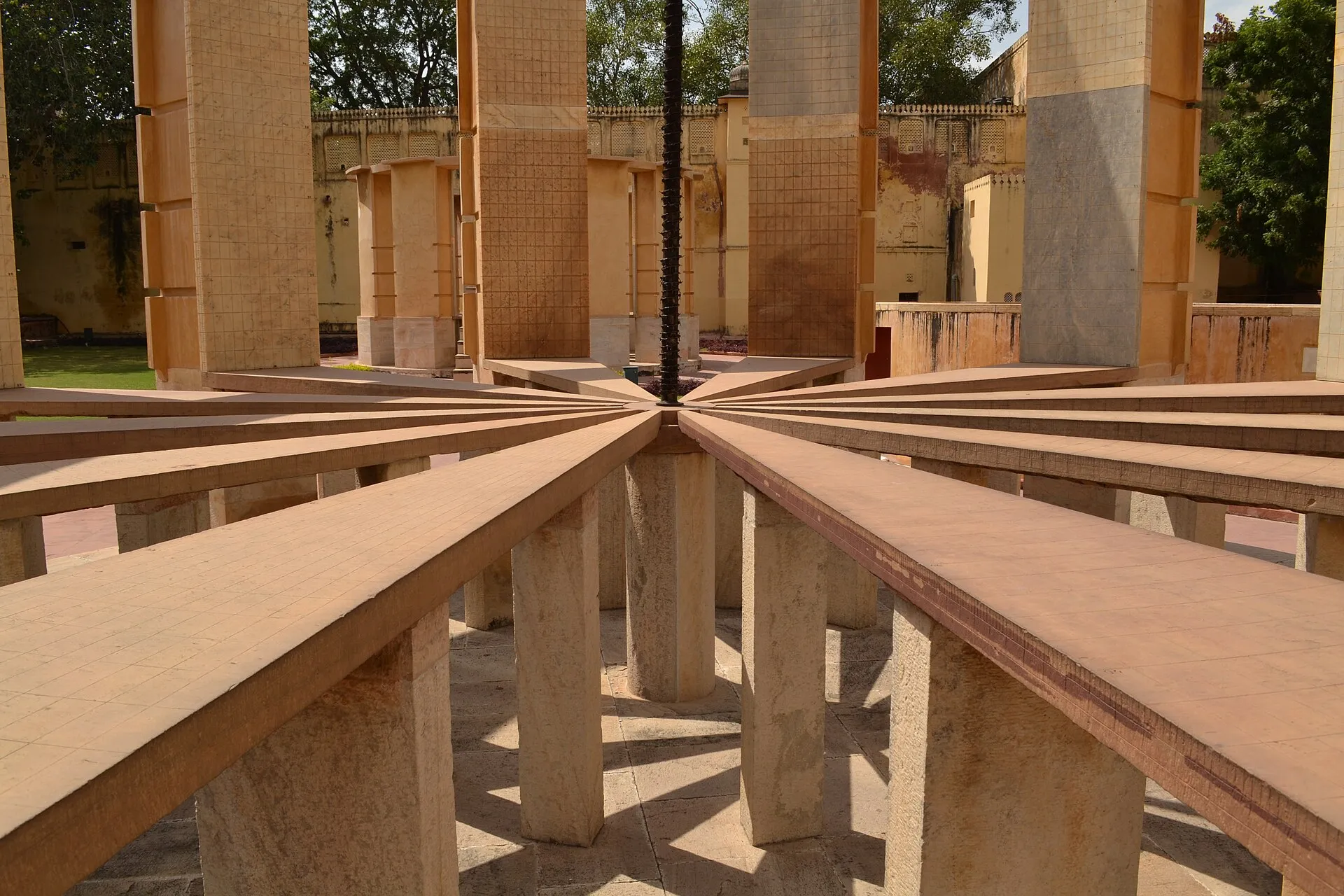
Each of the nineteen instruments looks like abstract sculpture but performs a specific measurement, and reading them is the whole point of a visit. The Samrat Yantra is a right-angled ramp aligned to the Earth's axis; its shadow sweeps across a curved marble scale at about a millimetre a second, letting a trained eye read local apparent time to the second. The Jai Prakash Yantra is a pair of sunken hemispherical bowls, each a mirror-map of the sky — cross-wires stretched over the rim cast a marker that lets you fix the Sun's position, or step into the bowl at night to stand beneath a specific star. The Ram Yantra, the cylindrical instrument in most photographs of the site, measures the altitude and azimuth of any celestial body and, unlike the sundials, works after dark. Most striking is the Rashivalaya Yantra, twelve separate dials, one for every sign of the zodiac, each tilted to catch its constellation only as that sign crosses the meridian. Smaller devices — the Laghu Samrat Yantra, the Nadivalaya, the Chakra Yantra and the Digamsa Yantra — round out a toolkit that could track time, predict eclipses and pinpoint stars, all without a single lens or moving metal part.
Historical Significance
Jai Singh II was a Rajput prince who governed for the Mughal emperors and used that position to gather the astronomy of three worlds. He set his court scholars to studying the Greek Almagest of Ptolemy, the tables of the Timurid astronomer Ulugh Beg from Samarkand, and the trigonometry arriving from Europe with Jesuit missionaries, whom he dispatched as far as Portugal to bring back instruments and books. The result of that synthesis was the Zij-i Muhammad Shahi, a set of star tables he compiled around 1732 and dedicated to the Mughal emperor Muhammad Shah. Jaipur's instruments were the physical laboratory behind those calculations, and the observatory here outlived its sisters: the twin site in Delhi survives as a ruin hemmed in by the modern city, while those at Ujjain, Varanasi and Mathura fell into decay or vanished entirely. That a set of purely analog instruments still reads the heavens three centuries on is why guides call Jantar Mantar the closest thing India has to a working eighteenth-century supercomputer.
When to Visit
The observatory is open daily, 9:00 AM to 5:00 PM. The best window is late morning, roughly 10 AM to noon, when the sun is high enough that the sundials and bowls throw crisp, readable shadows; at the very start of the day the courtyard can feel like a puzzle with the pieces missing. Clear skies matter more than the calendar — an overcast monsoon afternoon leaves most instruments useless — so the winter months of November to February are ideal. Evening sessions are occasionally arranged around eclipses and other astronomical events, worth asking about locally if your visit lines up with one.
Admission and Costs
Foreign visitors pay ₹200 (about $2.40); Indian nationals pay ₹50. Jaipur's composite ticket (around ₹1,000 for foreigners) folds Jantar Mantar in with the Hawa Mahal, Amber Fort and several other monuments and remains valid for two days, so it makes sense the moment you plan to see more than one sight. A licensed guide costs roughly ₹300–800 for an hour-long demonstration — the single best value at any Jaipur monument, because here the guide is what turns silent stone into a working machine. The site is walk-in; there is no need to book ahead.
The Case for a Guide
Jantar Mantar has almost no explanatory signage, and the instruments give up none of their meaning to a visitor walking through cold. Everything that makes the observatory extraordinary arrives through a guide reading the sky beside you.
- Reading the great sundial live: a guide points to where the Samrat Yantra's shadow falls on its marble scale, reads off the local apparent time, then explains the corrections for longitude and the equation of time that convert it to the clock on your phone — usually accurate to a couple of minutes.
- The twelve zodiac dials: at the Rashivalaya Yantra a guide shows why each of the twelve instruments is angled differently and how only the dial of the sign then crossing the meridian is actually in use, unpacking the blend of astronomy and astrology the court practised.
- Standing inside the sky map: at the Jai Prakash Yantra a guide walks you into the marble bowl and uses the cross-wires and engraved coordinates to show how the instrument fixes a star's position, a demonstration that is meaningless without narration.
- Why bigger meant better: a guide explains Jai Singh's core insight — that enlarging an instrument shrinks the relative error of every reading — and why he abandoned portable brass for monumental stone.
- A meeting of three traditions: a guide traces how Hindu, Islamic and European astronomy converge in these courtyards, from Ptolemy and Ulugh Beg to the Jesuit instruments Jai Singh imported from Europe.
Tips for Visitors
Come with sun protection: the observatory is entirely open to the sky, with no shade among the instruments. Pair the visit with the adjoining City Palace, whose entrance is a two-minute walk, and the nearby Hawa Mahal to make a compact half-day in the old walled city before heading out to the Amber Fort. Budget 45 minutes to an hour — the compound is small, but each instrument rewards a demonstration. Avoid the middle of the day in the hot pre-monsoon months of April to June, when the unshaded courtyard becomes gruelling. For more on planning a stay in the Pink City, see the Jaipur city guide.
Frequently Asked Questions
What time of year is best for visiting Jantar Mantar in Jaipur?
November through February is the clear winner. The winter sun sits low and unclouded, casting the sharp, well-defined shadows the sundials need to be read, and the open courtyard stays pleasant rather than punishing. Monsoon days from July through September flatten the experience because an overcast sky leaves most instruments inert. If your dates are flexible, a visit near the equinox or either solstice lets a guide show how the zodiac dials shift with the season.
When is Jantar Mantar open, and what is the best time of day to go?
The observatory opens daily from 9:00 AM to 5:00 PM. Aim for late morning, roughly 10 AM to noon, when the sun is high enough for the Samrat Yantra and the Jai Prakash bowls to give clean readings; the same courtyard that feels abstract at opening comes alive once the shadows lengthen and sharpen. The site occasionally hosts evening sessions around eclipses and other astronomical events, so it is worth asking locally if your trip coincides with one.
How much is the entrance fee for Jantar Mantar?
Foreign visitors pay ₹200 (about $2.40), while Indian nationals pay ₹50. Jaipur's composite ticket, around ₹1,000 for foreigners, bundles Jantar Mantar with the neighbouring Hawa Mahal, Amber Fort and several other monuments and stays valid for two days, so it pays off quickly if you are touring the city. A licensed guide who can demonstrate the instruments runs roughly ₹300–800 for an hour and is money far better spent here than at most sights.
How much time do you need at Jantar Mantar?
Plan on 45 minutes to an hour. The nineteen instruments sit close together in one walled compound, so there is little walking, but each device only makes sense once someone shows you how it works, and a good demonstration of the great sundial alone eats fifteen minutes. Rushing through in twenty minutes reduces the place to a field of strange sculptures, which is exactly the trap most visitors fall into.
Is Jantar Mantar worth visiting without a guide?
Honestly, not really. There is minimal on-site signage, and without narration the instruments read as inscrutable geometric shapes rather than working scientific tools. This is the one Jaipur monument where a guide changes everything: watching the shadow of the 27-metre sundial creep across its scale while someone explains that you are reading local time to the second is the moment the whole observatory clicks into focus.
Where is Jantar Mantar and how do you get there?
The observatory sits in the heart of the old walled Pink City, immediately beside the City Palace and a five-minute walk from the Hawa Mahal, so it slots naturally into a morning spent in the historic centre. The entrance faces Jantar Mantar Road just off the Tripolia Bazaar; the nearest major crossroads is Badi Chaupar, which also has a metro stop, and any auto-rickshaw in Jaipur will know the site by name. Coming from the newer parts of the city, allow 15 to 20 minutes by rickshaw or taxi depending on the notorious old-city traffic.
Is Jantar Mantar suitable for children, and is photography allowed?
It can be, with the right framing. The compound is flat, open and easy to walk, and older children often enjoy the puzzle of working out what each strange instrument does and watching the shadow of the giant Samrat Yantra sundial creep visibly across its marble scale. Photography is permitted throughout at no extra charge, and the geometry of the ramps, bowls and dials against a clear Rajasthan sky is genuinely photogenic. There is no shade anywhere in the compound, though, so bring hats and water for young visitors, especially outside the cooler winter months.