
Hawa Mahal timeline
-
Jaipur founded
Sawai Jai Singh II laid out the planned, grid-pattern capital of Jaipur on the plains below Amer, the walled city whose main bazaar Hawa Mahal would later overlook.
-
Pratap Singh builds the Palace of Winds
Maharaja Sawai Pratap Singh commissioned the five-storey facade, designed by architect Lal Chand Ustad in the form of Krishna's crown, as an extension of the City Palace zenana.
-
The Pink City
Jaipur's old-town buildings were washed in terracotta pink to welcome the Prince of Wales, giving Hawa Mahal's sandstone the rosy tone it is photographed in today.
- Today
A protected monument
The facade, weathered by two centuries of sun and monsoon, is maintained by the Rajasthan state archaeology department and remains one of India's most recognised landmarks.
Architecture
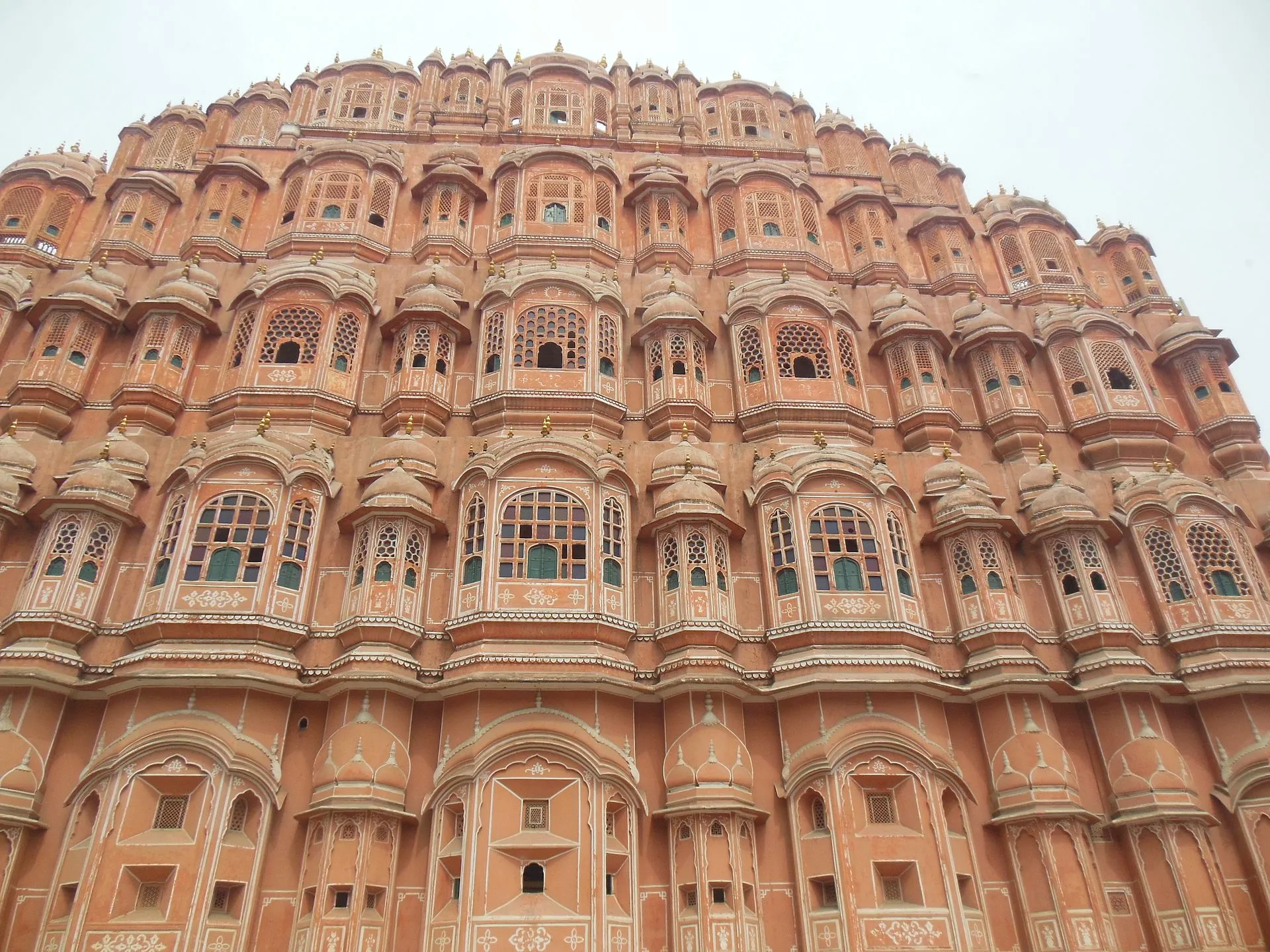
The facade rises in five tiers of convex jharokha windows that create the iconic honeycomb silhouette, each carved in unique floral and geometric patterns from red and pink sandstone trimmed with white lime. Its upper storeys are famously only about one room deep -- more an elaborate screen wall than a conventional palace -- which is why it reads as a flat, lace-like curtain of windows from the street.
The five levels each carry a name (Sharad Mandir, Ratan Mandir, Vichitra Mandir, Prakash Mandir, and the topmost Hawa Mandir), and because they are connected by sloping ramps rather than stairs, the royal women and their attendants could move between floors easily.
Stand inside and feel how air is funneled through the lattice openings, cooling the interior without any mechanical system -- the Venturi effect in action. Look out through the same screens the queens used to watch elephant parades, Holi celebrations, and military processions 200 years ago. Interior courtyards feature fountains and colored glass windows that cast tinted light across the walls. The Hawa Mandir at the top offers views over the Pink City old town, the City Palace complex, and the Nahargarh ridge of the Aravalli Hills.
Historical Significance
Hawa Mahal -- the "Palace of Winds" -- was built in 1799 by Maharaja Sawai Pratap Singh, grandson of Jaipur's founder Sawai Jai Singh II, as an extension of the royal zenana (women's quarters). A devout follower of Krishna, Pratap Singh had his architect Lal Chand Ustad shape the facade like the deity's crown.
Its five-storey pink sandstone screen contains 953 small latticed windows (jharokhas), each serving a dual purpose: it let the royal women observe festivals, processions, and daily street life on the bazaar below without being seen by the public (in keeping with the purdah system), and it channeled the Venturi effect, pulling breeze through the narrow openings to cool the interior -- hence "Palace of Winds."
From the street, Hawa Mahal appears to be an ornate five-storey building, but a guide reveals the surprise: it has almost no depth. The upper facade is essentially a single room thick, far more of an elaborate screen than a palace, and the rear side shows a jumble of columns and passages connecting small chambers around a courtyard.
A guide explains the social context -- why the Rajput queens needed such an elaborate viewing gallery, how the lattice screens are carved to different patterns on each level, and how the structure's wind-channeling design has carried it through two centuries of fierce summers and monsoons. Walk from here to the adjacent City Palace and Jantar Mantar, all within minutes of each other.
When to Visit
Open daily, 9:00 AM - 5:00 PM, year-round. Best time to arrive: early morning, right at opening, when the eastern-facing facade catches warm light and the narrow upper chambers have not yet filled with tour groups. The building is compact, so a thorough visit inside takes 30-45 minutes. Best photo spot: the first-floor rooftop cafes across Hawa Mahal Road offer the famous frontal view at sunrise -- the facade faces east, so morning light is ideal and afternoon light leaves it in shadow.
Admission and Costs
Foreigners: ₹200 ($2.40) for a standalone ticket, or no extra charge if you hold the ₹1,000 ($12) composite ticket (valid two days, also covering Amber Fort, Jantar Mantar, Nahargarh Fort, and more). Indian nationals: ₹50. A licensed guide runs ₹300-500 for a 45-minute tour, plenty for this compact building. There is no separate camera fee. If you plan to see several Jaipur monuments, the composite ticket pays for itself quickly.
The Case for a Guide
Hawa Mahal looks like a single photograph from the street, but a guide turns a five-minute snapshot into an hour of context -- the purdah culture, the devotional symbolism, and the physics of the facade that are invisible to a visitor walking past.
- Reading the facade as Krishna's crown: A guide points out how Lal Chand Ustad shaped the five tiers to echo the mukut of Krishna, and why a deeply religious king chose that form for a women's viewing gallery -- the kind of devotional detail that transforms the honeycomb from decoration into meaning.
- The Venturi effect, demonstrated: Rather than just naming the "Palace of Winds," a guide stands you where the lattice accelerates the breeze, showing how 953 angled openings cool the thin chambers without machinery -- early climate engineering you can feel on your skin.
- The view the queens had: Guides explain the zenana and purdah system that made the building necessary, then position you at a jharokha so you watch the bazaar exactly as the royal women did -- seeing without being seen.
- Front screen versus hidden rear: Most visitors never grasp that the famous facade is barely one room deep. A guide walks you to the rear courtyard to reveal the columns, ramps, and chambers that the street view completely hides.
- Photography timing and angles: A guide knows when the east-facing facade is best lit, which rooftop cafe gives the cleanest frontal composition, and where inside the upper storeys the colored glass throws the most striking light.
Tips for Visitors
Enter from the rear: the ticketed entrance is on the side lane behind the building, not from the famous front facade, so walk through the gateway to reach the inner courtyard. For the classic shot, cross to the rooftop cafes opposite -- the front faces east, making morning light ideal; afternoon light leaves the facade in shadow. Inside, the storeys connect by ramps rather than stairs, which makes the climb easy, though the upper chambers are narrow.
The whole visit takes 30-45 minutes, so it combines naturally with the neighbouring City Palace and Jantar Mantar on a single old-city walk. If short on time, the exterior view from the cafe across the street captures the essence. The composite ticket saves significant money if you are also visiting Amber Fort.
Frequently Asked Questions
When is the best season to see Hawa Mahal?
November through February is optimal -- the east-facing honeycomb facade catches warm morning light against reliably clear blue skies, and the comfortable temperatures let you linger at the rooftop cafe across the street for the perfect photograph. The Rajasthani summer from May through July pushes temperatures past 45 degrees C, while the July-to-September monsoon can obscure the pink sandstone facade in overcast gray.
When can visitors tour Hawa Mahal?
The monument is open daily, 9:00 AM to 5:00 PM, year-round. Arrive at opening or shortly after: the east-facing facade is lit by the rising sun, and the narrow upper-storey chambers fill with tour groups by mid-morning. The best frontal photograph is taken from the first-floor rooftop cafes on the opposite side of Hawa Mahal Road, not from inside the building.
How much is the entrance fee for Hawa Mahal?
Foreign visitors pay ₹200 ($2.40) for a standalone ticket, or nothing extra if they already hold the ₹1,000 ($12) composite ticket, which also covers Amber Fort, Jantar Mantar, Nahargarh and more and stays valid for two days. Indian nationals pay ₹50. A licensed guide is ₹300-500 for a 45-minute tour, enough for this compact building, and a camera brings no separate charge.
Why is Hawa Mahal called the Palace of Winds?
The name describes how the building works. Its 953 latticed jharokha windows are angled so that even a light breeze is funnelled and accelerated through the narrow openings -- the Venturi effect -- drawing cool air across the thin chambers and ventilating the interior through the fierce Rajasthani summer, long before mechanical cooling existed. "Hawa" is Hindi for wind or breeze, so Hawa Mahal literally means the Palace of Winds.
Who built Hawa Mahal and who designed it?
Hawa Mahal was commissioned in 1799 by Maharaja Sawai Pratap Singh, grandson of Jaipur's founder Sawai Jai Singh II, as an extension of the City Palace zenana (women's quarters). The architect was Lal Chand Ustad, who shaped the five-storey facade to resemble the crown (mukut) of the Hindu god Krishna, a devotional nod by the deeply religious king.
Is it worth going inside Hawa Mahal or is the facade enough?
Both are worthwhile for different reasons. The classic photograph is the street-level facade, best from the rooftop cafes opposite. Going inside rewards you with the view back out: the chambers are linked by gentle ramps rather than stairs, colored-glass windows throw tinted light across the walls, and from the top storey you look over the Pink City rooftops toward the City Palace and the Nahargarh ridge. Allow 30-45 minutes inside.
Where is Hawa Mahal and how do visitors reach it?
Hawa Mahal stands on Hawa Mahal Road at Badi Chaupar, on the main bazaar artery of Jaipur's walled Pink City, a short walk or auto-rickshaw ride from the City Palace and Jantar Mantar. The famous facade faces the street, but the ticketed entrance is around the back on the side lane -- walk through the gateway to reach the inner courtyard. App-based cabs and metered auto-rickshaws reach it easily from anywhere in the city.