
Getting Around Milan: A Practical Transport Guide
How to get around Milan on foot, by metro, tram, bus, and BikeMi — the ATM fare zones, ticket costs, and how to reach Malpensa, Linate, and Bergamo.
Updated · 11 min read
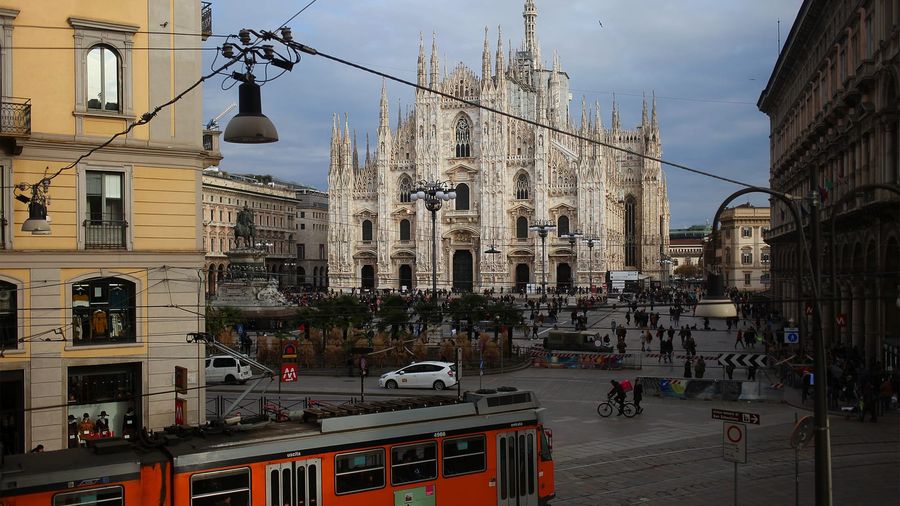
Milan is one of Italy's easiest big cities to cross without a car: the flat historic centre around the Duomo packs the headline sights within a short walk, and the dense ATM network — five metro lines plus trams, buses, and trolleybuses — reaches everywhere else on a single zoned ticket. Walk the core, ride the subway out to the Last Supper and the canals, hop a vintage tram for the fun of it, and let the train carry you in from Malpensa.
Milan is compact, flat, and built in rings around its cathedral, and that shape decides how you get around it. The heart of the city — the Duomo, the glass-roofed Galleria, La Scala, and the streets between them — is small enough to cross on foot, with little traffic to dodge.
Everything beyond that core, from the Last Supper in the west to the skyscrapers of Porta Nuova in the north, is stitched together by one of Italy's most efficient public-transport systems. Level ground you walk, longer hops you ride, and the whole network answers to a single operator's ticket.
Is Milan's centre walkable, and where should you start?
Yes — start on foot in Piazza del Duomo, the square at the city's geographic and symbolic centre. From the cathedral steps, the Galleria Vittorio Emanuele II, La Scala, and the designer streets of the Quadrilatero della Moda are all a few minutes away, so the core needs no transport at all.
The Duomo is the natural place to orient yourself, because the city radiates out from it. Walk north through the Galleria — Europe's oldest active shopping arcade — and you emerge at La Scala; stroll a little further and you reach the Brera district and Sforza Castle, all on flat, straightforward streets.
The only central sights that reward a ride rather than a walk sit on the edges of this core: Leonardo's Last Supper at Santa Maria delle Grazie to the west, the Navigli canal district to the south, and the modern Porta Nuova and Isola quarters to the north. Keep those for the network and give the centre to your feet.
How does the ATM network work?
One operator, ATM (Azienda Trasporti Milanesi), runs the metro, trams, buses, and trolleybuses on a single fare system. Five colour-coded metro lines form the backbone, the trams and buses fill every gap, and one ticket is valid across all of them, so you rarely need to think about which mode you are using.
The pieces each do a slightly different job, and knowing which is which saves time underground.
| Mode | What it is | Best for |
|---|---|---|
| Metro (M1–M5) | Five lines — red, green, yellow, blue, and lilac | Fast trips across the city and out to Linate Airport |
| Tram | A large network, including historic 1928 cars | Scenic street-level hops and stops the metro misses |
| Bus | Dense coverage, plus night routes | Neighbourhoods and the gaps between rail lines |
| Trolleybus | Electric buses on the outer ring roads | Circling the centre and reaching inner suburbs |
The metro does most of the heavy lifting: the red M1 and green M2 cross in the centre at Cadorna and link the Duomo, the castle, and the main stations, while the newest blue M4 runs clear out to Linate Airport. Plan any trip in the ATM Milano app, which shows live departures and sells tickets, and you will find the map resolves quickly once you spot the central interchanges at Duomo, Cadorna, and Centrale.
What do tickets cost and how do you pay?
Milan prices tickets by fare zone, not by distance, and nearly everything a visitor does sits inside the central zones Mi1–Mi3. A single urban ticket is valid for 90 minutes of connections across every mode, so most short journeys need only one. Buy in the app, tap a contactless card at the gate, or use a machine.
Fares are revised periodically, so treat the figures below as a guide and check the current price in the ATM app before you buy.
| Ticket | Roughly (zones Mi1–Mi3) | Good for |
|---|---|---|
| Single urban ticket | ~€2.20 | 90 minutes of connections, one metro ride |
| 24-hour pass | ~€7.60 | A full day of unlimited travel, all modes |
| 3-day pass | ~€15.50 | A long weekend of sightseeing |
| Carnet of 10 tickets | Varies | Occasional trips over several days |
The simplest approach for most visitors is contactless "tap-and-go": touch a bank card or phone to the reader at the metro gates or on board, and the system works out the right fare and even caps it at the daily price. Alternatively, buy and store tickets in the ATM app, or use the machines at any station.
Whichever you choose, keep your ticket or card to hand — the metro gates need it to exit as well as enter, and inspectors do check on trams and buses. If you are pairing transport with museums, the separate MilanoCard bundles unlimited ATM travel with attraction discounts and can pay for itself on a busy day.
Should you ride Milan's trams and BikeMi bikes?
For the pleasure of it, yes to both. Milan's orange 1928 "Ventotto" trams still rattle through the centre on everyday routes, making an ordinary ticket feel like a heritage ride, and the city's BikeMi bike-share puts hire bikes at stations across the flat core for quick hops between districts.
The vintage trams are a genuine attraction you can use as transport. These wood-panelled cars — the ones you see in postcards — run on normal scheduled lines such as route 1, so a standard €2.20 ticket buys you a seat on a piece of living history rather than a museum piece behind glass.
For covering ground under your own steam, BikeMi bikes unlock from an app and include electric models for longer trips; grab one at a station, ride, and dock it at another. Milan is dead flat, which makes cycling easy, and the quietest, most pleasant riding is along the Navigli canals and through the parks — in the tight, cobbled streets right around the Duomo, it is simpler to walk.
How do you get to and from Milan's airports?
Milan has three airports, and the right transfer depends on which one you land at. Malpensa is served by a dedicated express train, Linate now sits at the end of the M4 metro, and low-cost Bergamo relies on coaches. In every case, public transport beats a taxi on both price and, usually, time.
The table shows the main options; times vary with traffic and terminal.
| Airport | Distance | Best transfer | Roughly |
|---|---|---|---|
| Malpensa (MXP) | ~50 km NW | Malpensa Express train to Cadorna / Centrale | ~€13, 40–55 min |
| Linate (LIN) | ~7 km E | M4 blue metro line to San Babila | ~€2.20, 12–15 min |
| Bergamo (BGY) | ~45 km NE | Coach bus to Milano Centrale | ~€10, 60 min |
For Malpensa, the Malpensa Express runs about every 30 minutes from both terminals to Milano Cadorna and Milano Centrale; a combo ticket adds one onward city ride for a little more. For Linate, the opening of the full M4 line turned a fiddly bus trip into a direct subway ride on a normal urban ticket — one of the best airport-metro links in Europe. Bergamo (Orio al Serio), used by budget carriers, has no rail link, so frequent coaches to Centrale are the standard route.
How do you arrive by train and reach day trips?
Arrive by high-speed rail at Milano Centrale, the monumental main station and a major hub, with Rome around three hours away and Venice, Florence, and Turin all closer. From that same station, fast trains fan out across northern Italy, turning lakes and historic cities into easy day trips.
Milan is the rail capital of northern Italy, which is the main reason most visitors never need a car. Milano Centrale handles the Frecciarossa and private Italo high-speed services; Italy's cities link up at up to 300 km/h, and a metro ride connects the station to the centre in minutes. Porta Garibaldi and Cadorna handle additional regional and airport services.
The day trips are the payoff. Regional trains reach Lake Como (Como itself in under an hour), Bergamo's walled upper town, and the vineyards of the Franciacorta, while high-speed services put Venice, Florence, and Turin within easy return distance. Book Frecce and Italo tickets ahead for the cheapest fares, and validate any regional ticket before boarding.
Which guided tours are worth it, and what do they cost?
A Last Supper tour and a Duomo rooftop visit are the two paid experiences that most repay the money: one secures a timed slot that is notoriously hard to book alone, the other adds context and queue-skipping to Milan's signature climb. Walking and food tours round out the choices.
Milan's guides play to the city's strengths — Renaissance art, Gothic architecture, and design. The table shows the main options and rough per-person costs; prices vary by operator and season.
| Tour type | Roughly | Why take it |
|---|---|---|
| Free walking tour (tips-based) | €10–15 tip | A two-hour orientation of the centre and its history |
| Duomo + rooftop guided visit | €25–45 | Skip-the-line entry and the terrace among the spires |
| Last Supper guided tour | €55–80 | The hard-to-get timed ticket, secured and explained |
| Food / aperitivo tour | €60–100 | Tastings across markets and Navigli bars |
| Private half-day guide | €200–350 | A tailored route for up to a small group |
A Last Supper tour is the most practical splurge, because independent tickets release months ahead and vanish within days; a guide who bundles the slot removes the single biggest planning headache in Milan. A Duomo rooftop visit, meanwhile, lets you walk among the cathedral's 3,400 statues with views to the Alps on a clear day. Whatever you choose, book ahead — the best slots fill fast.
Day trip or base — how should you plan Milan?
Milan rewards a stay of two or three nights rather than a rushed day, because its quieter pleasures — an evening aperitivo along the Navigli, a slow morning in Brera, the Duomo rooftop at golden hour — belong to people who linger. Fast rail then turns the surrounding north into easy excursions.
You can tick off the headline sights in a long day, but the city is at its best in the unhurried margins, and it makes a natural launch pad for everything around it. From a Milan base, the lakes, the vineyards, and the art cities of the north are all within a comfortable day's return by train — no car required.
Once you have the transport sorted, the Milan city guide covers what to see when you arrive, from the Duomo and the Galleria to the canals and the castle on the city's edge.
Save Getting Around Milan: A Practical Transport Guide
Save Getting Around Milan: A Practical Transport Guide to your free account
Sign in or create a free account to keep this place in Saved places and add it to your trips.
Frequently Asked Questions
Is Milan's city centre walkable?
The core is very walkable. The Duomo, the Galleria, La Scala, and Sforza Castle all sit within a flat fifteen-to-twenty-minute walk of one another, and the old centre carries little through-traffic. You only need the metro or a tram for the outlying sights — the Last Supper at Santa Maria delle Grazie, the Navigli canals, the Isola and Porta Nuova districts, and the airports.
How do you pay for the metro, tram, and bus in Milan?
Everything runs on one ATM ticket valid across metro, tram, bus, and trolleybus. Buy a single ride, a 24-hour pass, or a carnet in the ATM Milano app or from a station machine, choosing the zones your trip crosses — central Milan sits in zones Mi1–Mi3. You can also tap a contactless card or phone straight on the metro gates and on board, and the system charges you the correct fare automatically.
How do you get from Malpensa Airport to central Milan?
Take the Malpensa Express train. It links both terminals to Milano Cadorna and Milano Centrale in roughly 40–55 minutes, running about every 30 minutes for most of the day. A one-way ticket costs around €13, with a slightly dearer combo ticket that adds one onward metro, tram, or bus ride. Shuttle coaches to Centrale are cheaper but slower and exposed to motorway traffic, so the train is usually the better choice.
How do you get from Linate Airport to the city centre?
Ride the M4 blue metro line. Since the full line opened, Linate sits at one end of the subway, reaching San Babila in the centre in about 12–15 minutes for the price of a standard urban ticket. It is far faster and cheaper than a taxi, which fights city traffic for a similar or longer journey. Linate is Milan's close-in airport, only about 7 km east of the Duomo.
Do you need a car in Milan?
No. Between five metro lines, an extensive tram and bus network, BikeMi bikes, and a walkable centre, the city is easy to cover without one. Driving is actively discouraged in the middle — Area C charges a daily fee to enter the historic core and Area B bars the most polluting vehicles — and parking is scarce and costly. Arrive by train at Centrale and rely on public transport instead.