First-Timer's Guide to Kyoto: Temples, Districts, and Day Trips
A practical guide to visiting Kyoto for the first time — the essential temples, best neighborhoods, when to visit, transport from Tokyo.
Read the full guideUpdated · 13 min read
Kyoto rewards first-timers who choose rather than cover. Plan three days for the essential temples—Kinkaku-ji, Fushimi Inari, Ryōan-ji—plus the Higashiyama and Gion districts and Nishiki Market. Arrive from Tokyo in about 2 hours 15 minutes by Shinkansen, get around by bus and bicycle, and visit in spring or autumn.
Kyoto is the city that explains Japan to itself. Seventeen UNESCO World Heritage sites. Over a thousand temples and shrines. Seventeen centuries of continuous cultural production. For a first-time visitor from outside Japan, it can feel like being handed a library card and told to explore the entire collection in four days. The key is choosing rather than covering, and allowing each place the time it deserves rather than sprinting through a checklist. Kyoto is Japan's cultural counterweight to Tokyo's modernity, and both cities reward comparison.
How do you get to Kyoto?
Kyoto has no airport of its own. The Tokaido Shinkansen from Tokyo takes 2 hours 15 minutes on the Nozomi and costs ¥13,910 one way; Osaka is just 15 minutes away. From Kansai Airport, the Haruka limited express reaches Kyoto Station in 75 minutes for ¥2,900.
From Tokyo: Shinkansen
The Tokaido Shinkansen from Tokyo Station to Kyoto Station takes 2 hours 15 minutes on the Nozomi, 2 hours 40 minutes on the slower Hikari (covered by Japan Rail Pass — Nozomi is not). The journey costs ¥13,910 one way at standard unreserved pricing. Book reserved seats at least two days ahead for weekend travel; seats sell out during Golden Week (late April to early May) and autumn foliage season.
The window seat decision: Mount Fuji appears to the right of the train when traveling from Tokyo to Kyoto, roughly 40 to 50 minutes after departure. A clear day makes seat bookings on the right (E-side seats) worth requesting specifically when reserving.
From Osaka: Extremely Easy
Kyoto is 15 minutes from Osaka by Shinkansen or 28 minutes on the cheaper Hankyu or Keihan private railways (¥410–480 versus ¥1,430). If you're basing yourself in Osaka and day-tripping to Kyoto, the logistics are trivial.
From Airports
Kyoto has no airport. The practical options:
- Kansai International Airport (KIX): Haruka limited express to Kyoto Station, 75 minutes, ¥2,900.
- Osaka Itami (ITM): Airport limousine bus to Kyoto, 55–75 minutes, ¥1,340.
- Many visitors fly into Tokyo (Narita or Haneda) and use the Shinkansen to reach Kyoto, which doubles as a sightseeing journey.
What is the best way to get around Kyoto?
Kyoto leans on buses more than trains for reaching temples. The city bus charges a flat ¥230 per ride, and a ¥700 day pass pays off after three trips. Two subway lines, widely available taxis, and rental bicycles (¥1,000-1,500 a day) round out the options across the flat central and eastern districts.
Kyoto's main sightseeing areas are spread across the city: the western mountains (Arashiyama), the eastern hills (Higashiyama), the central downtown, the northern temples (Kinkaku-ji, Ryōan-ji), and the Fushimi area south of the station.
Buses: The city bus network connects all tourist areas with a flat fare of ¥230 per ride. A day pass (¥700) pays for itself after three rides and is sold at Kyoto Station bus terminals and major hotels. Buses 100 and 101 cover the most tourist-dense routes; service becomes crowded in peak season.
Taxis: Available widely. Relatively affordable by Japanese city standards. Essential for reaching some temple areas poorly served by bus.
Bicycle: Kyoto is flat in its central and eastern sections, and cycling is a genuinely excellent option for self-guided exploration. Hire bikes near Kyoto Station or in the Higashiyama district for ¥1,000–1,500 per day.
Subways: Two subway lines (Karasuma running north-south, Tozai running east-west) serve mainly residential and business destinations. Useful for reaching Daigo-ji and the Tozai line's eastern terminus.
Which Kyoto temples and shrines should first-timers prioritise?
With over 1,600 temples, selection beats accumulation. Five stand out: Kinkaku-ji's golden pavilion (¥500), Fushimi Inari's 10,000 vermillion torii gates (free, 24 hours), the Arashiyama bamboo grove, Ryōan-ji's Zen rock garden, and the Higashiyama district around Kiyomizu-dera. Arrive early—before 7 AM at Fushimi Inari—to beat the crowds.
Kyoto's 1,600+ temples require a philosophy of selection rather than accumulation. These five offer the most distinctive experiences for first-time visitors.
Kinkaku-ji (Golden Pavilion)
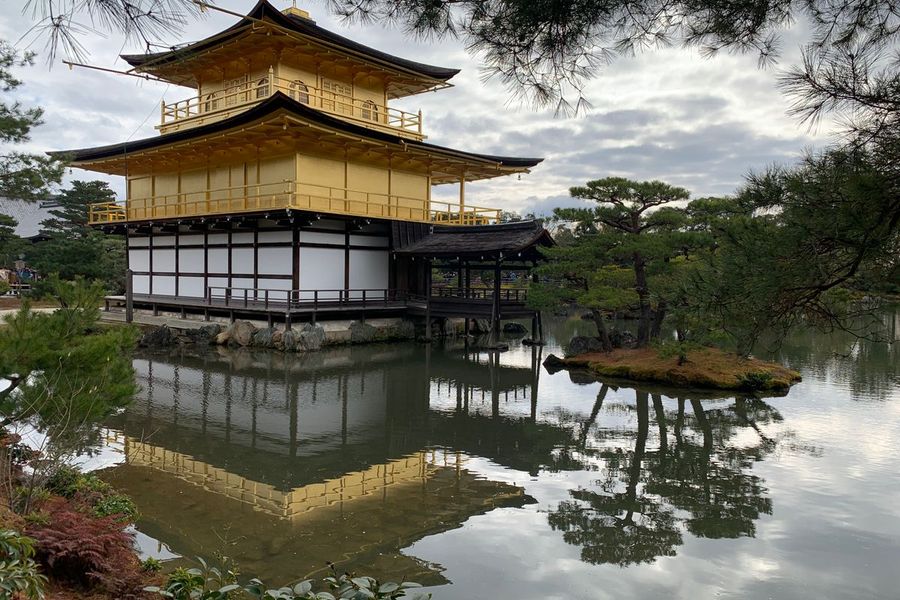
The three-story pavilion covered in gold leaf reflected in Kyokochi Pond is one of the most photographed structures in Asia. Arrive before 9 AM when it opens to experience the reflection on still water before tour groups arrive. The site is visited on a one-way path; it takes 30–40 minutes to complete. Admission ¥500.
The honest assessment: Kinkaku-ji is extraordinarily beautiful and genuinely worth visiting, but the surrounding area is heavily commercialized and the path through can feel regimented during peak hours. Pair it with Ryōan-ji (rock garden, 2 km south) in the same morning for balance.
Fushimi Inari-Taisha
Ten thousand vermillion torii gates winding 4 km up Mount Inari. The most photographed portion (the first 200 gates) takes 15 minutes. The full hike to the summit and back takes 2–3 hours. Free entry, open 24 hours.
Timing matters enormously here. The lower gates are completely jammed by 9 AM on most mornings in spring and autumn. Arriving before 7 AM produces photographs that look nothing like the daytime experience. Alternatively, the upper mountain trails are never crowded regardless of arrival time—most visitors turn back at the first major viewpoint.
The surrounding Fushimi neighborhood rewards exploration: craft sake breweries, the Meiji-era Fushimi Momoyama Castle, and a canal district with sake warehouses.
Arashiyama Bamboo Grove
The famous bamboo path takes approximately 10 minutes to walk through and is genuinely beautiful. It is also visited by thousands of people daily and photographs well only in early morning low light or overcast conditions. The neighborhood around it, however, is one of Kyoto's most rewarding: the Tenryu-ji temple garden (UNESCO listed), the Togetsukyo Bridge, traditional rickshaw rides, and the forested Jojakko-ji temple complex up a quiet staircase that most visitors overlook.
Plan at least half a day in Arashiyama rather than a quick visit for the bamboo alone.
Ryōan-ji
The rock garden here—15 carefully raked stones arranged on white gravel within a walled space—is one of the most significant works of abstract composition in Japanese cultural history. Its meaning is deliberately open to interpretation; Zen masters have been debating it for five centuries. Arrive when the temple opens and sit with it for 15 minutes rather than photographing and moving on. The surrounding pond garden is equally fine.
Higashiyama District
This is less a single site than a collection of temples and neighborhoods strung along the eastern hills: Kiyomizu-dera (the veranda stage temple with views across the city), Ninenzaka and Sannenzaka (preserved traditional streets of shops and teahouses), Chion-in (the largest temple gate in Japan), and Shoren-in (a quiet temple with camphor trees hundreds of years old).
A full Higashiyama walk from Kiyomizu-dera north to Nanzen-ji takes 3–4 hours and needs no particular guidance—the path is well marked and the succession of temples unfolds naturally. Wear comfortable shoes; the stone-paved lanes on the hillside are beautiful but uneven.
Where can you see Kyoto's geisha districts?
Kyoto's geiko tradition centres on five hanamachi: Gion Kobu, Gion Higashi, Miyagawacho, Kamishichiken, and Pontocho. Gion is the most famous, its Shirakawa canal and Hanamikoji machiya beautifully preserved; spotting a geiko or maiko needs early-evening timing around 5-6 PM and real discretion. Pontocho's riverside alley is one of Kyoto's finest dining streets.
Kyoto's geiko (the Kyoto term for what other regions call geisha) tradition is concentrated in five hanamachi (flower town) districts: Gion Kobu, Gion Higashi, Miyagawacho, Kamishichiken, and Pontocho.
Gion is the most famous and most photographed. The Shirakawa canal area and Hanamikoji Street's traditional machiya townhouses are architecturally preserved. Chances of spotting a geiko or maiko (apprentice) on their way to an appointment are real but not guaranteed; it requires early evening timing (5–6 PM) in the right streets and a degree of discretion. Do not attempt to stop or photograph them at close range—this is intrusive and is discouraged.
Pontocho: The narrow alley running parallel to the Kamo River is one of Kyoto's finest dining streets. Kaiseki restaurants, izakayas, and cocktail bars occupy both sides. Summer months feature outdoor platforms (yuka) extending over the river, a uniquely atmospheric Kyoto experience.
What is Nishiki Market and when should you visit?
Nishiki Market is a five-block covered arcade in central Kyoto that locals call "Kyoto's Kitchen," running for over 400 years. Tofu shops, pickle sellers, fresh fish vendors, and wagashi makers line the narrow passage. Visit on an empty stomach to sample rather than buy full portions, ideally weekday mornings before tour groups arrive.
The five-block covered market in central Kyoto has operated for over 400 years and is called "Kyoto's Kitchen" by locals. Tofu shops, pickle sellers, fresh fish vendors, and wagashi (Japanese sweet) makers line both sides of the narrow passage. Visit on an empty stomach and sample rather than buy full portions. Best visited weekday mornings before tour groups arrive.
What day trips can you take from Kyoto?
Three day trips stand out. Nara (45 minutes) has 1,200 wild deer and Japan's largest bronze Buddha at Todai-ji. Osaka (28-75 minutes) offers Dotonbori's neon and food-obsessed nightlife. Hiroshima and Miyajima (2.5 hours by Shinkansen) pair the Peace Memorial with Itsukushima Shrine's floating torii gate, best seen at high tide.
Nara (45 minutes)
The ancient former capital holds 1,200 wild deer roaming freely around the Todai-ji temple complex (home to Japan's largest bronze Buddha). The deer are accustomed to tourists, approach readily when offered deer crackers sold at stalls, and make for particularly memorable encounters. The temples at Kasuga Taisha and the Isuien garden are quieter alternatives to the main site.
Osaka (28–75 minutes)
Japan's second city is cultural counterpart to Kyoto: loud, commercial, food-obsessed, and endlessly entertaining. Dotonbori district at night, the Kuromon covered market, Osaka Castle, and the Shinsekai neighborhood are all worth an afternoon and evening.
Hiroshima and Miyajima (2.5 hours by Shinkansen)
The Peace Memorial Museum and Genbaku Dome are among the most significant historical sites in Asia. Miyajima Island (20-minute ferry from Hiroshima) holds the famous floating torii gate of Itsukushima Shrine, visible at high tide with the gate appearing to stand in the sea. A single long day is achievable; overnight allows a more human pace.
When is the best time to visit Kyoto?
Cherry blossom season (late March to early April) and autumn foliage (mid-November to early December) are Kyoto's most spectacular and most crowded times, so book accommodation four to six months ahead. Late October and May offer near-ideal weather with thinner crowds, while January and February are cold, quiet, and occasionally snow-dusted.
Cherry blossom season (late March to early April) is Kyoto's most spectacular time and its most crowded. Maruyama Park, the Philosopher's Path, and Arashiyama all bloom simultaneously, drawing enormous crowds. Book accommodation four to six months ahead. Prices double or triple at quality hotels.
Autumn foliage (mid-November to early December) rivals cherry blossom for beauty and matches it for crowds. The maples at Eikan-do, Tofuku-ji, and Rurikoin temple turn deep red and orange. Same booking advice applies.
Late October and May offer near-ideal conditions: pleasant temperatures, low rain, manageable crowds, and competitive prices.
Summer (July and August) is hot and humid—30°C+ temperatures and high humidity make extended walking uncomfortable. The Gion Matsuri festival (July, one of Japan's three great festivals) compensates partially for the heat.
January and February are cold but quiet. Snow occasionally settles on temple roofs, producing photographs that justify the cold entirely.
How should you structure three days in Kyoto?
A three-day plan covers Kyoto without rushing. Day one tackles eastern Kyoto: Fushimi Inari at dawn, then Higashiyama and Gion. Day two heads west to Arashiyama and north to Kinkaku-ji and Ryōan-ji. Day three walks the Philosopher's Path and Nishiki Market, or takes a day trip to Nara.
Day 1 (Eastern Kyoto): Fushimi Inari before 7 AM, then train to Higashiyama for Kiyomizu-dera and the Ninenzaka walk to Gion. Evening in Pontocho.
Day 2 (Western Kyoto): Arashiyama half-day (bamboo grove, Tenryu-ji, Jojakko-ji). Afternoon at Kinkaku-ji and Ryōan-ji. Evening at Nishiki Market.
Day 3 (Northern and central): Philosopher's Path walk (Nanzen-ji to Ginkaku-ji), Nishiki Market if not visited, afternoon departure or day trip to Nara.
What practical things should you know before visiting Kyoto?
Japan remains cash-dependent, and temples typically take cash only, though 7-Eleven and Japan Post ATMs accept international cards. Staying near Kyoto Station simplifies transport logistics, while Higashiyama or Gion puts you among the eastern sights. English signage is widespread at stations and major temples, so basic phrasebook Japanese is appreciated but not required.
Cash versus card: Japan is more cash-dependent than most developed countries, though this is changing rapidly. Temples typically take cash only. ATMs at 7-Eleven and Japan Post accept international cards reliably.
Accommodation location: Staying near Kyoto Station simplifies logistics (all bus lines originate there, Shinkansen departs from there) but places you far from the temple districts. Staying in Higashiyama or Gion puts you near the eastern sights but complicates arrivals. Both work; the choice depends on your priorities.
Language: Kyoto has substantial tourist infrastructure in English. Station signs, major temple signage, and most tourist-facing businesses have English versions. Restaurant menus increasingly include English or pictures. Phrasebook Japanese for basic greetings and ordering is appreciated but not required.
Related Guides
- Getting Around Tokyo — transport logistics for Japan's capital before or after a Kyoto visit
- Tokyo vs. Osaka: Which City Fits Your Trip? — weighing the two major cities against each other
- Athens Archaeological Tours — another historically layered city where selection matters as much as coverage
Kyoto rewards slowness. The travelers who remember it most vividly are those who spent an hour in a single garden, who found a temple tucked behind a housing block with no other visitors, who timed Fushimi Inari at dawn. The checklist approach leaves Kyoto feeling like a chore; the selective approach leaves it feeling like a destination worth returning to.
Planning your first Kyoto visit? Send questions about itinerary structure and timing — every season requires a different approach.
Frequently Asked Questions
How do I get from Tokyo to Kyoto?
The Tokaido Shinkansen bullet train is the fastest option, taking about two hours and fifteen minutes. The Japan Rail Pass covers the Hikari and Kodama services but not the fastest Nozomi trains.
How many days do I need in Kyoto?
Three days lets you cover the essential temples, the geisha districts and Nishiki Market, with one day spare for a day trip to Nara or Arashiyama.
What is the best way to get around Kyoto?
Kyoto relies more on buses than trains for reaching temples, though the subway and bicycles are useful. A prepaid IC card works on all of them and saves fumbling for change.
When is the best time to visit Kyoto?
Cherry blossom season in late March to early April and the autumn foliage in November are the most beautiful but also the busiest and priciest. Early summer and winter are quieter.