
Best Time to Visit Hallstatt: Austria's Busiest Lakeside Village
A village of fewer than 800 people draws over a million visitors a year, so timing is everything in Hallstatt. Here is when to go for open salt mines.
Read the full guideUpdated · 10 min read
The best time to visit Hallstatt is late May through June and September into October, when the salt mine, Skywalk, and Dachstein caves all operate and crowds stay below the July-August peak. Arrive before 9 AM or after 4 PM to beat the day-trip coaches, and expect November to March to be quiet but with headline attractions closed.
Hallstatt presents a planning problem unlike almost anywhere else in Austria. A village of fewer than 800 permanent residents receives more than a million visitors a year, funnelled along a single lakeside street pinned between the Hallstätter See and the steep Dachstein massif. There is no room to spread out. The result is that when you arrive — both the season and the hour — shapes the experience far more than it would in a larger town. Get the timing right and you have one of the most beautiful villages in the Alps largely to yourself; get it wrong and you are shuffling through a crowd in front of the same postcard view as everyone else.
This guide is about timing that visit deliberately: which months open up the attractions, which hours belong to the day-trippers, and how the seasons change what is actually possible in Hallstatt.
What is the short answer on the best time to visit Hallstatt?
Come in late May, June, September, or early October for the fullest experience: every major attraction runs, the funicular and lake operate reliably, and October adds copper-and-gold forest reflections across the water. Choose November through March only if an almost-empty village matters more to you than the salt mine and Skywalk, which close for winter.
For most travellers, late May through June and September into October are the sweet spots. The salt mine, the Skywalk, and the Dachstein caves are all running, the weather is reliable enough for the funicular and the lake, and the crowds — while real — have not yet reached their July and August peak. If your priority is solitude over open attractions, November through March delivers an almost empty village, with the significant caveat that several of Hallstatt's headline sights are closed for the season.
How does Hallstatt change season by season?
Each season reshapes Hallstatt. Spring is transitional — the salt mine reopens in late March and the lake greens up by May. Summer runs at full volume, with July and August congested. Autumn is the connoisseur's choice, trading crowds for golden foliage and still morning water, while winter closes the headline sights but empties the village.
Spring (April to May)
Spring is a transitional season here. The Salzwelten Hallstatt salt mine — billed as the world's oldest, with over 7,000 years of continuous extraction — reopens in late March, and the funicular that climbs 838 metres up the Salzberg starts running again. Early April can still be grey and the higher attractions weather-dependent, but by May the lakeside greens up, the wooden boathouses reflect in calm water, and day-trip numbers are still climbing rather than peaking. Late May is one of the most rewarding times to come: long daylight, full access to the attractions, and crowds that have not yet hit their summer crush.
Summer (June to August)
Summer is Hallstatt at full volume in every sense. June is genuinely excellent — warm enough for the lake and the mountains, with everything open and the worst of the crowds still ahead. July and August are when the village reaches its limits. This is peak season for the salt mine, whose combined ticket (mine, funicular, and the Skywalk viewing platform) runs about €40 (around $43) for adults and €20 (around $22) for children aged four to fifteen, with a family ticket at roughly €90 (around $97). Summer time slots sell out, so book online in advance rather than turning up and hoping.
The midsummer challenge is congestion. Tour coaches from Salzburg and the wider Salzkammergut converge on the single main street from mid-morning, and the residents have publicly asked visitors not to block the narrow lanes. The heat is mild by Mediterranean standards, which is part of the appeal, but the density of people in such a small footprint is the real drawback. If you can only come in high summer, the strategy below on timing your hours becomes essential.
Autumn (September to October)
Autumn is, for many, the connoisseur's choice. September keeps summer's open attractions and mild weather while shedding a meaningful share of the crowds, and by October the Salzkammergut forests turn, throwing copper and gold reflections across the lake. The salt mine and Skywalk are still operating into early November, and the cooler, clearer air often produces the sharpest mountain views and the stillest morning water for photographs. The trade-off is shorter days and a rising chance of low cloud or rain, so build a flexible day or two into the itinerary.
Winter (November to March)
Winter strips Hallstatt back to something close to how its residents experience it. The crowds fall away, the village takes on a quiet, snow-dusted beauty, and accommodation is easier to find. But the season comes at a cost: the salt mine and the Skywalk close from early November until late March, and the Dachstein Giant Ice Cave — which sits below freezing even in summer — shuts entirely for the colder months. What remains open is the village itself, the lakeside Evangelical church that defines every photograph of Hallstatt, and the eerie Beinhaus (bone house) in St. Michael's Chapel, with around 1,200 skulls, some 600 of them hand-painted. Come in winter for atmosphere and emptiness, not for the marquee attractions.
Why does the time of day matter as much as the month in Hallstatt?
In a village of one lakeside street, the hour you arrive can matter more than the month. Day-tripper coaches from Salzburg reach Hallstatt around 10 AM and pack the lane within minutes. Arrive before 9 AM for mist on the lake and shuttered calm, or stay overnight to own both the early morning and late afternoon.
In a village this small, the hour you arrive can change your visit more than the season. Day-tripper coaches typically reach Hallstatt around 10 AM and the main street transforms from tranquil to packed within minutes. Two approaches beat the rush:
- Arrive before 9 AM. The early village — mist on the lake, shutters still closed, the odd resident walking a dog — is the version worth travelling for.
- Stay overnight. A single night in or near the village lets you have both the early morning and the late afternoon, after the buses have left, when Hallstatt empties out again.
Either way, the middle of the day in July and August is the slice to plan around, not into.
What should you budget for Hallstatt tickets?
Walking Hallstatt's lakeside, church, and lanes costs nothing, but the paid sights add up. The salt mine combined ticket — mine, funicular, and Skywalk — is the biggest item at around €40 ($43) per adult; book it online for a summer time slot. Note the Salzburg Card does not cover Hallstatt, and a half-day private guide runs €180-300.
Hallstatt is not an expensive town to walk around — the lakeside, the church, and the village lanes cost nothing — but the paid attractions add up, and a few planning notes save money and frustration:
- The salt mine combined ticket (mine, funicular, and Skywalk) is the single biggest line item at around €40 ($43) per adult. Book it online for a guaranteed time slot in summer.
- The Salzburg Card does not cover Hallstatt, a common and costly assumption for travellers basing themselves in the city. Budget for Hallstatt's tickets separately.
- A private guide for the Hallstatt area runs roughly €180–300 (about $195–325) for a half-day. In a village where the prehistoric and mining history lies entirely beneath the photogenic surface — this is the namesake site of the Hallstatt culture of 800–400 BC — a guide turns a pretty stop into a genuinely substantive visit, and helps a group move efficiently through the crowds.
How do you get to Hallstatt and get around?
Hallstatt is most often a day trip from Salzburg, about 75 minutes away by car or bus. Arriving by train adds a scenic ferry crossing of the Hallstätter See from the station opposite the village. Parking is limited, so use the P1 tunnel car park and walk in, and dress in layers — the salt mine holds a constant 8°C.
Hallstatt is most often visited as a day trip from Salzburg, about 75 minutes away by car or bus. Trains are scenic but involve a ferry transfer: the railway station sits across the water, and a short boat crossing of the Hallstätter See delivers you to the village centre — a memorable arrival in its own right. A few practicalities worth knowing before you go:
- Parking is tightly limited. Use the P1 tunnel car park and walk about ten minutes into the centre; do not expect to park on the village street.
- Dress in layers regardless of season. The salt mine interior holds a constant 8°C year-round, and the Dachstein ice cave is below freezing even in August, so a warm layer earns its place in your bag in midsummer.
- Respect the village. This is a living community of a few hundred people, not an open-air attraction. Keep out of the narrow residential lanes early and late, when locals are going about their day.
What is the bottom line on timing a Hallstatt visit?
If you want everything open with room to breathe, target late May, June, September, or early October and time your day around the mid-morning coaches. If solitude outranks the salt mine, winter delivers a hushed, snow-dusted village few travellers see. Either way, treat timing as the main decision, and never arrive unplanned at noon in August.
If you want everything open with the best balance of weather and breathing room, target late May, June, September, or early October, and arrange your day so you are in the village before the mid-morning coaches or after they leave. If solitude matters more than the salt mine and you can accept closed attractions, winter offers a quiet, atmospheric Hallstatt that few visitors ever see. Either way, the village rewards travellers who treat timing as the main decision rather than an afterthought — and punishes those who arrive, unplanned, at noon in August.
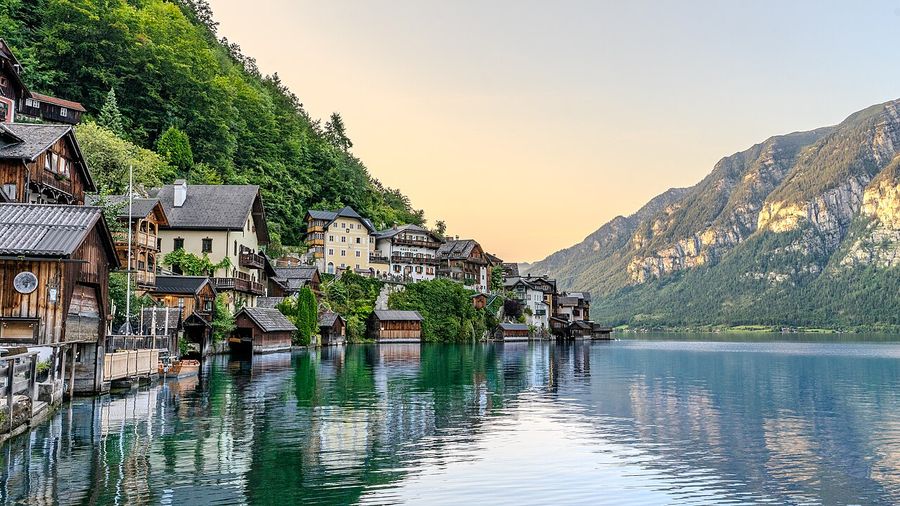
Hero photograph of Hallstatt at sunset, looking north along the Hallstätter See, by David Kernan, licensed CC BY 4.0 via Wikimedia Commons.
Frequently Asked Questions
When is the best time to visit Hallstatt?
Late May and June, then September and October, give the best balance of open attractions, mild weather, and manageable crowds. The salt mine, Skywalk, and Dachstein cave all operate, the lake reflections are at their best, and the village is busy but not overwhelmed.
When is Hallstatt least crowded?
November to March, when day-trip numbers fall sharply. The trade-off is that the salt mine, Skywalk, and Dachstein Ice Cave are closed or weather-limited for much of that window, so the village is peaceful but several headline attractions are unavailable.
What time of day should I arrive in Hallstatt?
Before 9 AM or after 4 PM. Day-tripper coaches from Salzburg and the Lake District typically arrive around 10 AM and thin out in the late afternoon, so an early start or an overnight stay buys you the village at its quietest.
Is the Hallstatt Salt Mine open all year?
No. The Salzwelten Hallstatt salt mine runs from late March to early November and closes for winter, as does the Skywalk reached from the same funicular. If those are central to your trip, avoid the December-to-March window.