
Eggenberg Palace timeline
-
Construction begins
Hans Ulrich von Eggenberg commissions the court architect Giovanni Pietro de Pomis to build a palace that encodes the calendar in stone.
-
Palace completed
The four-winged baroque residence, with its 365 windows and 24 state rooms, is finished three kilometers west of Graz.
- 1678–1685
Planetary Hall painted
Court painter Hans Adam Weissenkircher fills the Planetensaal with the seven planetary gods and the twelve signs of the zodiac.
- 1760s
Rococo state rooms
The piano nobile is redecorated with rococo interiors and East-Asian cabinets, including the Japanese panels depicting Osaka.
-
Acquired by Styria
The Province of Styria takes over the palace, opening its halls, gardens, and museums of the Universalmuseum Joanneum to the public.
-
UNESCO World Heritage
Schloss Eggenberg is inscribed as an extension of the 1999 Graz historic-centre listing.
Architecture
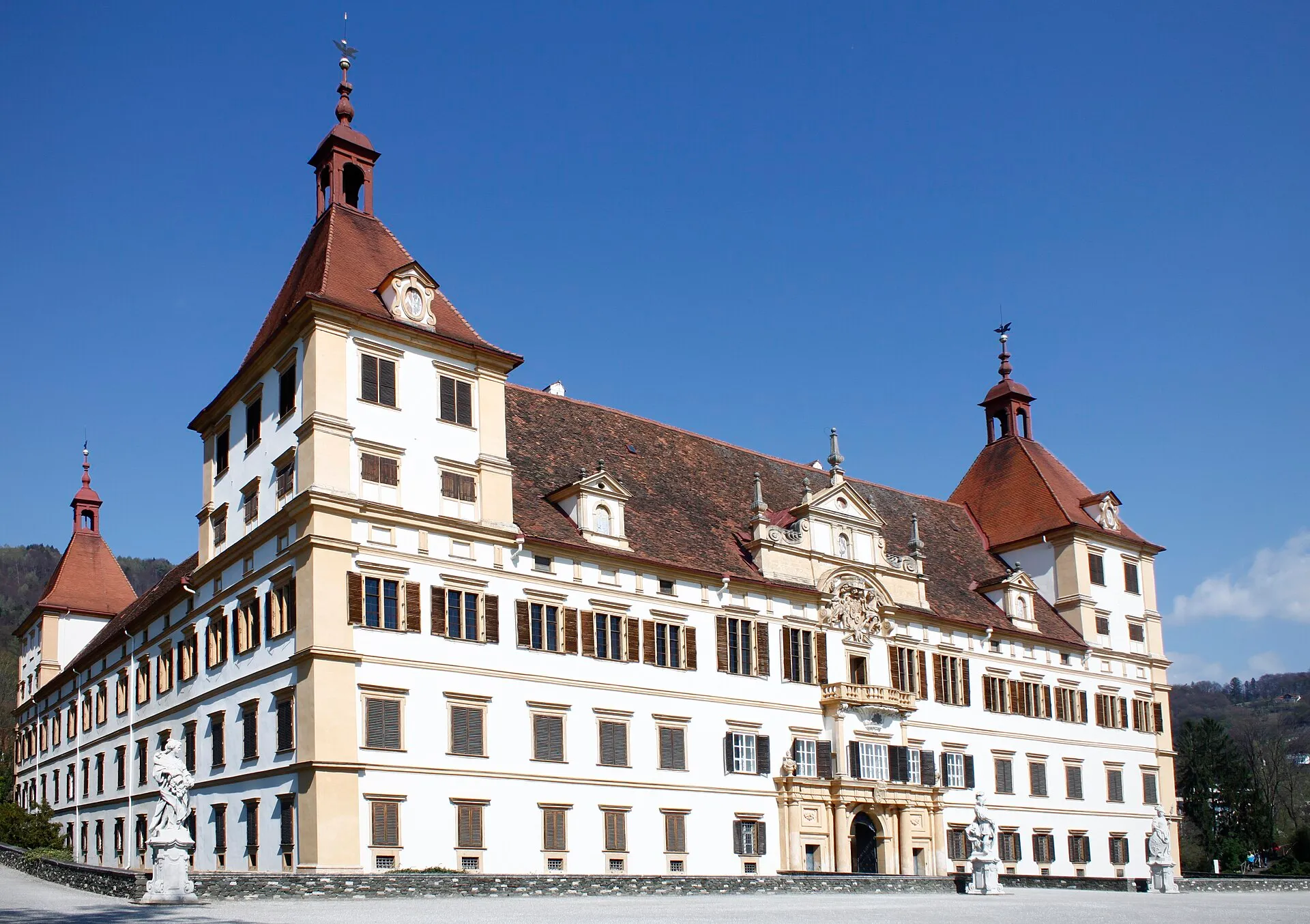
Eggenberg's genius is its plan: four ranges enclosing a square courtyard, anchored by four corner towers for the four seasons and the cardinal points, so the building diagrams the year before you step inside. The set pieces worth lingering over:
- The Planetensaal (Planetary Room): the double-height culmination of the piano nobile, its ceiling and walls hung with canvases by court painter Hans Adam Weissenkircher (1678–1685) depicting the seven planetary gods and the twelve signs of the zodiac — baroque cosmology as interior decoration, and the intellectual heart of the palace.
- The 24 state rooms: an unbroken enfilade of aligned doorways, still carrying original 17th-century stucco work and painted ceilings, each corresponding to an hour of the day. Rococo redecoration in the 1760s added East-Asian cabinets, and one room preserves rare Japanese panels showing a view of Osaka — among the earliest surviving images of the city and a magnet for visiting scholars.
- The 365 windows: the shifting daylight they admit is itself part of the program, changing the mood of each room hour by hour and reinforcing the calendrical theme.
- The gardens: a formal baroque parterre beside the palace opens into an English landscape park where peacocks roam freely, alongside a reconstructed Planetary Garden and a lapidarium of Roman relief stones.
For photographers, the symmetric front facade with its central tower reads best in late-afternoon light; the courtyard arcades frame clean geometric shots; and the peacocks in the parterre are the garden's easiest portrait — though the Planetensaal itself is off-limits to cameras.
Historical Significance
Hans Ulrich von Eggenberg rose from provincial Styrian nobility to become Obersthofmeister (chief steward) and closest adviser to Emperor Ferdinand II, steering Habsburg policy through the opening decade of the Thirty Years' War and gathering the titles of Imperial Prince (1623) and Duke of Krumau (1628). The palace he raised west of Graz was political theater in architectural form — its Hermetic and Ptolemaic number-symbolism proclaiming universal order at the very moment Europe was tearing itself apart over religion. Today the wings around the courtyard hold three museums of the Universalmuseum Joanneum:
- The Archaeology Museum guards the Strettweger Kultwagen, a bronze cult wagon from about 600 BC unearthed in a Styrian burial mound in 1851 — one of the most significant finds of the European Iron Age.
- The Old Gallery (Alte Galerie) traces painting and sculpture from the Middle Ages to the baroque, with works by Lucas Cranach the Elder and Pieter Brueghel the Younger and the celebrated Admont Madonna of around 1320.
- The Coin Cabinet (Münzkabinett) rounds out the palace's role as one of Styria's great repositories of art and history.
When to Visit
- State rooms: guided tours only, Wednesday–Sunday, 10 AM–5 PM, and open April through October — they close entirely over winter, so a cold-season visit is limited to the museums and grounds.
- Museums (Archaeology, Old Gallery, Coin Cabinet): open year-round, Wednesday–Sunday, 10 AM–5 PM, closed Mondays and Tuesdays.
- Gardens and peacocks: open daily from 8 AM until dusk, with free entry.
- How long to allow: the state-room tour runs about 50 minutes; a full visit with museums and a garden stroll needs 2–3 hours.
- Best slot: the first tour at 10 AM has the smallest groups, and the peacocks are liveliest in the morning.
Admission and Costs
- State-rooms guided tour: €17 (about $18) for adults.
- Museum combination (Archaeology + Old Gallery): €10 (about $11).
- Full ticket (state rooms + all museums): €19 (about $21).
- Gardens: free, and under-19s enter every area free.
- Graz Card (€19.50 / ~$21 for 24 hours) covers all Eggenberg venues plus the Schlossberg lift, city museums, and trams — the best value if you are seeing more of the city.
The Case for a Guide
A guide turns Eggenberg from a handsome facade into a legible code. The whole point of the building is hidden in its numbers and paintings, and much of it is invisible to an unbriefed visitor:
- Decoding the calendar: why 365 / 24 / 52 is no coincidence, and how the Planetensaal's planetary gods and zodiac tie the rooms to Hermetic and Ptolemaic ideas of cosmic order.
- The Osaka panels: the story of how a Japanese folding screen was cut down and set into a Styrian palace during the rococo redecoration of the 1760s.
- Power and the Thirty Years' War: how Hans Ulrich von Eggenberg's career under Ferdinand II is written into the architecture.
- The right rooms, in the right order: the state rooms are seen only on a guided route, so a good guide is also your access — and your best steer on which pieces in the Archaeology Museum and Old Gallery reward a closer look.
Pair the visit with the Schlossberg and Kunsthaus Graz and a single guide can thread all three into one narrative of how Graz built, defended, and reinvented itself.
Tips for Visitors
- Book the tour, not just the ticket: state rooms are guided-tour only — check the schedule and arrive before your slot, as group sizes are capped.
- Cameras down in the Planetensaal: photography is permitted in parts of the palace but prohibited in the Planetary Room — ask your guide where you can shoot.
- Tram 1 is the easy way in: the direct connection from Hauptplatz to the Schloss Eggenberg stop takes about 15 minutes, then a short walk to the gate.
- The gardens alone justify the trip: even if you skip the interior, the baroque parterre and free-roaming peacocks reward the tram ride, and entry is free.
- Mind the closures: the palace is shut Mondays and Tuesdays, and the state rooms close entirely November–March.
- Best photos: the symmetric facade and central tower photograph best in late-afternoon light; mornings bring the most active peacocks.
Frequently Asked Questions
What is the best season to explore Eggenberg Palace?
May through September is the prime window: the state rooms are open for guided tours, the peacocks roam the baroque parterre in full plumage, and warm weather makes the parkland a pleasure to stroll. The state rooms close entirely from November through March, so a winter visit is limited to the year-round museums and a quieter, frost-dusted garden.
How do you get to Eggenberg Palace from central Graz?
Take tram line 1 from Hauptplatz or Jakominiplatz to the Schloss Eggenberg stop — a direct ride of about 15 minutes, followed by a short walk to the palace gate along Eggenberger Allee. The palace sits roughly three kilometers west of the UNESCO old town, so it is far too far to fold into a casual old-town stroll on foot.
Do you need a guided tour to see the state rooms at Eggenberg Palace?
Yes. The 24 state rooms of the piano nobile can only be seen on a guided tour, which runs on a fixed schedule from April to October, and group sizes are capped. Check the times in advance and arrive before your slot. The Archaeology Museum, Old Gallery, and Coin Cabinet in the wings can be visited on your own, year-round.
How much is the entrance fee for Eggenberg Palace?
The state-rooms guided tour is €17 (about $18) for adults; the museum combination of Archaeology plus the Old Gallery is €10 (about $11); and a full ticket covering the state rooms and all museums is €19 (about $21). The gardens are free, under-19s enter every area free, and the Graz Card covers all Eggenberg venues.
What are the must-see highlights inside Eggenberg Palace?
The intellectual heart is the Planetensaal (Planetary Hall), with ceiling canvases of the seven classical planets and the zodiac. The state-room enfilade preserves rare Japanese panels showing a view of Osaka, and the wings hold the Strettweg Cult Wagon — a bronze ritual vehicle from around 600 BC — along with paintings by Cranach and Brueghel the Younger in the Old Gallery.
Is Eggenberg Palace worth visiting if you only have a short time?
Even on a tight schedule the trip pays off. If you cannot fit a state-room tour, the gardens are free and open daily from 8 AM until dusk, and the free-roaming peacocks and baroque parterre reward the short tram ride on their own. With two to three hours you can add the guided tour and at least one of the museums.
Why is Eggenberg Palace a UNESCO World Heritage Site?
In 2010 Schloss Eggenberg was added to the World Heritage listing "City of Graz – Historic Centre and Schloss Eggenberg" as an extension of the 1999 inscription of the old town. UNESCO recognizes the palace as an exceptionally complete and intact example of an aristocratic baroque residence whose architecture encodes a deliberate cosmological program.