
Plaza de Mayo timeline
-
Juan de Garay lays out the square
When Juan de Garay re-founded Buenos Aires he set aside this block beside the riverside Fort as the town's central Plaza Mayor — the open ground from which the colonial, and later national, capital would grow outward on its grid.
-
The May Revolution
On May 25 crowds gathered in front of the Cabildo, the colonial town hall on the plaza's western edge, as the revolutionary junta deposed the Spanish viceroy — the opening act of Argentine independence, still marked every year as the Revolución de Mayo.
-
The Pirámide de Mayo is raised
A plain white obelisk went up at the plaza's centre on the first anniversary of the revolution, becoming Argentina's first national monument; it was later encased in its current form by Prilidiano Pueyrredón in 1856.
-
Two plazas become one
The Recova, an arcaded market building that had split the space into the Plaza de la Victoria and the Plaza del Fuerte, was demolished, merging them into the single broad square seen today and clearing the sightline between the Cabildo and the government house.
-
The Casa Rosada takes its final shape
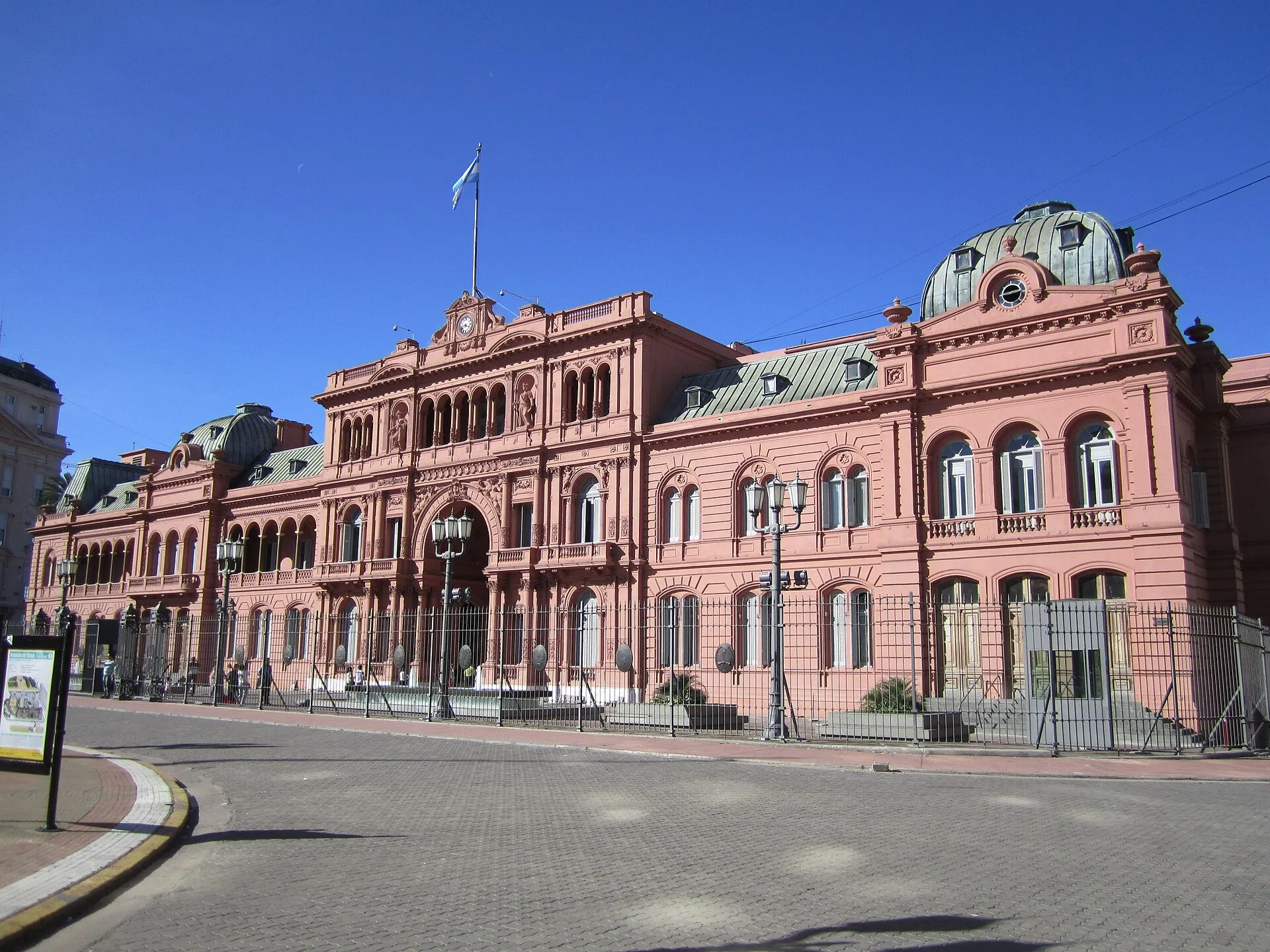
Architect Francesco Tamburini joined the existing post office and government house into one palace with a grand central arch; its salmon-pink render — by legend a blend of the Federalist red and Unitarian white, or of lime and ox blood — gave the Casa Rosada its name.
-
Día de la Lealtad
On October 17 hundreds of thousands of workers filled the plaza demanding the release of Colonel Juan Perón, the mobilisation that launched Peronism and is still commemorated as Loyalty Day.
-
The bombing of Plaza de Mayo
On June 16 navy aircraft bombed and strafed the plaza to kill President Perón during a failed coup, leaving more than 300 civilians dead — one of the deadliest attacks on a civilian crowd in Argentine history and a prelude to the dictatorship that followed months later.
-
The Madres begin to march
On April 30 a group of mothers of the disappeared began circling the Pirámide, defying the ban on public gatherings; their white headscarves became a global symbol of resistance to the 1976-1983 dictatorship, and they still march every Thursday.
-
The cacerolazos topple a government
In December, pot-banging crowds converged on the plaza during the economic collapse; President Fernando de la Rúa resigned and famously left the Casa Rosada roof by helicopter, and the country ran through several presidents in a single week.
Architecture
Casa Rosada balcony: the most iconic balcony in South America — where Perón rallied the descamisados, where Evita sang "Don't Cry for Me Argentina" (in the musical version, at least), and where Maradona celebrated the 1986 World Cup. Its salmon-pink render and grand central arch date from Tamburini's 1898 unification of the earlier post office and government house into a single palace. Metropolitan Cathedral: twelve austere neoclassical columns — read as the twelve apostles — front a lavishly painted interior and the mausoleum of José de San Martín, guarded by an eternal flame and Granadero soldiers. Cabildo: the whitewashed colonial town hall where the independence movement gathered in May 1810, now a museum of original-period artifacts, and visibly narrower than it once was after street-widening cut away its wings. Painted headscarves on the pavement: white outlines of the Mothers' pañuelos ring the Pirámide — a guide explains the symbolism and the individual stories behind them. The Pirámide de Mayo at the plaza's center, raised in 1811 and reshaped in 1856, is a modest obelisk yet the most politically charged point in all of Argentina.
Historical Significance
Plaza de Mayo has witnessed every turning point in Argentine nationhood since Juan de Garay set the block aside beside the Fort in 1580. The Revolución de Mayo of 1810 ignited the independence movement from this very square; the Cabildo on the western edge served as the seat of the revolutionary junta, and its balcony was where the cry for self-governance first echoed. In the 20th century the plaza became the stage for Peronist mass rallies — October 17, 1945 saw hundreds of thousands of workers demand Perón's release, a date still celebrated as Día de la Lealtad. On June 16, 1955 navy aircraft bombed the crowded plaza in a failed coup against Perón, killing more than 300 civilians. The darkest chapter came during the 1976-1983 military dictatorship, when the Madres began their silent circular marches to demand information about their desaparecidos; their white headscarves became an international symbol of resistance. More recently, the economic crisis of 2001 brought furious cacerolazos (pot-banging protests) that toppled multiple presidents in a single week and sent President De la Rúa off the Casa Rosada roof by helicopter. A visit to Recoleta Cemetery completes the picture with the tombs of many figures — Evita among them — whose political careers played out on this square.
When to Visit
Plaza: Open 24 hours — it's a public square you can cross at any time. Casa Rosada tours: weekends and public holidays, by prior registration online — bring the passport you booked with. Museo Casa Rosada (behind the palace, in the old Taylor Customs House): Wednesday to Sunday, 11 AM - 6 PM (free, no booking). Madres de Plaza de Mayo march: every Thursday at 3:30 PM around the Pirámide. Best: Thursday afternoons to witness the Mothers' march, or weekday mornings for a quieter historical tour before the midday heat. Duration: 1-2 hours including the cathedral and the surrounding colonial buildings of Monserrat.
Admission and Costs
Plaza entry: Free. Casa Rosada weekend guided tour: Free (register online in advance through the official Casa Rosada website). Museo Casa Rosada: Free. Metropolitan Cathedral: Free — a small donation is appreciated for the San Martín mausoleum chapel. The only real cost is a human guide: a private guide for the Plaza de Mayo and Casa Rosada runs AR$25,000-50,000 ($25-50) for 2 hours, and a small-group historical walking tour of the surrounding Monserrat district is AR$15,000-25,000 ($15-25) per person. Because the Argentine peso moves fast, confirm prices in pesos on the day rather than trusting an old dollar figure.
The Case for a Guide
Nothing stops you walking across Plaza de Mayo alone and photographing the Casa Rosada — but the square's meaning is almost entirely invisible without someone to decode it. A guide is what separates "a pink building and an obelisk" from the stage on which modern Argentina was argued into being.
- The headscarves on the pavement: A guide stops you at the white pañuelos painted around the Pirámide, explains that each represents a mother of a desaparecido, and tells the stories behind the still-running Thursday march — detail most visitors step over without noticing.
- Reading the Casa Rosada balcony: From the exact spot where Perón rallied the descamisados, Evita gave her last public speech, and Maradona lifted the 1986 World Cup, a guide layers the competing myths of Peronism onto a single façade.
- The San Martín mausoleum protocol: Inside the cathedral, a guide explains why the liberator's tomb is guarded by the Granaderos a Caballo he founded in 1812, why it sits at an angle, and the diplomacy behind returning his remains from France in 1880.
- Navigating the politics safely: Peronismo, the Guerra Sucia, the 2001 collapse — a good local guide walks you through the nuances without steering you into an argument, and reads whether a gathering crowd is a tour group or a protest you should give room.
- Timing the plaza: Guides know when the Casa Rosada tour slots release, when the Madres actually form up, and which corner catches the best afternoon light on the pink façade — the practical knowledge that turns a rushed stop into a coherent visit.
Tips for Visitors
Register for the Casa Rosada ahead: weekend palace tours are popular and must be booked through the official website, often filling days in advance — and you can only enter the working palace on those tours, so weekday visitors should aim for the free Museo Casa Rosada instead. Thursday is special: if you can visit on a Thursday afternoon, witnessing the Mothers' march adds an emotional dimension no museum can replicate. Political sensitivity: Argentine politics is passionate and personal, and the plaza is the country's default protest site — a guide helps you navigate Peronismo, the Guerra Sucia, and current debates without stepping into polarizing territory. Safety: the plaza is well-patrolled, but demonstrations can flare unpredictably; if you see large crowds gathering with flags and drums, assess from a distance before approaching. Walk to San Telmo: head south along Defensa street for an easy 10-minute walk into the antique district — the transition from political center to bohemian barrio is one of Buenos Aires' great contrasts, and continues down to the tango corners of La Boca.
Frequently Asked Questions
What months are ideal for visiting Plaza de Mayo?
The Argentine autumn (March-May) and spring (September-December) deliver pleasant walking weather in the low 20s°C, perfect for lingering in this open square and exploring nearby colonial streets. Summer (January-February) brings stifling heat and humidity that makes extended outdoor sightseeing uncomfortable, while winter evenings can feel brisk on the exposed plaza. Aim for a weekday morning if you want the plaza to yourself, or a Thursday afternoon to see the Madres march.
When can visitors tour Plaza de Mayo and the Casa Rosada?
The plaza is open 24 hours — it's a public square you can cross any time. Casa Rosada guided tours run on weekends and public holidays and must be booked in advance through the official Casa Rosada website; bring the passport you registered with. The adjoining Museo Casa Rosada, behind the palace in the old Taylor Customs House, opens Wednesday to Sunday, 11 AM - 6 PM, and is free. The Madres de Plaza de Mayo circle the Pirámide every Thursday at 3:30 PM.
How much does it cost to visit Plaza de Mayo?
Walking into the plaza is free, as are the Casa Rosada weekend tour (online registration required), the Museo Casa Rosada, and the Metropolitan Cathedral. The only paid option is a human guide: expect roughly AR$25,000-50,000 ($25-50) for a two-hour private walk of the plaza and Casa Rosada, or AR$15,000-25,000 ($15-25) per person for a small-group history tour of the surrounding Monserrat district.
Can I go inside the Casa Rosada?
Yes, but only on the free weekend tour, which takes you through the ceremonial halls, the White Hall, the Hall of Argentine Women, and out onto the famous balcony where Perón and Evita addressed the crowds. Weekday visitors cannot enter the working palace, but the Museo Casa Rosada behind it — displaying presidential sashes, batons, and the excavated foundations of the old Fort and Taylor Customs House — is open Wednesday to Sunday and needs no booking.
Whose tomb is inside the Metropolitan Cathedral on the plaza?
The Catedral Metropolitana holds the mausoleum of General José de San Martín, the general who liberated Argentina, Chile, and Peru from Spanish rule. His remains, repatriated from France in 1880, rest in a side chapel guarded day and night by the ceremonial Granaderos a Caballo regiment he founded in 1812. The cathedral is also where Jorge Bergoglio served as archbishop before becoming Pope Francis in 2013, which draws a steady stream of visitors to the pew he used.
Is Plaza de Mayo safe to visit, and what should I watch for?
The square itself is well-policed and fine to visit by day; the usual big-city caution over phones and bags applies, especially in crowds. The one variable is politics: Plaza de Mayo is Argentina's default protest site, so marches, drums, and road closures can appear with little notice. A demonstration is usually peaceful and photogenic, but if you see large crowds massing with flags and banners, read the mood from a distance before walking in, and avoid the plaza entirely on politically charged dates such as March 24 (Day of Remembrance) unless you specifically want to witness the commemoration.