
Historical Significance
Without context, Rainbow Row is a pretty photo and little more — thirteen houses in a tidy line. With a guide, each becomes a chapter in Charleston's commercial history, from the colonial merchants who built ground-floor counting houses to the enslaved workers who loaded cargo on the wharves that once lapped at these foundations. Guides point out details invisible to the casual eye: the earthquake bolts added after the devastating 1886 earthquake, the single house plan whose narrow gable faces the street so the long piazza can catch the harbour breeze, and the subtle shifts in window proportion and fanlight design that separate the earliest Georgian work from later Federal renovations.
Dorothy Legge's restoration in the 1930s was a hinge moment in American preservation. At a time when most cities were clearing colonial buildings for redevelopment, Charleston chose to protect them — and Rainbow Row became the movement's poster child. Guides who understand this context explain how one woman's purchase of a single dilapidated townhouse helped catalyse a preservation ethic that the Preservation Society of Charleston — the oldest community preservation organisation in the United States, founded in 1920 — had already been building, and which went on to shape similar campaigns in Savannah, New Orleans, and beyond. As the Explore Charleston visitor authority notes, the row is now the city's most recognisable streetscape precisely because that early stand kept it standing.
Charleston chose to protect its past when most of America was tearing it down — and Rainbow Row is the brightest proof.
Architecture
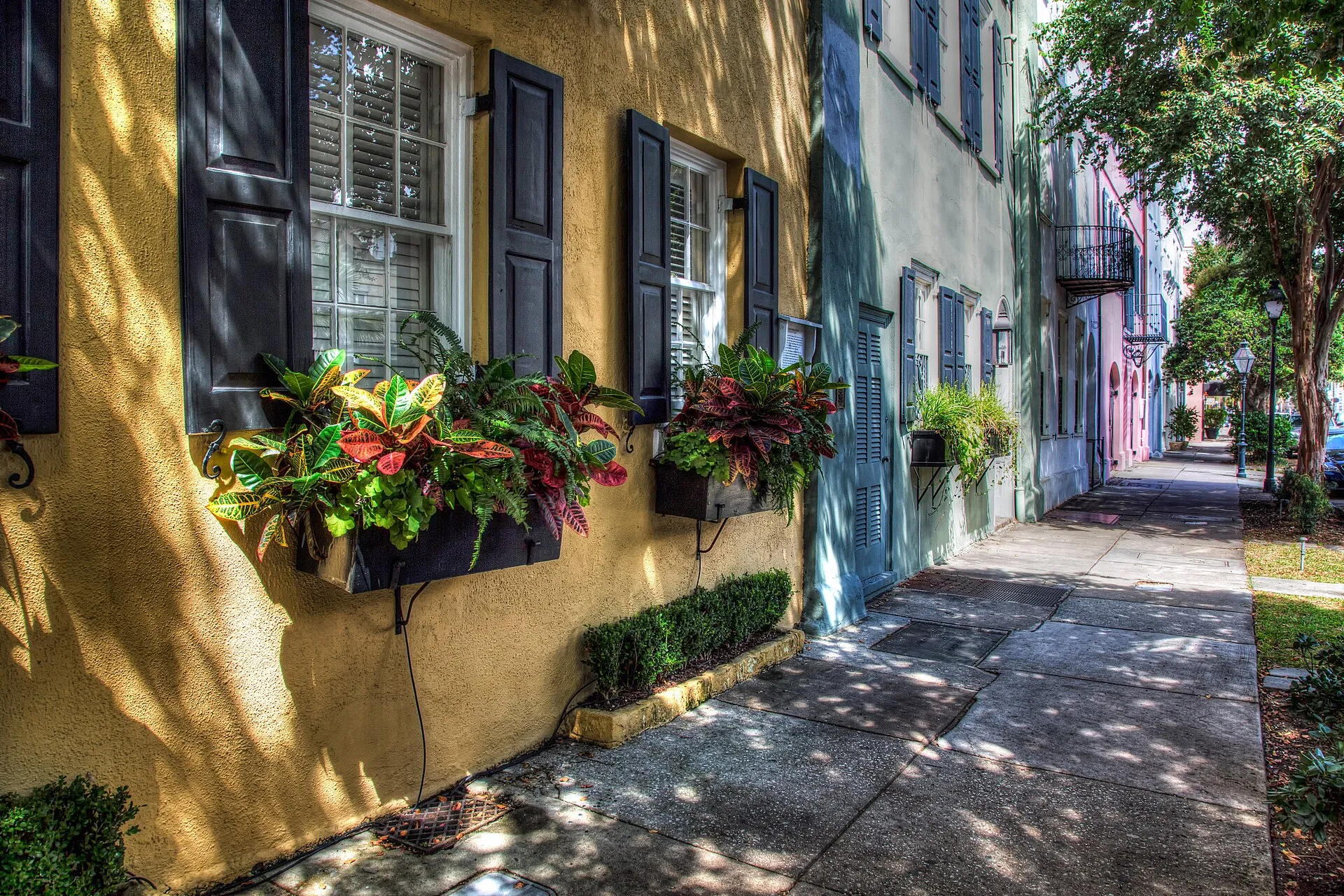
Rainbow Row is a lesson in how one street can hold a century of building fashion. Read left to right and you move across roughly 1740 to 1845, from restrained early-Georgian symmetry into the lighter detailing of the Federal period, all rendered in the same soft masonry and stucco.
- 99 East Bay (the pink house): Dorothy Legge's first restoration in 1931, painted Caribbean pink — the spark for the entire Rainbow Row colour tradition.
- Georgian detailing: look for symmetrical five- and three-bay facades, double-hung sash windows with small panes, and delicate fanlights arching above the doorways, hallmarks of the 1740s–1780s.
- The wharf level: the ground-floor storefronts once opened directly onto the water; land reclamation later pushed the harbour edge several blocks east, which is why a former commercial waterfront now sits mid-peninsula.
- Earthquake bolts: the star-shaped and circular iron plates on several facades are not ornament — they cap iron tie-rods threaded through the walls, retrofitted after the 1886 earthquake that toppled chimneys across the city.
- Window-box gardens: owners keep elaborate seasonal plantings, and the interplay of pastel stucco and cascading flowers means the composition is never quite the same on two visits.
The plan behind the pretty fronts is as interesting as the paint. Several houses follow, or adapt, the single house type unique to Charleston — one room wide, turned side-on to the street with a long piazza (porch) down the flank to shade the interior and funnel the prevailing southwesterly breeze — a passive-cooling response to the Lowcountry climate that predates air conditioning by two centuries.
When to Visit
Rainbow Row is an open public street with no gates, tickets, or hours — you can see it at any time of day or night, year-round. Timing matters only for light and crowds, and here the two work in your favour together.
- Best light: between 7 and 9 AM, when the east-facing facades catch the low sun directly and the pastels glow with minimal shadow.
- Fewest people: weekday mornings before 10 AM or late afternoon after 4 PM; tour groups and carriage routes concentrate between 10 AM and 2 PM.
- After rain: the wet asphalt and cobbles mirror the colours, a reflection photographers prize.
- Spring blooms: March through May fills the window boxes with flowers, layering more colour onto the streetscape.
Seasonally, April, May, and October score highest on our month ratings: comfortable temperatures, clear skies, and flattering light. Summer (July–August) is the low point — not because anything closes, but because heat, humidity, and afternoon thunderstorms make the shadeless sidewalk uncomfortable and wash the colours flat under a hazy midday sky.
Admission and Costs
Viewing and photographing Rainbow Row is completely free. It is a public street, visible from the sidewalk at all times, with nothing to book and no admission gate. The only costs are optional — the interpretation and access that a guide brings.
- Group walking tour: $25–40 per person, usually part of a two-hour Historic District route that also takes in The Battery and Church Street.
- Private architecture tour: $200–375 for up to six people, with a deep focus on the Georgian, Federal, and antebellum styles that define the surrounding blocks.
- Photography-focused tour: $150–250 for a private session with a guide who knows the optimal angles, lighting windows, and lesser-shot details.
If you are budgeting a full Charleston day, note that most peninsula headline sights — Rainbow Row, The Battery, and the Charleston City Market — cost nothing to see; the ticketed exceptions are the Fort Sumter ferry ($26 adults) and Magnolia Plantation ($22 adults). Tip walking guides $5–10 per person, or 15–20% on a private tour.
The Case for a Guide
A knowledgeable guide is what turns Rainbow Row from a five-minute photo stop into the keystone of a Charleston walking tour. Because there is no interior to visit and no interpretive signage on the street, everything that makes the block significant is invisible without someone to narrate it.
- They decode the architecture in real time — separating original Georgian fabric from Federal and later restoration work, and pointing out the earthquake bolts, fanlights, and single-house piazzas you would otherwise walk straight past.
- They separate history from folklore — putting the Caribbean-colour legend, the 1931 Legge restoration, and the wharf-front commercial origins in their true chronological order.
- They sequence the peninsula — chaining Rainbow Row naturally into The Battery, the Charleston City Market, and the Fort Sumter ferry so the city's story builds rather than blurs.
- They find the shot — photography-focused guides know the exact hour, the crossing point on East Bay Street, and the after-rain reflections that make the difference between a snapshot and a keeper.
Charleston sets an unusually high bar here: licensed city guides must pass a rigorous written examination covering some 300 years of local history and architecture, so a credentialed guide arrives with genuine depth rather than a memorised script.
Tips for Visitors
These are private, occupied homes, not exhibits — the single most important thing to remember. Do not enter gates, climb the stoops, or peer through windows; photograph from the sidewalk and the street, and keep voices low, especially early morning and evening when residents are home.
- Cross to the east side of East Bay Street for the best overall composition, where you can frame several houses in a single shot without a wide-angle lens.
- Pair it with The Battery, a five-minute walk south along East Bay Street — the two make a natural continuous streetscape tour of about half a mile.
- Skip driving. Metered street parking on East Bay is scarce and time-limited; park once at the Meeting Street visitor garage (about $2/hour) and walk, or use the free DASH trolley and a short stroll.
- Mind the footing. The brick and tabby sidewalks are historic and uneven, so flat, sturdy shoes matter; the flat, level asphalt of the street crossing is the most wheelchair- and stroller-friendly vantage point.
Frequently Asked Questions
When is the best time of year to photograph Rainbow Row?
April, May, and October give the most photogenic conditions — clear skies and warm morning sunlight that make the thirteen pastel facades pop against Charleston's palmetto-lined streets. Spring window boxes overflow with flowers that complement the historic palette, while October's low autumn light turns the colours golden after the summer humidity breaks. The houses face east, so early-morning light flatters them in every season, but the intense heat and haze of July and August make lingering on the shadeless East Bay Street sidewalk unpleasant.
What time of day offers the best light and fewest crowds at Rainbow Row?
For photographs, arrive between 7 and 9 AM: the eastern sun strikes the facades directly and casts a warm, low-shadow glow across the pastels. For the fewest people, choose a weekday before 10 AM or after 4 PM, since tour groups and carriage routes cluster between 10 AM and 2 PM. After a rain shower the wet street mirrors the colours, and the block is quietest of all just after dawn.
How much does it cost to see Rainbow Row?
Nothing. Rainbow Row is a public street, and the houses are visible from the sidewalk at all hours, free of charge. If you want the history behind the facades, a group walking tour that includes Rainbow Row runs about $25–40 per person for a roughly two-hour Historic District route, while a private architecture or photography tour ranges from $150 to $375 depending on group size and focus.
Can you go inside the houses on Rainbow Row?
No. All thirteen houses are occupied private residences, not museums, so there is no interior access. Photograph from the sidewalk and the opposite side of East Bay Street; do not enter gates, climb the stoops, or peer through windows. The one house you can legitimately point to by name is 99 East Bay, the pink house that Dorothy Porcher Legge restored in 1931 and that started the whole colour tradition.
Why are the houses on Rainbow Row painted in pastel colours?
The pastels date only to the 20th-century restoration, not to the colonial period. When preservationist Dorothy Porcher Legge began rescuing the derelict row in 1931, she painted her house a soft Caribbean pink, and later owners followed with their own hues. Guides often add the folk explanation that Charleston's merchants, who traded heavily with the West Indies, used bright colours so illiterate sailors could find the right shop on a busy wharf — a charming story that is more legend than documented fact, since the colours postdate the wharves by two centuries.
How does Rainbow Row fit into a walking tour of Charleston's Historic District?
It sits at the centre of the peninsula's most walkable stretch. From Rainbow Row it is a five-minute stroll south along East Bay Street to The Battery and White Point Garden, and about ten minutes north to the Charleston City Market. Many visitors combine the row with the ferry to Fort Sumter, which leaves from Liberty Square a short walk up the waterfront.