
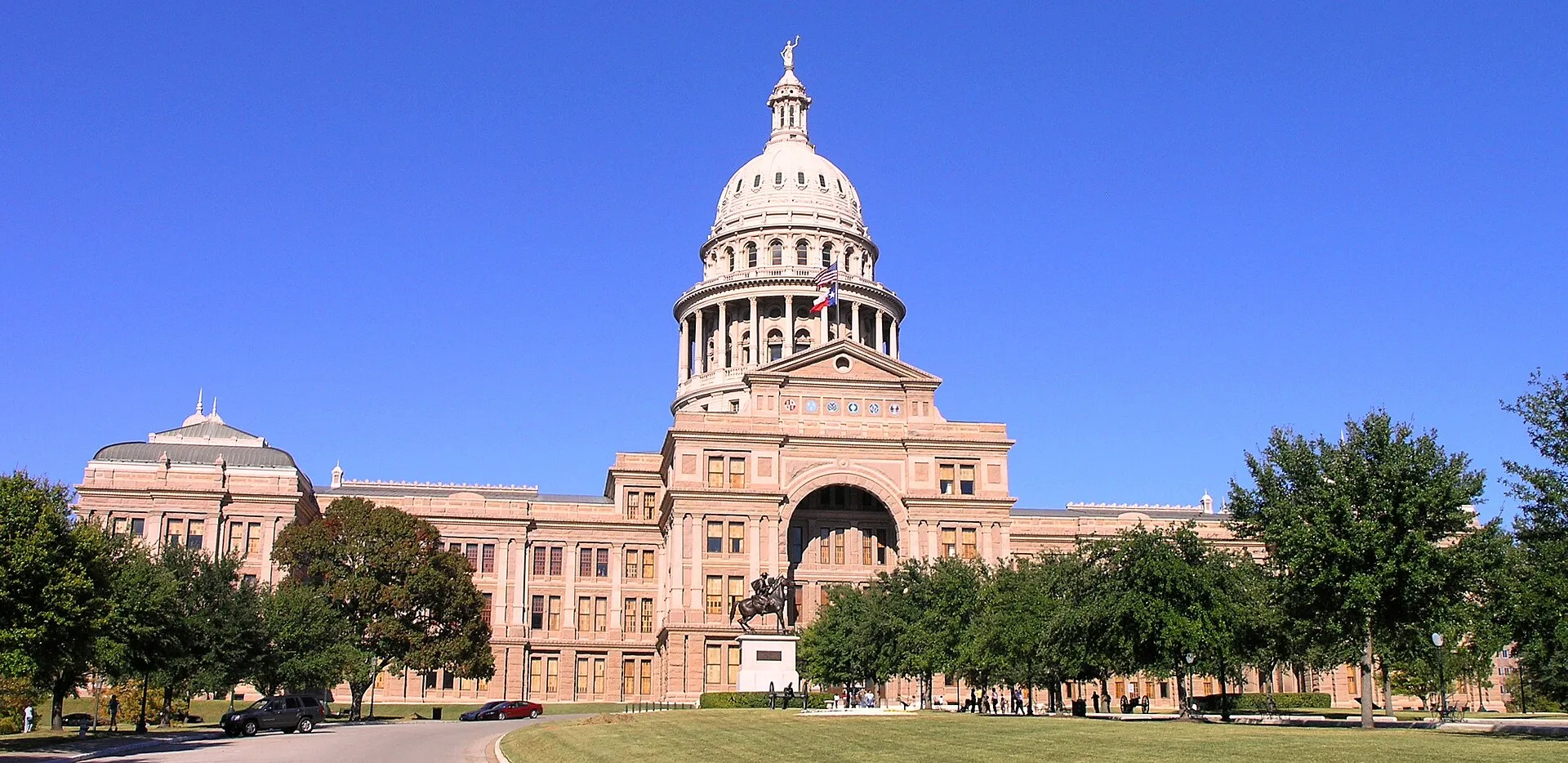
Texas State Capitol timeline
-
The first permanent Capitol opens
Texas builds a modest limestone statehouse on the hilltop at the head of Congress Avenue, the site reserved for government since Austin became the republic's capital in 1839.
-
Fire destroys the old statehouse
A November fire guts the 1853 building, forcing the state into a temporary capitol and accelerating plans for the grand replacement already on the drawing board.
-
Construction begins under Elijah E. Myers
Detroit architect Elijah E. Myers — who also designed the Michigan and Colorado capitols — wins the competition with an Italian Renaissance Revival scheme crowned by a towering dome.
-
Sunset Red granite replaces the discolouring limestone
After the original limestone streaks and stains, the owners of Granite Mountain near Marble Falls donate sunset-red granite; a labour dispute over the quarry work brings sixty-two Scottish stonecutters to Texas.
-
The Capitol is dedicated
A week of celebrations in May opens the finished building, paid for not in cash but with three million acres of Panhandle prairie.
-
Fire sweeps the east wing
A blaze in the lieutenant governor's apartment kills one person and exposes decades of unsympathetic alterations, setting a comprehensive restoration in motion.
-
A new Goddess of Liberty and landmark status
A National Guard helicopter lifts an aluminium replica of the corroded 1888 statue onto the dome; the same year the Capitol is named a National Historic Landmark.
-
The underground Capitol Extension opens
A four-storey annex burrowed beneath the north lawn nearly doubles the working space while leaving Myers's silhouette untouched, lit by a sunken rotunda skylight.
-
The Tejano Monument joins the grounds
Bronze figures of a vaquero family mark three centuries of Hispanic settlement; the African American history memorial follows in 2016, widening the story the lawns tell.
- Today
A working statehouse and free attraction
The Legislature still meets here in odd-numbered years while free guided tours run through the rotunda daily, keeping the Capitol one of the most visited sights in Austin.
Historical Significance
No other American statehouse was bought the way this one was. Cash-poor but land-rich, nineteenth-century Texas handed a Chicago syndicate three million acres of Panhandle prairie in exchange for the finished building — a barter that created the legendary XIT Ranch, once among the largest fenced ranches in the world.
The deal is why the Capitol reads less as a government office than as a statement of Texan self-regard: every dimension, from the height that deliberately out-reaches Washington to the lone stars worked into the door hinges, was chosen to insist that Texas does things on its own scale.
The building was also hard-won. When the original limestone began to streak and discolour, the owners of Granite Mountain donated the sunset-red granite instead, and a bitter dispute over the quarry work brought sixty-two Scottish stonecutters to Austin to finish the stone. Inside, the chambers have staged the defining moments of state politics — the debate over secession, the impeachment of a governor, and the 1966 arrival of Barbara Jordan, the first African American elected to the Texas Senate since Reconstruction.
The grounds tell a parallel, still-contested story: the placement of the Ten Commandments monument here was argued all the way to the U.S. Supreme Court in Van Orden v. Perry (2005), and the Tejano and African American memorials added in 2012 and 2016 have widened whose history the lawns commemorate.
Architecture
Elijah E. Myers framed the Capitol in the Italian Renaissance Revival style he had already used for the Michigan statehouse, organising more than 360,000 square feet around a Greek-cross plan — still the largest state capitol in the United States by floor area.
The sunset-red granite exterior gives the building its warmth, but the craftsmanship lives in the detail: terrazzo floors inlaid with the seals of the six nations that have governed Texas, brass door hinges and fixtures cast with the lone star, and a four-storey rotunda hung with portraits of every Texas governor and president of the Republic. Stand on the star set into the rotunda floor and look straight up: the painted interior of the dome spells out T-E-X-A-S around a single star far overhead.
Crowning it all, a nearly 16-foot zinc Goddess of Liberty holds a gilded star aloft. The corroded 1888 original was lifted down by a National Guard helicopter in 1985 and now stands at eye level in the nearby Bob Bullock Texas State History Museum, replaced on the dome by an aluminium replica.
The most dramatic modern addition is invisible from Congress Avenue: the 1993 Capitol Extension burrows four storeys beneath the north lawn, lit by a sunken rotunda skylight at ground level, and houses committee rooms and a public cafeteria while leaving the historic facade untouched.
When to Visit
Building hours run Monday through Friday 7 AM to 10 PM, and Saturday-Sunday 9 AM to 8 PM. Free guided tours are offered every 30-45 minutes from 8:30 AM to 4:30 PM on weekdays and 9:30 AM to 3:30 PM on weekends. Self-guided visits are available during all open hours; pick up a brochure at the visitors centre in the southeast corner of the grounds.
The best time to visit is early morning on weekdays, when the rotunda is quiet and light through the eastern windows illuminates the terrazzo floors. The Texas Legislature meets in odd-numbered years from January to May; visiting during session lets you watch debates from the public galleries.
Admission and Costs
Building admission: Completely free at all times. Free guided tours: Offered every 30-45 minutes from 8:30 AM to 4:30 PM weekdays and 9:30 AM to 3:30 PM weekends, departing from the Capitol Extension Visitor Center. Self-guided visit: Free at any time during building hours using brochures from the southeast corner visitors centre. Private guide: $150-275 for a 90-minute focused tour of the building, rotunda, legislative chambers, and grounds for up to 10 people. Group tour (15+): $10-15 per person for scheduled educational programmes.
The Case for a Guide
Symbolism saturates every surface of this building, and most of it is invisible to visitors who walk through without interpretation. Lone stars hide in the door hinges, the brass fixtures, and the terrazzo floors; the free docent tour compresses them into sound bites, while a private guide has the time to unpack them fully.
- Decoding the architectural symbolism: a guide points out the lone stars worked into the hardware and floors, explains why the dome was built to out-reach Washington, and shows how the plan itself was designed to express Texas exceptionalism.
- Legislative drama made vivid: guides bring the chambers to life with specific stories — whose desk belonged to which consequential legislator, where Barbara Jordan sat when she broke a century-long colour line in the Senate, and how the acoustics were engineered to carry voices through all-night filibusters without amplification.
- Grounds monuments in context: the 22-acre lawns hold monuments spanning the Civil War to the civil-rights era; a guide explains the political battles behind where each one stands and why the memorial landscape keeps changing.
- Austin connections: guides weave the Capitol into the wider city, linking it to Sixth Street four blocks south, the South Congress strip beyond the river, and the University of Texas campus directly north — a city where political power, live music, and intellectual ambition have always coexisted in creative tension.
Tips for Visitors
Arrive before 10 AM on weekdays -- the free guided tours are first-come, first-served and popular with school groups. The Capitol sits four blocks north of Sixth Street, making a morning Capitol visit and evening music outing a natural pairing.
Dress comfortably: the building is air-conditioned, but the grounds tour involves walking on gravel paths in full Texas sun, so bring water and a hat. Check the legislative calendar -- if the Legislature is in session, the public galleries in both chambers offer a front-row seat to Texas politics.
Walk south on Congress Avenue from the Capitol for the most iconic view of the building, and continue all the way to South Congress Avenue for an afternoon of shopping and food, or detour down to Lady Bird Lake for the waterfront hike-and-bike trail and a cooling swim at Barton Springs Pool in Zilker Park. The Bob Bullock Texas State History Museum, three blocks northeast, complements a Capitol visit with interactive exhibits spanning 16,000 years of Texas history.
Frequently Asked Questions
What season is best for visiting the Texas State Capitol?
March through May and October through November provide the most comfortable conditions, with mild temperatures perfect for exploring the 22-acre grounds and the shaded walking paths lined with monuments. The capitol interior is air-conditioned and impressive year-round, but the outdoor grounds with their live oaks and rolling lawns are best appreciated when Austin is not in the grip of its fierce summer heat, which keeps temperatures above 35°C from June through September.
When can visitors tour Texas State Capitol?
Building hours: Monday through Friday 7 AM to 10 PM, Saturday and Sunday 9 AM to 8 PM. Free guided tours: Offered every 30 to 45 minutes from 8:30 AM to 4:30 PM on weekdays, and 9:30 AM to 3:30 PM on weekends.
What makes the Texas State Capitol worth a guided tour?
Much of the building's meaning is encoded rather than labelled: lone stars hidden in the door hinges and terrazzo, a dome deliberately built taller than Washington's, and chambers where secession, a governor's impeachment, and Barbara Jordan's 1966 election all played out. A guide reads those details in sequence and ties them to the three-million-acre land deal that paid for the building, context the free 30-minute docent tour has no time to develop.
What should visitors know before touring Texas State Capitol?
Admission and the guided tours are free, but the weekday tours fill quickly with school groups, so arrive before 10 AM. The interior is air-conditioned while the 22-acre grounds are not, so carry water and a hat in summer. If the Legislature is sitting — odd-numbered years, January to May — the public galleries let you watch debates, and the wheelchair-accessible entrance and elevators on the north side reach every floor, including the underground extension.