
Edinburgh Castle timeline
-
Death of Queen Margaret
The saintly queen died in the castle days after her husband Malcolm III fell in battle; her son would later raise a chapel here in her memory.
-
St Margaret's Chapel built
King David I raised the tiny Norman chapel in memory of his mother, Queen Margaret; it survives as Edinburgh's oldest building.
-
Retaken by the Scots
Thomas Randolph scaled the north cliff by night and seized the castle from its English garrison during the Wars of Independence.
-
Mons Meg arrives
The Duke of Burgundy gave James II the six-ton bombard that still guards the castle entrance.
-
Birth of James VI
Mary, Queen of Scots bore the future king of Scots and of England in the Royal Palace, leading to the 1603 union of crowns.
- 1571-1573
The Lang Siege
A two-year bombardment destroyed David's Tower; the Half Moon Battery was built over its ruins.
-
Cromwell takes the castle
After crushing the Scots at Dunbar, Oliver Cromwell's army besieged the rock and forced its surrender within three months.
-
First One O'Clock Gun
A daily time signal began so ships in the Firth of Forth could set their chronometers by the report.
-
National War Memorial opens
Sir Robert Lorimer's shrine to Scotland's war dead was dedicated in a former barrack block overlooking Crown Square.
-
Stone of Destiny departs
The coronation stone displayed at the castle since 1996 moved to the new Perth Museum.
Fortification History
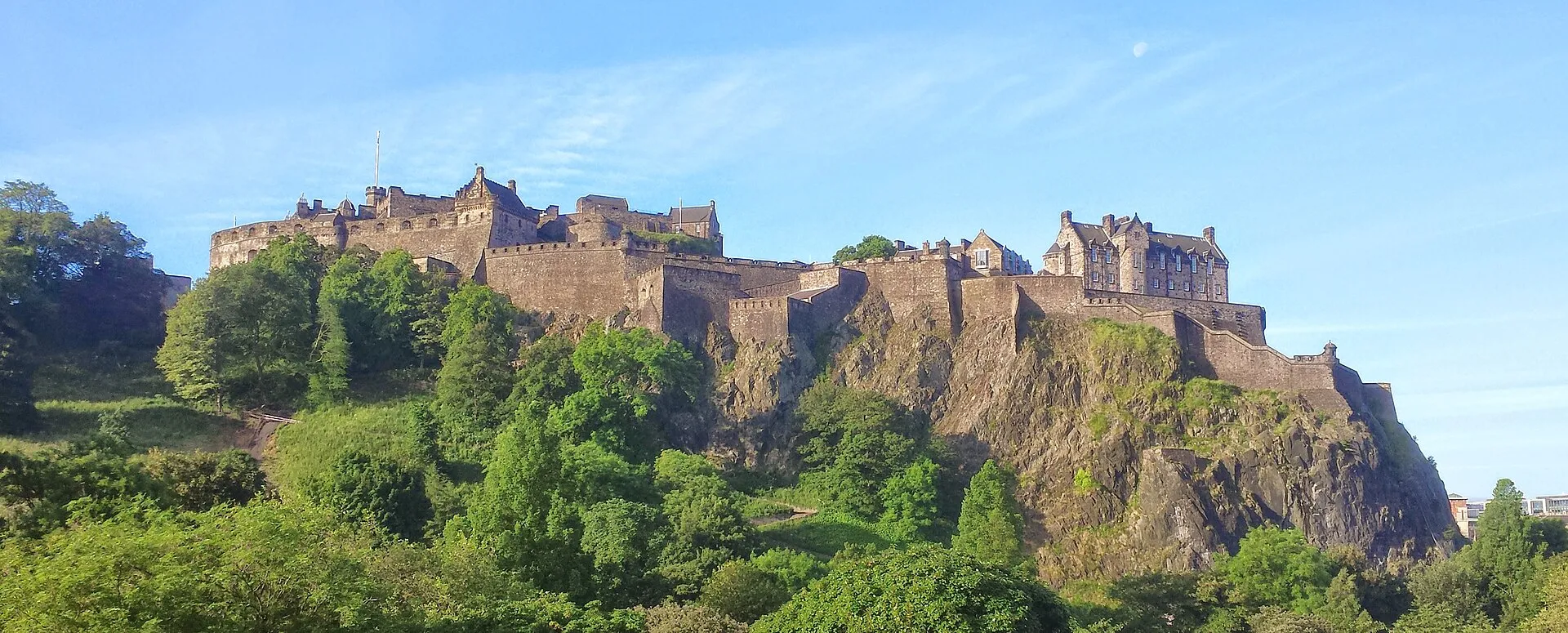
Castle Rock hands the fortress a near-impregnable base: sheer cliffs on three sides funnel every attacker toward the single eastern approach up the Royal Mile, which successive defences were built to hold. The oldest visible one is the Half Moon Battery, raised around 1574 over the shattered stump of David's Tower after the Lang Siege of 1571–1573 pounded the medieval keep to rubble with cannon fire.
Guarding the entrance today is Mons Meg, a six-ton medieval bombard given to James II in 1457 by the Duke of Burgundy; it could hurl a 150-kilogram (330-pound) stone nearly two miles before its barrel burst in 1681. The One O'Clock Gun, fired from the Mills Mount Battery every day except Sunday since 1861, began as a time signal so ships in the Firth of Forth could set their chronometers — a role it shared with the time ball on the Nelson Monument across the city. From the Argyle Battery and Mills Mount, the cannon line still commands the sweeping northern view the guns were built to defend.
Beyond the batteries, the inner defences climb in layers. Just past the drawbridge stands the Portcullis Gate, rebuilt after the Lang Siege and crowned by the Victorian Argyle Tower, named for the Marquess of Argyll held here before his execution in 1685. Higher up, the narrow Foog's Gate guards the final approach to the summit and St Margaret's Chapel. This staircase of gates — outer battery, portcullis, and inner ward — meant an attacker who breached one line simply met the next, which is why the castle so often had to be starved or bombarded into surrender rather than stormed.
Notable Rooms
Crown Room: home to the Honours of Scotland — the crown, sceptre, and sword of state used to inaugurate Scottish monarchs. Made around 1540, they are the oldest surviving royal regalia in the British Isles. Locked away after the 1707 Act of Union, they were rediscovered in a sealed chest in 1818 by a search party led by the novelist Sir Walter Scott. The Stone of Destiny shared this room from 1996 until it moved to the new Perth Museum in 2024.
Great Hall: built for James IV around 1512, its oak hammerbeam roof is the finest medieval interior in Scotland and still bristles with an arsenal of arms and armour.
Royal Palace: birthplace, in 1566, of James VI of Scotland — later James I of England — son of Mary, Queen of Scots, whose line would unite the two crowns in 1603.
St Margaret's Chapel: built around 1130 and Edinburgh's oldest surviving building, this tiny Norman chapel is still used for small weddings and christenings.
Prisons of War: vaulted cellars where captives from the American Revolution and the Napoleonic Wars carved intricate bone ship models and door graffiti still on display today — including a defiant Stars and Stripes cut into an oak door by an American prisoner, among the earliest surviving depictions of the flag.
Scottish National War Memorial: opened in 1927 in a converted barrack block on the site of the medieval St Mary's Church, Sir Robert Lorimer's shrine records the names of the Scottish dead of the two World Wars and later conflicts in Rolls of Honour kept in a steel casket beneath the vaulted roof.
Outside the walls, a tiny Victorian Dog Cemetery in the shadow of the ramparts marks the graves of regimental mascots and officers' dogs — a quietly moving footnote most visitors miss on their way to the batteries above.
When to Visit
The castle opens daily at 9:30 AM, with last entry about an hour before closing: 6 PM in summer (April–September) and 5 PM in winter (October–March). Aim for the first hour, 9:30–10:30 AM, before the Royal Mile coach groups arrive, or the final ninety minutes once day-trippers have left. The One O'Clock Gun fires at 1 PM every day except Sunday, Good Friday, and Christmas Day — gather near the Mills Mount Battery about ten minutes early for a clear view. Allow two to three hours to walk the steep, cobbled site.
Time your visit around the calendar as well as the clock. Throughout August the Esplanade is given over to the Royal Edinburgh Military Tattoo, so grandstands ring the entrance and daytime tickets sell out well ahead; on performance days the castle may admit its last daytime visitors earlier to prepare for the evening show. Winter mornings between November and February are the emptiest of the year, and the site closes fully only on 25–26 December and 1 January, reopening at 11 AM on 2 January.
Admission and Costs
Adults: £19.50 ($25) (online £17.50 ($22)). Children (5-15): £12 ($15) (online £10.50 ($13)). Under 5: Free. Family ticket: Available online. Guided group tour: £30-50 ($38-64) per person with accredited guide. Private guide: £200-350 ($255-445) for 2-hour tour. Edinburgh Castle is included in the Explorer Pass and Historic Scotland membership.
The Case for a Guide
Edinburgh Castle has been besieged 26 times and contains Edinburgh's oldest surviving building, the oldest crown jewels in Britain, and a gun that has fired daily for over 160 years — a guide connects these disparate facts into a continuous story of Scottish identity and resistance.
- The 1 O'Clock Gun's ship navigation history: The gun has fired at exactly 1 PM every weekday since 1861, originally so ships in the Firth of Forth could set their chronometers by sound — a guide explains why timekeeping was critical for navigation before GPS and why Edinburgh's position on the Firth made a sound signal more reliable than the earlier time ball
- The Stone of Destiny return controversy: The stone used to crown Scottish and then English/British monarchs was seized by Edward I in 1296, returned to Scotland in 1996, and displayed at the castle until it moved to Perth in 2024 — but many historians believe Edward took a decoy and the real stone is still hidden somewhere in Scotland; a guide presents the evidence and the ongoing debate
- St. Margaret's Chapel oldest building: The tiny Norman chapel built around 1130 is Edinburgh's oldest surviving building, predating the castle's major fortifications by centuries — a guide explains who St. Margaret was (Queen of Scotland, later canonized), why the chapel survived when virtually everything else was demolished and rebuilt, and how it is still used for weddings today
- The castle's 26 sieges: Edinburgh Castle has been captured and recaptured more times than almost any fortress in Britain — a guide traces the most significant sieges (including the 1314 night assault, the 1573 cannon bombardment, and the 1745 Jacobite standoff) and shows the physical evidence each left on the walls
- Underground vaults and prisoners' graffiti: The castle's lower vaults held prisoners from the American Revolution and Napoleonic Wars who carved elaborate bone models and inscriptions still visible today — a guide leads you to the specific carvings and translates the messages prisoners left for anyone who came after them
Tips for Visitors
Book tickets online: Skip queues and save money (cheaper online). Allow 2-3 hours: Lots to see, steep climbs within castle. Wear layers: Exposed and windy on the rock. August Royal Military Tattoo: Famous evening show, book months ahead. Steep approach: Uphill walk from Royal Mile, take your time
Frequently Asked Questions
When is the best season to visit Edinburgh Castle?
June through August provides the longest opening hours, the warmest temperatures for the exposed castle rock, and the iconic Royal Edinburgh Military Tattoo in August that performs against the castle's floodlit walls. May and September offer fewer crowds with reasonably mild weather. Scottish winter from November through March means shorter days, bitter winds on the castle ramparts, and frequent rain, though the fortress has an undeniable dramatic presence under stormy skies and the Christmas market below adds seasonal charm in December.
When can visitors explore Edinburgh Castle?
Daily: 9:30 AM - 6 PM (April-September). Winter: 9:30 AM - 5 PM (October-March). Best: Early morning (9:30-10:30) to avoid crowds. One O'Clock Gun: Fires daily except Sundays, Good Friday, Christmas
What is the admission price for Edinburgh Castle?
Adults: £19.50 ($25), online £17.50 ($22), so book ahead to save. Children (5-15): £12 ($15), online £10.50 ($13). Under 5: Free. Guided group tours run £30-50 ($38-64) per person, while private guides cost £200-350 ($255-445) for a 2-hour tour. The castle is included in the Explorer Pass and Historic Scotland membership.
What should visitors know before visiting Edinburgh Castle?
Book tickets online: Skip queues and save money (cheaper online). Allow 2-3 hours: Lots to see, steep climbs within castle. Wear layers: Exposed and windy on the rock. August Royal Military Tattoo: Famous evening show, book months ahead.
How do you get to Edinburgh Castle?
The castle stands at the top of the Royal Mile, a steady 10-15 minute uphill walk from Waverley railway station or Princes Street up the Mound and Castlehill; there is no visitor parking on the Esplanade. Lothian Buses run frequently to the west end of Princes Street and to the George IV Bridge and Grassmarket, each a short climb away, and the airport tram terminates a few minutes' walk from the west end. Taxis can drop off at the foot of the Esplanade but cannot wait there.
Is Edinburgh Castle accessible for visitors with limited mobility?
The route to the summit is steep and cobbled, which is hard going for wheelchair users and anyone with limited mobility, but a free courtesy vehicle carries visitors who need it from the entrance up to the Crown Square level near the Honours of Scotland and the Great Hall. Some historic buildings, including St Margaret's Chapel, have narrow doorways and steps that cannot be adapted. Historic Environment Scotland offers a free companion ticket for anyone assisting a disabled visitor, and it is worth arranging assistance when you book.
How long should you spend at Edinburgh Castle?
Most visitors need two to three hours to do the castle justice: allow time to queue for the Crown Room where the Honours of Scotland and Stone of Destiny history are displayed, to take in the Great Hall, St Margaret's Chapel, the Prisons of War and the Scottish National War Memorial, and to be at the Mills Mount Battery for the One O'Clock Gun. A guided tour of about ninety minutes covers the essentials and the stories that connect them, after which many people stay on to explore the batteries and viewpoints at their own pace.