
Historical Significance
Belém Tower was conceived as a working fortress, not a folly. Its lower bulwark bristled with a ring of gun embrasures whose cannon could sweep the river, catching ships in a crossfire with the fort at Cascais and the São Sebastião bastion on the opposite bank. The vaulted chamber below the waterline served first as a powder store and later as a dungeon, and during the Spanish Habsburg occupation (1580-1640) and the nineteenth-century Liberal Wars it held political prisoners in cells that flooded at high tide. Facing the water on the bulwark terrace stands a statue of Nossa Senhora do Bom Sucesso (Our Lady of Safe Homecoming), the patron to whom departing sailors prayed. A guide maps out which voyages left from this exact stretch of shore, why the tower's guns were obsolete within a century as ships grew larger, and how the building slid from front-line defence to lighthouse, telegraph station and customs post before becoming the national symbol it is today.
Architecture
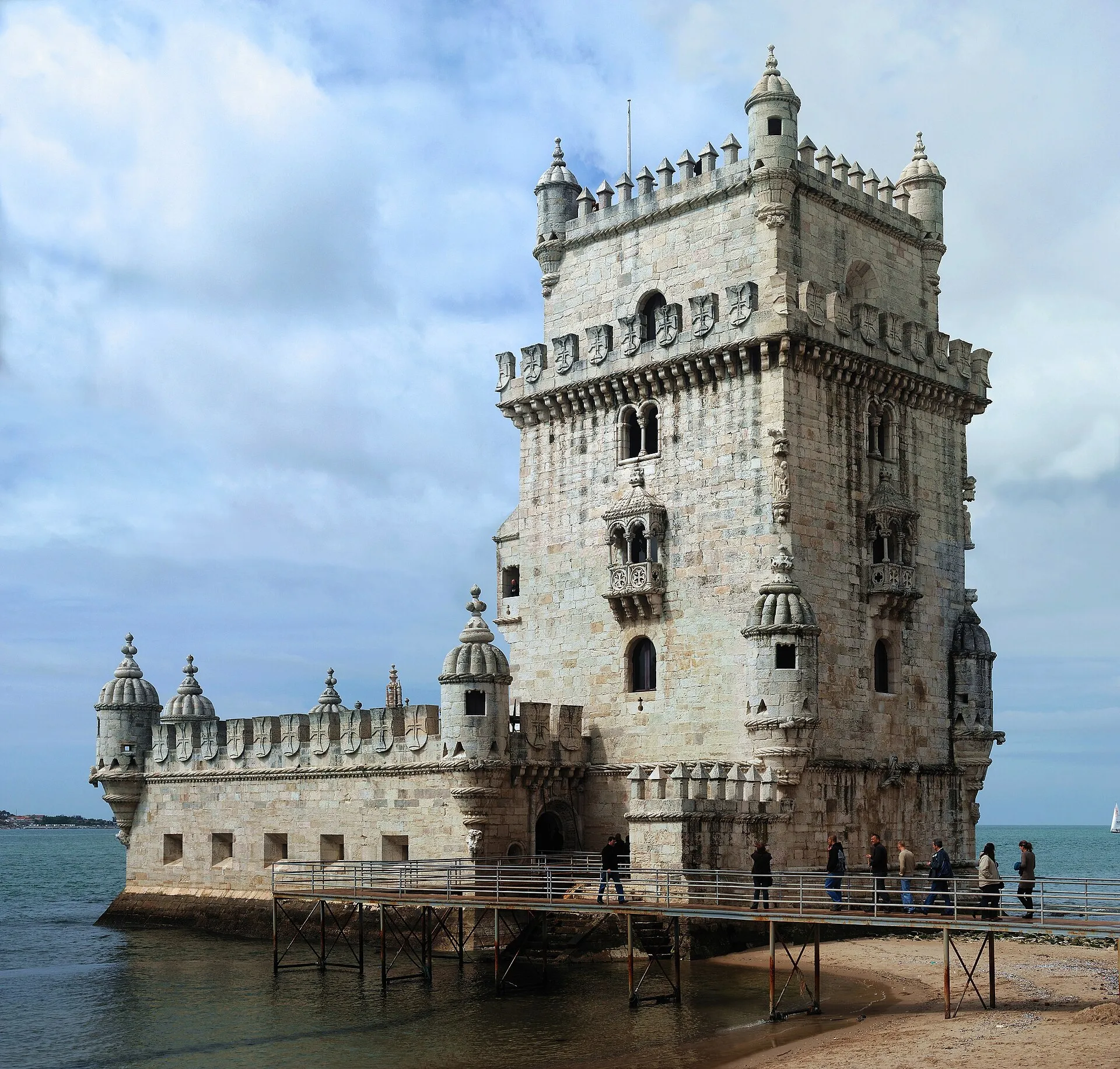
Rhinoceros corbel — the first depiction in European stone of a rhinoceros, carved after the animal Manuel I received from India in 1515; the same beast inspired Albrecht Dürer's famous woodcut. Armillary spheres — the skeletal navigation globes carved across the parapets, Manuel I's personal emblem and a boast of Portugal's command of the oceans. Governor's loggia — a Venetian-style Renaissance balcony on the south face, a rare decorative flourish grafted onto a military building. Moorish watch-turrets — the ribbed, dome-capped guaritas at each corner of the bulwark, drawn straight from the North African forts Francisco de Arruda had helped build. Rooftop terrace — reached by the tight spiral stair, it opens onto the Tagus, the Ponte 25 de Abril suspension bridge and the Cristo Rei statue on the far bank. Dungeon level — the barrel-vaulted chamber below the waterline that stored gunpowder and later imprisoned captives.
When to Visit
Hours: October-May 10 AM-5:30 PM | June-September 10 AM-6:30 PM, with last admission 30 minutes before closing. Closed: Mondays, 1 January, Easter Sunday, 1 May and 25 December. Best time: arrive at the 10 AM opening on a weekday — by 11 AM the first coach groups reach Belém and the single spiral staircase turns the small interior into a slow queue. Photography: late afternoon light rakes across the western-facing facade and the bastion, so linger for the golden hour. Duration: 45 minutes to 1 hour inside the tower; budget 2-3 hours to add the riverside walk past the Padrão dos Descobrimentos and the Jerónimos Monastery.
Admission and Costs
Standard admission: €10 (about $11). Combined ticket (Tower + Jerónimos Monastery): €18 (about $20) — saving roughly €4 ($4) versus separate tickets. Free entry: the first Sunday of every month until 2 PM, and for Lisbon residents under 25. Group guided tours: €25-40 ($27-44) per person, usually including skip-line entry and a 1-1.5 hour guide. Private Belém walking tour: €100-180 ($110-195) for up to six people, typically covering the tower, the monastery and the Pastéis de Belém custard-tart bakery. The Lisboa Card bundles free entry to the tower with unlimited public transport, which pays off quickly if you are also using the tram to reach Belém.
The Case for a Guide
Manueline decode — without a guide the carved ropes, spheres and sea creatures are pretty but mute; with one, each motif ties back to a specific chapter of Portugal's ocean expansion. Maritime context — a guide stands you where the caravels actually departed for India and Brazil and explains how the shoreline has moved since. Military logic — cannon ports, the drawbridge and the flooding dungeon make sense only once someone walks you through how the fortress defended the river. Belém itinerary — a good guide threads the tower together with the Jerónimos Monastery, the Padrão dos Descobrimentos and the MAAT so the half-day reads as one story rather than four separate stops.
Tips for Visitors
Combine with Jerónimos: the monastery is a 10-minute walk east — buy the combined ticket. Narrow stairs: the tower's spiral staircase is steep and single-file in places, and a traffic-light system sometimes controls the flow, so factor in a wait at busy times. Pastéis de Belém detour: the original custard-tart bakery is 5 minutes away — go before 10 AM or after 4 PM to skip the queue. Tram 15E: runs from Praça do Comércio directly to Belém, faster and cheaper than a taxi. Lisboa Card: covers free entry to the tower plus the public transport to reach it. Photography: the reflection shots work best at high tide, when water surrounds the base again as it did five centuries ago.
Frequently Asked Questions
What is the best time of year to visit Belém Tower?
May through September is the prime window: the tower stays open an hour later (6:30 PM instead of 5:30 PM), the Tagus riverfront walk is warm and dry, and low-angle sunshine makes the Manueline limestone glow. Because the interior is small and admits people in batches up the single spiral staircase, queue length matters more than weather — arrive at the 10 AM opening, before the coach groups reach Belém around 11 AM. January through March brings the fewest visitors, a fair trade if you prefer quiet over the longer summer hours.
What are Belém Tower's opening hours?
Hours: October-May 10 AM-5:30 PM; June-September 10 AM-6:30 PM (last entry 30 minutes before closing). Closed Mondays, 1 January, Easter Sunday, 1 May and 25 December. The tightest bottleneck is the narrow spiral staircase, so a weekday 10 AM arrival gives the smoothest visit.
Is Belém Tower worth visiting with a guide?
A guide turns decorative stone into a readable story: the carved ropes, armillary spheres, Cross of the Order of Christ and the famous rhinoceros corbel each encode a piece of Portugal's maritime expansion. Guides also connect the tower to the nearby Jerónimos Monastery and the vanished shoreline it once guarded, context you would otherwise walk straight past.
How do I combine Belém Tower with nearby sights?
Buy the combined ticket that pairs the tower with the Jerónimos Monastery, a 10-minute walk east, then detour to the original Pastéis de Belém bakery before 10 AM or after 4 PM to skip its queue. The Padrão dos Descobrimentos and the MAAT museum sit along the same riverside promenade, making a half-day of it.