
Peace Palace timeline
-
First Hague Peace Conference
Delegates from 26 nations met in The Hague and created the Permanent Court of Arbitration, the first standing institution for settling disputes between states by law rather than war.
-
Carnegie funds a temple of peace
Steel magnate Andrew Carnegie pledged $1.5 million through his Carnegie Foundation to build a permanent home for the new arbitration court; the foundation still owns and runs the palace.
- 1905-1906
Cordonnier wins the design contest
An international competition drew 216 entries; French architect Louis Marie Cordonnier took first prize, with Dutch architect J.A.G. van der Steur adapting the plans to the site.
-
Foundation stone laid
Construction began during the Second Hague Peace Conference, as nations across the world sent marble, timber, ironwork and furnishings for the interior.
-
The Peace Palace opens
The building was inaugurated on 28 August 1913, barely a year before the First World War made a mockery of its founding optimism.
-
League of Nations court sits here
The Permanent Court of International Justice, created under the League of Nations, held its sessions in the palace between the two world wars.
-
International Court of Justice arrives
The ICJ, principal judicial organ of the new United Nations, replaced its League-era predecessor and has adjudicated disputes between states from the palace ever since.
-
World Peace Flame lit
A permanent flame was kindled outside the gates, one of a handful worldwide, marking the palace's continuing role as a symbol of peaceful dispute resolution.
-
Visitor Centre opens
A dedicated centre beside the gate finally let the public learn the palace's story and the workings of international law without entering the secure courthouse itself.
Architecture
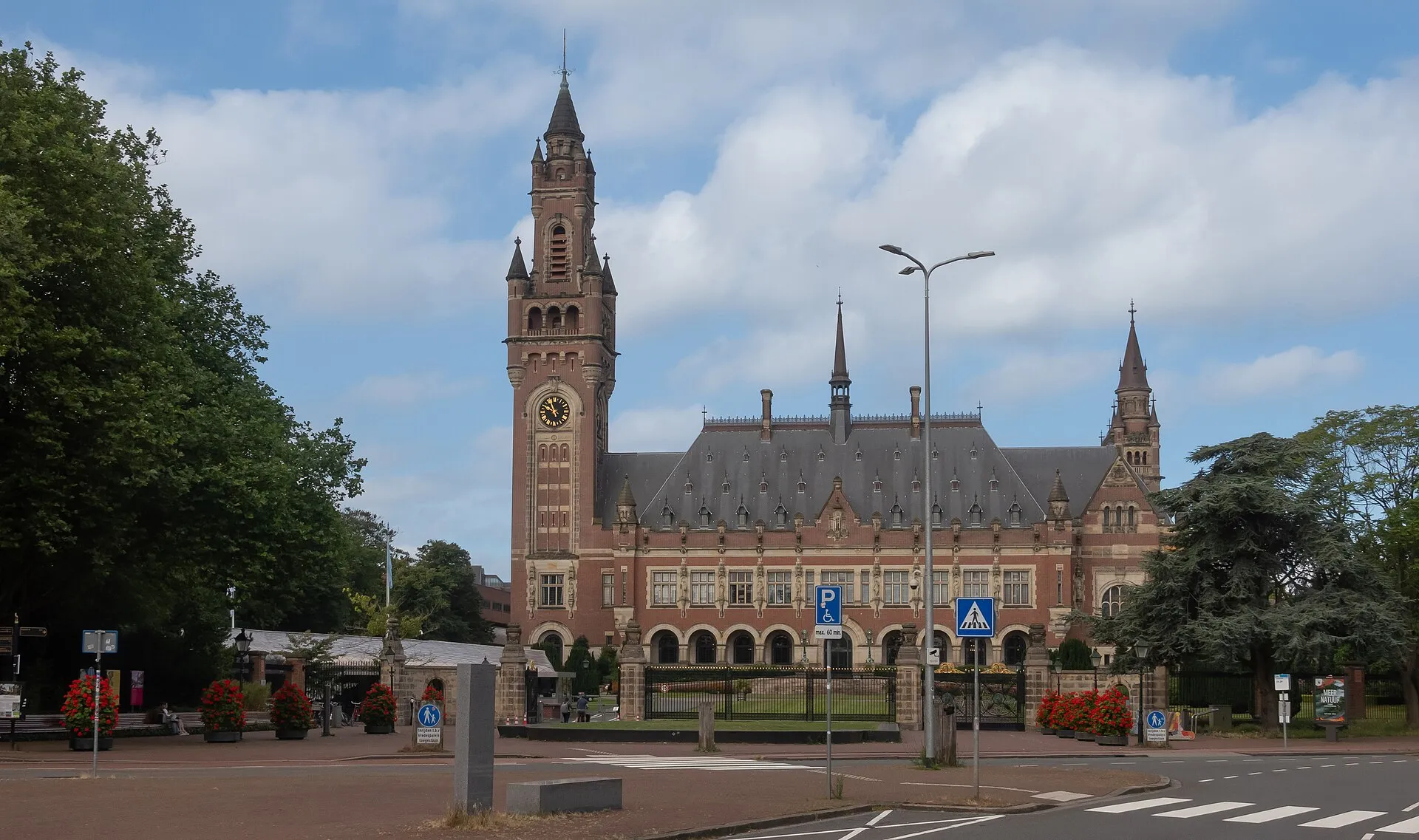
Louis Marie Cordonnier won the 1905–06 international competition — one of 216 entries — with a design in French neo-Renaissance style, which Dutch architect J.A.G. van der Steur adapted to the Zorgvliet site in red brick and granite. The result is deliberately asymmetric: a tall clock-and-carillon tower rises on one side, a shorter tower on the other, giving the palace the silhouette of a civic town hall rather than a severe temple.
Great Hall of Justice: the principal courtroom, where the ICJ's 15 judges — chosen to represent the world's major legal systems — sit beneath stained-glass windows gifted by Britain depicting the progress of peace. International donations: almost every room carries a nation's contribution, from Italian marble and a monumental jasper vase from Imperial Russia to a Swiss clock, German wrought-iron gates, Danish fountain, American and Indonesian timber, and Japanese silk wall hangings — the building was furnished as a collective act of diplomacy.
Peace Palace Library: one of the world's foremost international-law collections, housed in an ornate reading room that still draws scholars from across the globe. World Peace Flame: a permanent flame kindled outside the gates in 2002, visible from the public pavement at any hour.
Historical Significance
Few buildings carry so much of the modern effort to replace war with law. The palace exists because the First Hague Peace Conference of 1899 — convened at the initiative of Tsar Nicholas II and attended by 26 states — created the Permanent Court of Arbitration, and Carnegie's 1903 gift gave that court a home. Its 1913 opening marked both the high point and the first crisis of the ideal: the catastrophe of the First World War followed within a year.
Yet the institution endured. The Permanent Court of International Justice sat here under the League of Nations between the wars, and its successor, the International Court of Justice, has resolved disputes between states from these rooms since 1946 as the judicial organ of the United Nations.
The Hague's dense cluster of legal bodies — the ICJ, the International Criminal Court, the former Yugoslavia tribunal, the OPCW — all trace their presence to the vision planted by the Peace Palace. Combine it with the Binnenhof for a day spanning Dutch national government and international justice, or visit Madurodam to see a miniature of the palace standing among the country's other landmarks.
When to Visit
Visitor Centre: Tuesday–Sunday 10:00–17:00, closed Mondays — allow about an hour for the exhibits. Guided palace tours: interior access is tightly limited, usually offered only on weekends and only in windows when the International Court of Justice is not sitting; timed tickets are released online a few weeks ahead and sell out fast. There are no walk-in interior visits.
Grounds and gates: the palace is visible year-round from Carnegieplein and the surrounding park, and the World Peace Flame outside the railings is always lit. Best: a weekday morning for the Visitor Centre without the coach crowds, and the earliest weekend slot you can book if you want the rooms. Interior tours vanish during active hearings and state visits, so confirm before travelling.
Admission and Costs
Seeing the palace from the street is free, and so is the World Peace Flame by the gates — you pay only to go inside:
- Visitor Centre — about €11 ($12) adults, €6 ($6.50) children aged 6–12, free for under-6s
- Guided palace tour — a separate, higher-priced ticket sold only when interior access is open; check the Carnegie Foundation's booking page for the current rate and dates
- Exterior viewing and gardens — Free; the building reads well from Carnegieplein and the park paths that ring the estate
- Local guided walks — tip-based and paid walking tours of the international-law quarter typically run €15–40 ($16–44) per person and fold the palace into a wider story of The Hague
Because the interior tour is capacity-limited and the Visitor Centre tells most of the story, many travellers happily skip the costlier palace ticket.
The Case for a Guide
The Peace Palace rewards a guide more than almost any sight in The Hague: most of what makes it extraordinary is invisible without someone to explain the law, the history, and the diplomacy embedded in its walls.
- Which court is which: visitors routinely muddle the bodies based here. A guide separates the International Court of Justice (states versus states, inside the palace) from the International Criminal Court (individuals, housed elsewhere in the city) and the Permanent Court of Arbitration, so the institutions finally make sense rather than blur together.
- Reading the donated interior: the marble, ironwork, stained glass, the Russian jasper vase and the Japanese silk panels each came from a specific nation for a specific reason. A guide turns a decorative tour into a map of early-twentieth-century diplomacy and who was courting whom.
- The pre-war optimism: standing in a building opened in 1913, a guide can explain why its founders genuinely believed arbitration might end war — and how the 1914 catastrophe reshaped, rather than killed, the project of international law.
- How a real case works: a good guide walks you through an actual ICJ dispute — how it is filed, argued and decided, and why states with no army to compel them still show up and comply, which is the quiet miracle the palace was built for.
- Carnegie's bigger idea: the palace was one piece of Carnegie's conviction that institutions, not weapons, should settle quarrels. A guide connects the building to that philanthropic philosophy and to the global network of peace institutions it helped seed.
Tips for Visitors
- Book interior tours the instant dates open — weekend capacity is tiny and sell-outs are routine; set a reminder for the booking window rather than hoping for same-day space
- Bring photo ID and travel light — this is a live seat of the International Court of Justice, so security screening applies, large bags are turned away, and courtroom photography is restricted
- Do the Visitor Centre first — even without an interior ticket it supplies the legal context that makes the architecture and the donated gifts meaningful
- Shoot from Carnegieplein — the forecourt square gives the classic head-on view, while the rose garden along the side offers quieter angles
- Arrive by tram 1 — the Vredespaleis stop is almost at the gates, linking the palace to the centre and to Scheveningen
- Make it a governance day — pair the palace with the Binnenhof, a roughly 20-minute walk east, for Dutch national politics alongside international justice, or add the Mauritshuis for Vermeer
Frequently Asked Questions
Does the time of year affect a visit to the Peace Palace?
The Visitor Centre and the weekend palace tours run year-round with consistent quality, so seasonal timing matters less here than at open-air sights. That said, April through October gives the kindest weather for the Carnegieplein forecourt, the rose beds and the World Peace Flame outside the gates. Because the interior is a working courthouse, guided tours are suspended whenever the International Court of Justice is in session or hosting a state visit, and those closures can fall in any month, so always confirm and book before you travel.
When can visitors tour the Peace Palace?
The Visitor Centre beside the main gate opens Tuesday to Sunday, 10:00–17:00, and closes on Mondays. Guided tours of the palace interior are far more limited: they usually run only on weekends and only in blocks when the courts are not sitting, with timed tickets released online a few weeks ahead. The building is never open for walk-in interior visits, so if the palace rooms are your priority, book the moment a date you can travel appears on the Carnegie Foundation's booking calendar.
How much does it cost to visit the Peace Palace?
The Visitor Centre charges about €11 for adults and €6 for children aged 6–12, with under-6s free; the guided palace tour is a separate, higher-priced ticket sold only when interior access is open. Viewing the palace from Carnegieplein and the surrounding park, and seeing the World Peace Flame by the gates, costs nothing. If you only want the story rather than the rooms, the Visitor Centre alone is the sensible-value option.
What should visitors know before touring the Peace Palace?
Book interior tours the instant dates open — capacity is tiny and sell-outs are routine. Bring photo ID, as this is an active seat of the International Court of Justice and security screening applies. Large bags are not permitted inside, and photography is restricted in the courtrooms. Allow about an hour for the Visitor Centre and roughly an hour more if you secure a palace tour.
How do you get to the Peace Palace by public transport?
Tram 1 stops at the Vredespaleis stop almost outside the gates, linking the palace with The Hague city centre and the Scheveningen seafront, and several city bus routes pass nearby. From The Hague's main stations it is a short tram ride or a 25–30 minute walk through the leafy Zorgvliet district. The Carnegieplein forecourt is step-free, and the Visitor Centre is wheelchair accessible.
What else is worth seeing near the Peace Palace?
The Peace Palace sits in The Hague's museum and government belt. The Binnenhof parliamentary complex and the Mauritshuis, home of Vermeer's Girl with a Pearl Earring, are both about a 20-minute walk or a few tram stops east, while Madurodam — which includes a miniature of the Peace Palace itself — lies toward Scheveningen. Together they make an easy day exploring Dutch and international governance.