
Bahia Palace timeline
- 1860s
Si Moussa begins the palace
Grand vizier Si Moussa ben Ahmed laid out the first residence and riad garden in the southern medina, near the Mellah.
- 1894-1900
Ba Ahmed's great expansion
His son Ba Ahmed ibn Moussa, regent to the boy sultan Abd al-Aziz, roughly doubled the complex, adding the Cour d'Honneur, Grand Riad and harem.
-
The vizier's fall
Ba Ahmed died at the height of his power; the palace was stripped of its furnishings within days by the sultan's household.
-
Protectorate residence
Under the French protectorate the palace housed Resident-General Lyautey, and writer Edith Wharton described its rooms in 1917.
-
Medina World Heritage listing
UNESCO inscribed the surrounding Medina of Marrakesh, in which the palace sits, as a World Heritage Site.
Historical Significance
Bahia Palace is one of the best-preserved windows onto the private world of Morocco's late Alaouite ruling elite, built at the moment just before the French protectorate reshaped the country. Ba Ahmed ibn Moussa governed as grand vizier and regent in the 1890s, and the palace was both his home and a deliberate projection of that power — a complex large enough to house an extended household of wives, concubines, children and servants, each wing calibrated by Islamic conventions of hierarchy and privacy. Its sudden reversal is just as telling: when the vizier died in 1900, his accumulated fortune and furnishings were seized almost overnight, a vivid lesson in how fragile court power was.
The building's later life layered on more history. Under the protectorate from 1912 it became the Marrakech residence of Resident-General Hubert Lyautey, and the American novelist Edith Wharton, a guest there in 1917, left one of the most-quoted early descriptions of its courts in her travel book In Morocco. Today the palace is a protected monument inside the UNESCO-listed Medina of Marrakesh, inscribed in 1985, and still occasionally used for state functions — which is why only part of it is open to the public.
Architecture
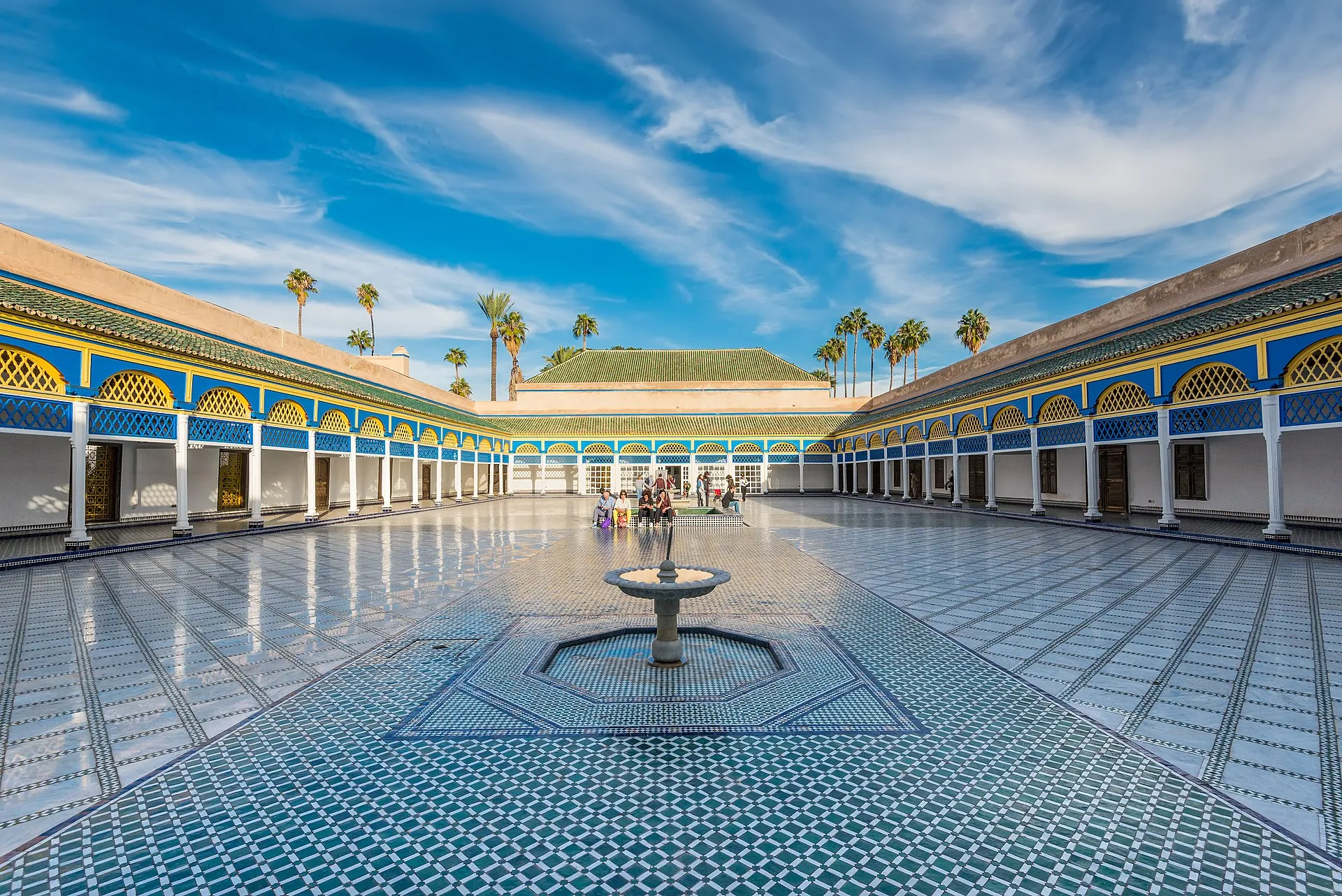
The design is a masterclass in the Moroccan riad principle: rooms turn their backs on the street and open instead onto interior gardens and courts, so wealth and decoration are hidden from outside and revealed only within. The showpiece is the Cour d'Honneur, a vast marble-paved court ringed by galleries whose cedar lintels carry painted floral and calligraphic bands. The intimate Petit Riad is a sunken garden of orange and banana trees around a central fountain, lit by stained-glass that throws colored light across the zellige.
Look closely and four crafts repeat throughout: zellige mosaic floors and dados, each tessera hand-cut from an individually glazed tile; carved gebs stucco fretted into muqarnas honeycombs; painted and carved zouak cedar ceilings — the Council Chamber's is the richest, gilded and polychrome; and smooth tadelakt lime plaster on the walls. Massive cedar doors, their panels incised over months of work, mark the thresholds between the public reception courts and the private harem wings. The decorative program is widely attributed to the master craftsman el-Mekki, who drew on artisans from Fez and the Atlas to give this Marrakech residence its lace-like finish.
When to Visit
Hours: Daily 9:00 AM - 5:00 PM, with the last tickets sold around 4:30 PM. Ramadan hours: typically reduced to about 9:00 AM - 3:00 PM, so confirm locally before setting out. Best time: arrive at opening or in the final 90 minutes before close, when the Cour d'Honneur is nearly empty and the low sun rakes across the marble. Avoid: 11:00 AM - 2:00 PM, when coach and cruise groups funnel through the main courtyard. Allow: 1 to 1.5 hours for an unhurried visit, a little more with a guide who stops to explain each craft. The palace sits in a pedestrian pocket of the medina; the nearest taxi drop-off is on Avenue Imam El Ghazali, a two-minute walk from the gate.
Admission and Costs
Admission: 100 MAD (about $10) per adult at the gate; reduced or free entry is usually offered for young children. There is no advance booking and queues are short outside the midday rush. Licensed guide at the palace: 150-300 MAD ($15-30) added to your ticket for a focused 45-60 minute tour. Half-day medina tour including Bahia: 250-400 MAD ($25-40) per person, usually paired with the Mellah, the souks and often El Badi Palace. Architecture- or history-specialist guide: 400-700 MAD ($40-70) for a deeper read of the Islamic decorative program. Carry small notes for the ticket window and for tipping a guide, as the card reader is not always reliable.
The Case for a Guide
Because Bahia Palace is almost entirely unlabelled, a licensed guide is the difference between admiring pretty rooms and understanding them. A good guide decodes the human drama — how Ba Ahmed amassed the wealth and power to build this while governing in the young sultan's name, and how the court stripped the palace bare within days of his death in 1900. They also route you cleverly, steering toward the quieter harem wings and the Petit Riad while tour groups bottleneck in the Cour d'Honneur, and point out details you would walk straight past.
- Read the crafts: tell apart zellige mosaic, carved gebs stucco, painted zouak cedar and polished tadelakt plaster in a single room.
- Follow the politics: the vizier's rise, his regency over Abd al-Aziz, and the looting that followed his death.
- Understand the layout: why the harem wings, private riads and reception courts are arranged as they are.
- Beat the crowds: a locally timed loop that saves the main courtyard for when the coaches leave.
- Set the context: how Bahia connects to the nearby Mellah, El Badi Palace and the wider Marrakech medina.
Tips for Visitors
Wear flat, grippy shoes: the marble galleries and tiled courtyards are polished smooth and turn slippery. Photography: the open courtyards flood with light while interiors stay dim, so shoot the ceilings against the sky and brace in doorways rather than fighting the gloom; tripods are restricted. Dress is relaxed but modest clothing reads as respectful in this historic quarter. Pair it up: the Mellah (old Jewish quarter) begins a 5-minute walk away, El Badi Palace is about 10 minutes south, and Jemaa el-Fnaa is 10 minutes north. Only about half the rooms are open — the rest remain state property — so don't expect to see all 150. The thick pisé walls keep the interior markedly cooler than the lanes outside, a genuine relief at midday in summer.
Frequently Asked Questions
How much is a ticket to Bahia Palace and do I need to book ahead?
Entry is 100 MAD (about $10) for adults, paid at the ticket window beside the Avenue Imam El Ghazali gate; bring cash, as the card reader is not always working. There is no advance booking and the line rarely runs more than 10-15 minutes outside the midday peak. A licensed guide who can read the rooms for you adds roughly 150-300 MAD ($15-30) on top of admission, and most medina walking tours fold the palace into a half-day circuit for 250-400 MAD ($25-40) per person.
What are the opening hours, and when is it quietest?
Bahia Palace opens daily 9:00 AM to 5:00 PM, with the last tickets sold around 4:30 PM; hours contract to roughly 9:00 AM-3:00 PM during Ramadan, so confirm locally before you go. Arrive at opening or in the last 90 minutes before close to photograph the Cour d'Honneur without tour-group crowds — the 11:00 AM-2:00 PM window is by far the busiest.
How does Bahia Palace differ from El Badi Palace nearby?
They are complementary, not interchangeable. Bahia is a near-complete late-19th-century residence, so you walk through furnished-feeling rooms, painted cedar ceilings and planted riad gardens. El Badi, a 10-minute walk away in the Kasbah, is a vast roofless ruin of the 16th-century Saadian era — grand in scale but stripped bare. Many visitors pair the two in one morning to contrast a lived-in palace with a monumental shell.
Is Bahia Palace suitable for visitors with limited mobility?
The palace is almost entirely on one level with no grand staircases, which helps, but the surfaces are historic: uneven marble, tiled thresholds and the occasional step between wings. Wheelchair users manage the main courtyards and the Petit Riad with assistance, though a few side rooms have raised sills. Flat, grippy shoes matter for everyone, as the polished floors turn slick.