
Architecture
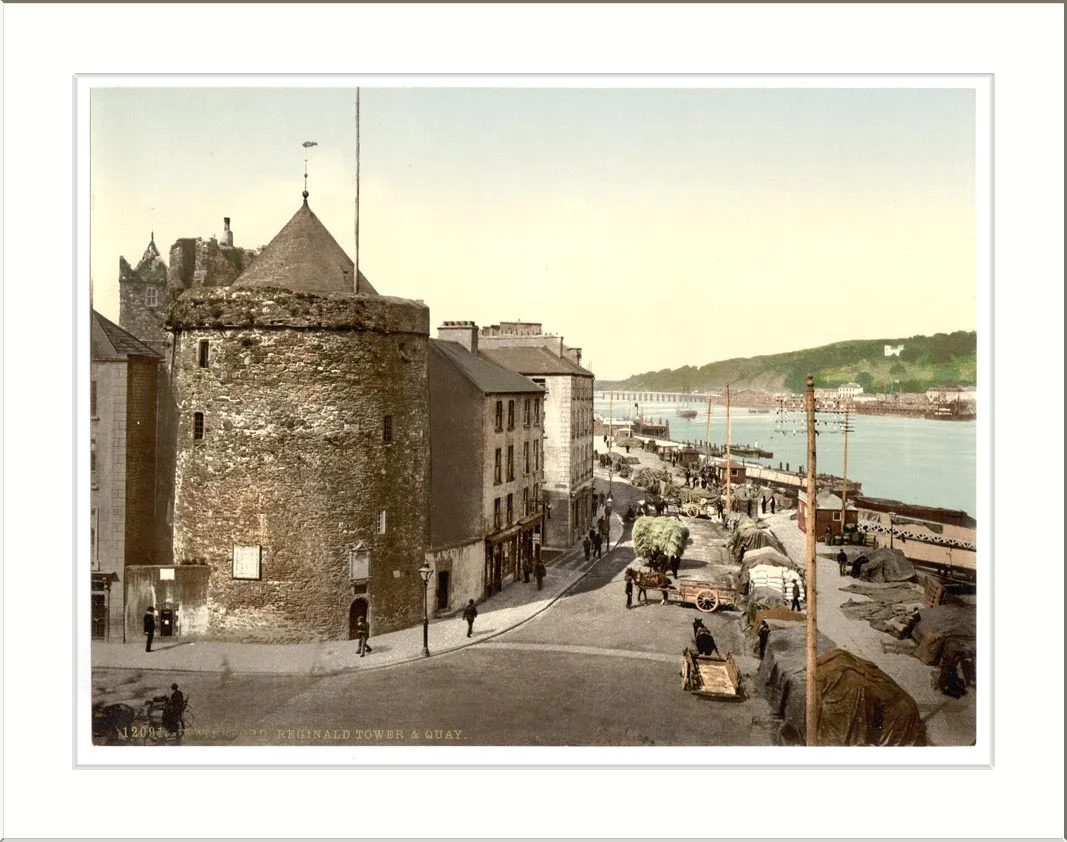
The tower's defining feature is its shape: a true drum of coursed rubble stone, its curved wall deflecting fire far more effectively than a flat face would. The masonry thickens dramatically at the base, tapering as it rises through four floors linked by a stair spiralling within the wall itself, a plan typical of the strongest Anglo-Norman work. Small windows and openings, widened in later centuries for comfort rather than defence, puncture the otherwise solid mass.
Set on the seaward angle of the old town defences, the tower once tied into a circuit of walls and gates that has largely vanished from view. Reading it against the surviving medieval fabric elsewhere in the quarter, including the great halls preserved beneath the Medieval Museum, shows how a single defensive idea was worked and reworked as the city's needs changed.
Historical Significance
Few buildings in Ireland have served so many masters. Over the centuries the tower did duty as a fortress guarding the quay, a mint striking the city's coin, a store for arms and powder, and, at times, a prison, before its long modern life as a museum. That succession of uses is precisely why it never fell into ruin or was demolished, and it explains the unusual claim that it has been in continuous use longer than any comparable urban structure in the country.
The tower also stands at the hinge of a national story. It watched the Anglo-Norman seizure of the city in 1170, an event that drew Ireland into centuries of English involvement, and it later weathered sieges as loyalties shifted. Understanding that arc makes the neighbouring House of Waterford Crystal and the prosperity it represents feel like the final act of a very long play that began on this quay.
When to Visit
The tower generally opens daily through the main season, from spring into early autumn, with shorter hours and some weekday closures over winter; the Office of Public Works publishes the current schedule, and it is worth checking before a special trip. Mornings tend to be quietest, and the low light of a clear evening flatters the stonework for photographs taken from the quay.
Allow a little under an hour for the interior itself. The tower works well as the opening act of a day in the Viking Triangle, after which the medieval streets and their two sister attractions are all within a few minutes on foot, making the whole quarter comfortable to cover between morning and mid-afternoon.
Admission and Costs
Admission is modest, at about €5 ($5.40) for an adult, with concessions for older visitors, students and children and a discounted family rate. The Office of Public Works runs the site, so an OPW Heritage Card admits the holder free and quickly pays for itself if you are touring several state monuments around Ireland on the same trip.
Anyone intending to visit more than one of the city's museums should weigh up the combined Waterford Treasures ticket rather than paying gate prices at each door. Guided walking tours of the Viking Triangle, which usually pause at the tower, are sold separately by local operators and typically run in the region of €12 to €20 ($13 to $22) per person.
The Case for a Guide
A knowledgeable local guide turns the tower from a handsome curiosity into a legible chapter of Irish history. Because so much of the story is layered rather than labelled, a guide who can point to where Viking foundation meets Norman rebuild, explain how a coastal port came to hold a royal mint, and connect the building to the wider Norman arrival of 1170 gives the stones a narrative that the compact exhibition can only sketch. Many visitors book a Viking Triangle walking tour precisely so that the tower, the Medieval Museum and the crystal works are threaded into one continuous account.
Tips for Visitors
Wear shoes with a bit of grip: the spiral stair is original, uneven and narrow, and it can be slick in wet weather when visitors track rain up from the quay. Duck to look for the story staff love to point out, the reminders of the tower's centuries as a working fortress worked into its very fabric.
Combine the visit with a riverside walk. The quay outside is one of the best vantage points in the city for a photograph that frames the tower against the Suir, and from here it is only a short level stroll up into the medieval lanes, so there is no need to backtrack to reach the rest of the Viking Triangle.
Frequently Asked Questions
How much does it cost to visit Reginald's Tower?
Standard adult admission runs to roughly €5 ($5.40), with reduced rates for seniors, students and children, and a family ticket available at the desk. Because the tower is run by the Office of Public Works, it participates in the OPW Heritage Card scheme, so holders of that annual pass enter without further charge. Visitors planning to see the neighbouring Medieval Museum as well should ask about the combined Waterford Treasures ticket, which bundles several sites at a saving.
Is Reginald's Tower really the oldest building of its kind in Ireland?
It is widely described as Ireland's oldest civic building and the country's oldest urban monument in continuous documented use. A defensive tower has stood on this corner of the quay since the Viking era, and while the masonry you see today is largely Anglo-Norman work of the twelfth and thirteenth centuries, it rests on those earlier foundations. That layering is exactly what makes the tower the natural starting point for understanding Waterford and its Viking Triangle.
How long should I spend inside the tower?
Most visitors need about thirty to forty-five minutes to climb the spiral stair through its four floors and take in the exhibition on Viking and medieval Waterford. The rooms are small and the displays concise, so it rarely feels rushed even on a busy afternoon. Pairing it with a slow walk along the quay and up into the medieval quarter makes for an easy half-day.
Is the tower accessible for visitors with limited mobility?
The upper floors are reached only by a tight medieval spiral staircase, which cannot be adapted, so step-free access to the whole building is not possible. Staff are used to advising visitors on what can be seen at ground level and can point out the same stories told across the OPW's other Waterford sites. Anyone with mobility concerns should ring ahead to plan the visit.