
Spiritual Significance
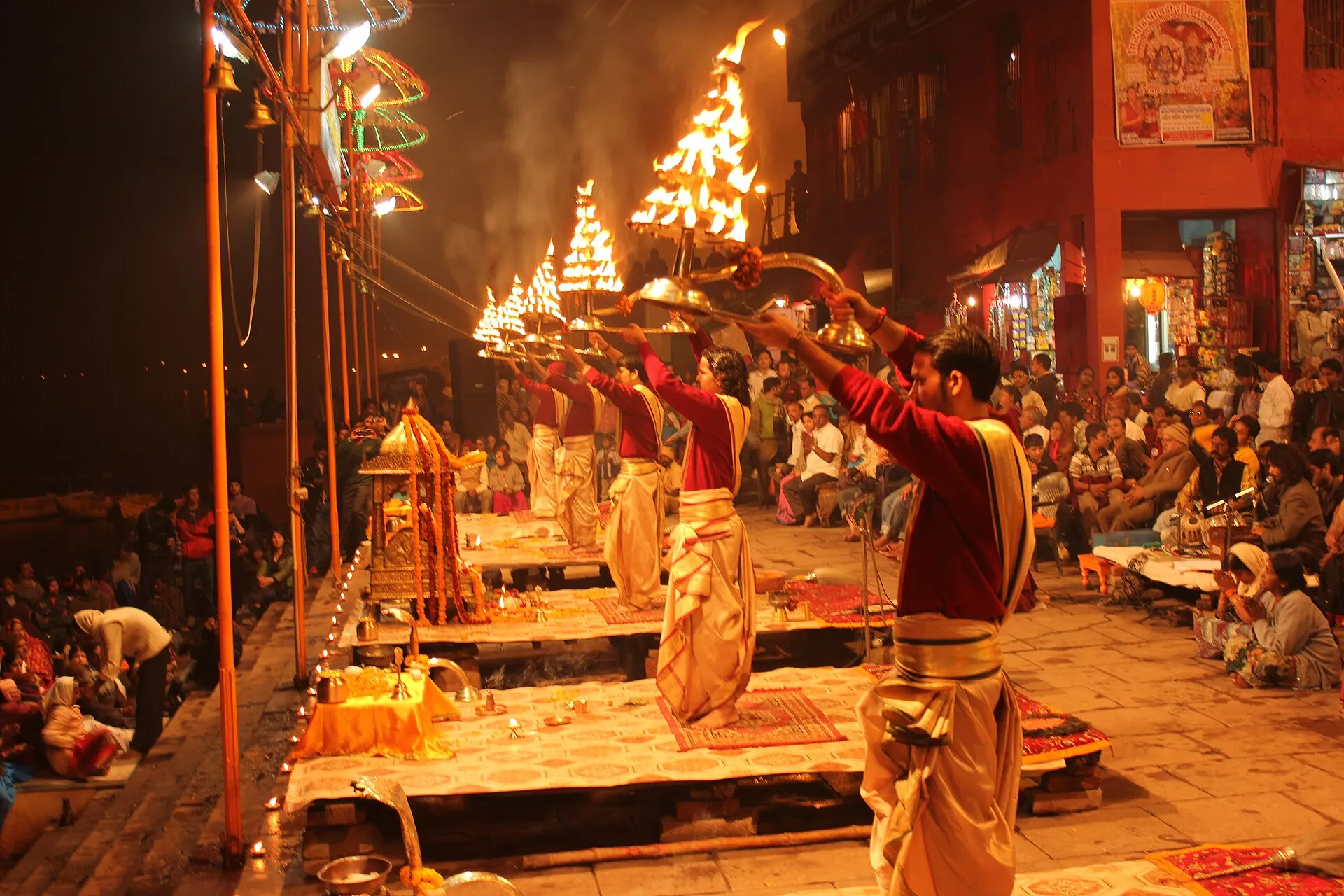
Two Hindu traditions explain the ghat's name and its pull on pilgrims. In one, Lord Brahma created the site to welcome Lord Shiva to the city; in the other, Brahma performed the Dashashwamedh here -- a rite of ten (dasha) horse (ashwamedha) sacrifices -- and the name has clung to the steps ever since. Dashashwamedh is also one of the five Panchatirthi ghats that devout pilgrims bathe at in a single circuit -- alongside Assi, Manikarnika, Panchganga, and Adi Keshava -- fixing it as a set point on Varanasi's sacred map. Whichever story a visitor holds, the belief that matters is moksha: many Hindus consider bathing in the Ganges at Kashi and dying within the sacred city a release from samsara, the endless cycle of rebirth. That conviction is why hundreds descend the steps at sunrise to bathe, cup the river water in their hands, and murmur prayers their families have repeated for generations. In the evening the same devotion becomes public spectacle: the Ganga Aarti is an offering of fire to the river goddess Ganga, in which seven priests in matching robes swing multi-tiered brass lamps, incense, conch shells, and yak-tail whisks in choreographed arcs while Sanskrit hymns and drums roll across the water. A guide translates the chants and names each gesture, so the ceremony reads as worship rather than performance.
Visitor Etiquette
A few habits keep a visit respectful on Varanasi's most sacred steps. Bathing pilgrims are mid-ritual -- never photograph individuals up close without asking, and step back when families gather at the water's edge. The cremation ghats -- chiefly Manikarnika a short walk north and Harishchandra to the south -- are working funeral sites, not attractions: watch quietly from a distance and put the camera away entirely. Dress modestly with shoulders and knees covered, and be ready to remove your shoes if you enter an adjacent shrine or take a boat. Expect insistent boatmen, flower sellers, and self-appointed "priests" seeking donations -- settle any price in advance and decline politely if you are not interested. During the crowded Ganga Aarti, keep bags zipped and in front of you, and hold small children close on the steps. If you release a floating diya, do it as a quiet personal moment rather than a photo prop.
Dashashwamedh Ghat timeline
- Antiquity
Brahma's ten-horse sacrifice
Tradition holds that Lord Brahma created the ghat to welcome Shiva to the city and performed the Dashashwamedh yajna — a rite of ten horse sacrifices — on these steps, the legend from which the name descends.
-
Peshwa rebuilds the ghat in stone
The Maratha Peshwa Balaji Baji Rao reconstructed Dashashwamedh in durable stone, giving the riverfront steps much of the form pilgrims still descend today.
-
Ahilyabai Holkar's patronage
Ahilyabai Holkar, the queen of Indore who rebuilt shrines and ghats across Varanasi, renovated the site as part of her wider restoration of the holy city.
-
Nightly Ganga Aarti formalised
The Ganga Seva Nidhi foundation began staging the choreographed evening fire ceremony that now draws thousands to the steps every night.
-
Kashi Vishwanath Corridor opens
The Kashi Vishwanath Dham corridor, inaugurated in December, cleared a broad walkway linking the Ganges ghats directly to the temple, easing the route between Dashashwamedh and the shrine.
When to Visit
Ghat accessible: 24 hours -- pilgrims bathe at all hours, and the steps never close or charge admission. Dawn boat ride: 5:00-6:30 AM (varies by season) -- the most atmospheric time to see the ghat from the water. Ganga Aarti: every evening at 6:45 PM (winter) or 7:00 PM (summer), lasting approximately 45 minutes, held without exception, rain or shine; an overflow aarti runs at the adjoining Rajendra Prasad Ghat. Arrive early: claim a spot on the steps at least 30 minutes before the ceremony begins, as the front rows fill first. The nearest point cars and auto-rickshaws can reach is the Godowlia crossing, a 5-10 minute walk through the lanes above the ghat.
Admission and Costs
Ghat access: free. Ganga Aarti: free to watch from the steps. E-rickshaw or auto from Varanasi Junction (Cantt) station to Godowlia: about ₹50-150 ($0.60-1.80). Boat viewing during Aarti: ₹300-500 ($4-6) per hour for a private rowboat. Reserved platform seats: some tour operators offer reserved spots for ₹500-1,000 ($6-12). Floating flower lamp offering: ₹20-50 ($0.25-0.60) to release a diya (oil lamp on a leaf) onto the Ganges. Agree the boat and seat price before you commit, as rates rise sharply on the busiest festival evenings such as Dev Deepawali.
The Case for a Guide
The Ganga Aarti is one of the world's great ceremonial performances, but every gesture the seven priests make carries specific theological meaning — a guide translates the ritual from spectacle into comprehensible spiritual communication.
- Seven priests' choreographed gesture meanings: Each movement of the brass lamps, the conch shells, the incense, and the flowers corresponds to a specific offering to the river goddess Ganga — a guide explains the sequence in real time, identifying which elements represent the five elements (pancha bhuta) and why the ceremony must be performed simultaneously by all seven priests
- Boat timing for best photography: The cremation ghats and the Aarti platforms photograph differently from the water versus the steps — a guide knows which boat positions catch the fire reflections in the Ganges and which arrival time captures the full ceremonial buildup before the lamps are lit
- The 84 ghats each with different function: Each of Varanasi's ghats has a specific caste, religious tradition, or historical identity — a guide walks you between them explaining which ghats are for washing clothes, which for cremation, which for specific Hindu communities, and which have royal histories
- Nearby ghats and the Man Mandir observatory: A short walk south stands Man Mandir Ghat, whose rooftop Jantar Mantar — a stone astronomical observatory built by Maharaja Jai Singh II of Jaipur around 1737 — most visitors miss entirely; a guide knows which neighbouring ghats reward the detour and why
- Cremation ghat respectful viewing protocol: Manikarnika Ghat is one of Hinduism's most sacred cremation sites and is visible from the river — a guide teaches the precise approach, explains what you are witnessing spiritually and not just visually, and navigates the protocols around photography and proximity
- Pilgrim ritual sequence: Pilgrims arriving in Varanasi follow a specific circuit of bathing, temple visits, and offerings spanning multiple days — a guide explains where Dashashwamedh fits in that sequence and why bathing here specifically is believed to liberate the soul from the cycle of rebirth
Tips for Visitors
Two visits recommended: dawn and dusk are completely different experiences -- try to see both during your Varanasi stay. Getting there: the Godowlia crossing is the last point auto- and e-rickshaws reach, a short walk above the ghat, so wear comfortable shoes for the uneven lanes. Boat from the river: watching the Aarti from a boat gives you a panoramic view and avoids the dense crowds on the steps -- agree the fare before boarding. Navigate with a guide: the lanes leading to Dashashwamedh from the main road are a maze. Exit through the Vishwanath Corridor to Kashi Vishwanath Temple for a seamless transition. Combine with Sarnath for a half-day Buddhist pilgrimage that contrasts powerfully with the Hindu rituals at the ghat.
Frequently Asked Questions
When is the Ganga Aarti at Dashashwamedh Ghat and how early should I arrive?
The fire ceremony is held every evening without exception, starting around 6:45 PM in winter and 7:00 PM in summer and lasting roughly 45 minutes. Because the stone steps fill from the front, arrive at least 30 minutes early for a clear view of the seven priests, or hire a rowboat to watch the flames reflected off the Ganges from the water.
What months are best for visiting Dashashwamedh Ghat?
November and December are the finest months, when cool evening air sharpens the drama of the Ganga Aarti and dawn boat rides drift through gentle river mist. The October-to-February window is broadly excellent, and Dev Deepawali on the November full moon turns every ghat into a carpet of oil lamps. Avoid the June-to-August monsoon, when flooding submerges the lower steps and boat services stop.
How much does it cost to experience Dashashwamedh Ghat?
Reaching the ghat and watching the Ganga Aarti from the steps is free. A private rowboat for viewing the ceremony from the river runs about ₹300–500 ($4–6) per hour, and some operators sell reserved platform seats for ₹500–1,000 ($6–12). Releasing a floating diya (an oil lamp on a leaf) onto the Ganges costs a token ₹20–50 ($0.25–0.60).
What is the best way to see Dashashwamedh Ghat twice in one visit?
Dawn and dusk are entirely different experiences, so try to see both. Come at first light for a quiet boat ride past the ghats as pilgrims bathe, then return in the evening for the Ganga Aarti. A guide navigates the maze of lanes from the main road, secures a viewing spot before the crowds, and links the ghat to the nearby Kashi Vishwanath Temple.
How do I get to Dashashwamedh Ghat?
The last stretch is always on foot. From Varanasi Junction (Cantt) railway station, about 5 km away, an auto- or e-rickshaw to the Godowlia crossing costs roughly ₹50–150 ($0.60–1.80) and takes 20–30 minutes in traffic; from there it is a 5–10 minute walk down the lanes to the river. Lal Bahadur Shastri International Airport lies about 25 km northwest. No cars reach the ghat itself, so wear comfortable shoes for the crowded, uneven lanes.
Can non-Hindus and tourists attend the Ganga Aarti?
Yes. The Ganga Aarti is a public ceremony open to everyone regardless of faith, and photographing the ceremony itself is welcome. The etiquette that matters is elsewhere: never photograph bathing pilgrims up close without asking, and put the camera away entirely near the Manikarnika and Harishchandra cremation ghats, which are working funeral sites rather than attractions.